6 min read · Cost
Yuba City is the larger half of the twin-city market on the Feather River, and its deep stock of ranch belts, decades of tracts, and older core homes has reached the age where the Hardie question comes up on nearly every re-side. This guide prices the brand itself — what the James Hardie system premium buys on a northern-valley wall, how profile and finish decisions move the number across Yuba City's very different neighborhoods, and where the Feather River quietly adds detailing scope that a generic quote never mentions. If you are still comparing Hardie against vinyl or engineered wood at the whole-project level, start with our Yuba City siding replacement cost guide; this page assumes Hardie and prices it honestly.
Profile economics across the ranch and tract belts
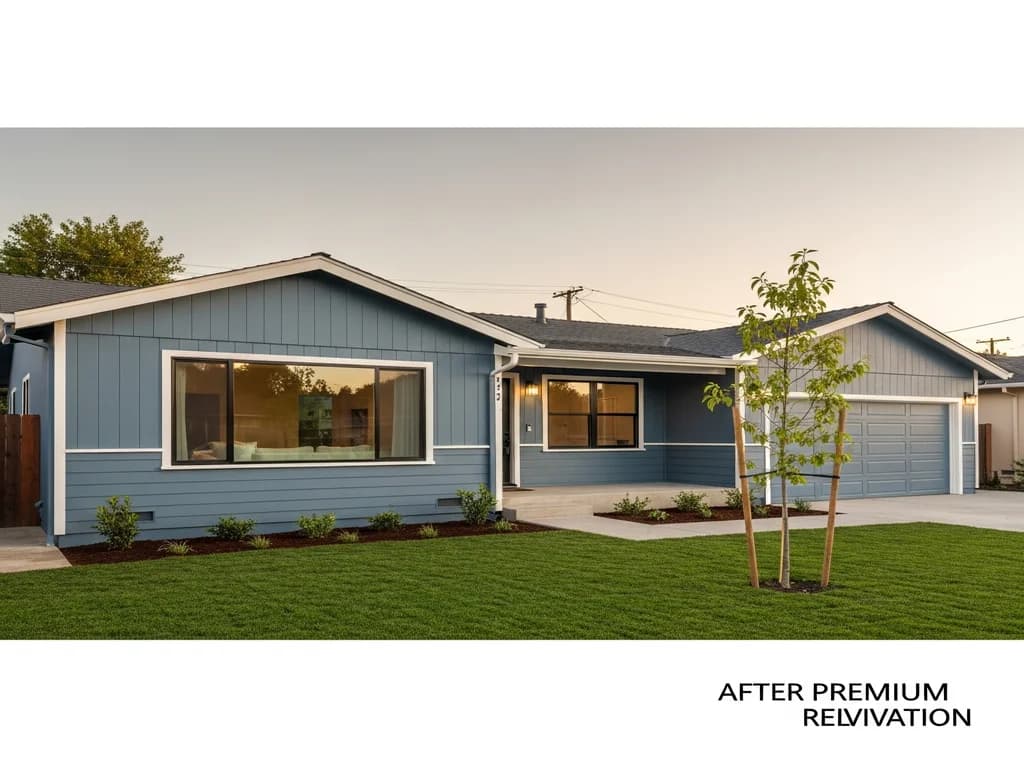
Yuba City's housing runs the full arc of a valley seat that never stopped building, and the profile decision prices differently in each belt. The broad post-war ranch neighborhoods and the 1970s-through-1990s tracts are the volume of the market: long, mostly single-story elevations where HardiePlank lap runs fast and anchors the value end of the band. Board-and-batten built from HardiePanel is the popular move for breaking builder uniformity on a repeated tract facade — it costs more in batten layout and labor, and it earns it visually. The older established homes near downtown and the river reward proportioned lap profiles with period-sensitive trim, which shifts money from field boards into cut-and-fit carpentry, while HardieShingle gables and the thicker Artisan line sit at the premium end wherever they appear. Because so much of the stock is single-story, Yuba City labor stays moderate compared to two-story markets — a real advantage the per-foot number quietly reflects.
ColorPlus math under open, low-canopy sun
The finish decision matters more in Yuba City than in shadier markets for one plain reason: the tracts here are open and low-canopy, so south and west walls take the full northern-valley UV load with nothing to soften it. Hardie's factory-baked ColorPlus finish costs more up front than primed board painted in the field, but it is cured in a plant specifically to resist the fade and chalking that this exposure inflicts on an ordinary field coat. A field-painted exterior on an unshaded Yuba City elevation is on a repaint clock from the day the crew leaves, and a decade of that cycle typically outspends the ColorPlus premium on the hot walls — with the factory finish warranty riding along besides. We still price primed-and-painted honestly when a custom color or budget calls for it, and our exterior painting crews do that work, but on this city's exposure the factory finish is usually the cheaper decade.
Speccing HZ10 with a Feather River bottom course
Yuba City is squarely Hardie Zone 10 territory — the durability budget goes to heat, UV, and expansion-tolerant fastening and gapping, not to freeze-thaw or coastal salt. But the city carries one wrinkle the county's dry interior does not: the neighborhoods closest to the Feather River sit with more humidity and seasonal high water, and on those parcels the bottom-course clearances, flashing laps, and kickout details work harder than they do out in the western tracts. That is a detailing line, not a different product — the same HZ10 board serves the whole city — and it is one a low bid tends to omit because it never shows in a drive-by. Fire, meanwhile, is a modest consideration here: Yuba City sits on the open valley floor, so we do not pad a quote with ignition-resistant assembly scope the parcel does not call for, reserving a grassfire-aware eye only for the rural margins at the city's edge.
Older core homes near downtown: trim that keeps character
The established homes near Yuba City's historic core and the river are where a Hardie number picks up its carpentry. These houses carry proportioned casings, deeper shadow lines, and trim details that HardieTrim has to replicate rather than simply replace, which converts elevation footage into hours of fitting that a repeated tract wall never needs. They are also the homes most likely to surprise at tear-off — decades of heat, and near the river some moisture, often leave layered original siding and dry rot on lower walls that only surfaces once the cladding is off, which is why an honest quote on an older core home carries a substrate allowance next to the Hardie material lines. Done right, the payoff is real: a period-sensitive Hardie package reinforces the character of an older home instead of erasing it, and puts a heat-stable system on walls that have been fighting the valley sun for generations.
How to vet a Hardie quote in the twin-city market
Three checks tell you whether a Yuba City Hardie bid describes the job you think it does. First, confirm it names genuine James Hardie components — HardiePlank or HardiePanel, HardieTrim, matched accessories — because a bid that only says fiber cement may be pricing a generic board that carries neither the HZ10 rating nor the warranty. Second, pin down the finish: factory ColorPlus and primed-for-field-paint are different products at different prices, and a quiet swap between them is the oldest trick in a low bid. Third, on a river-adjacent address, ask how the bottom course and flashing are being handled — silence on that line means it was not scoped. Then verify the contractor through the CSLB license lookup before signing anything. For the whole-project picture beyond the brand — materials compared, tear-off, drainage plane — our Yuba City siding replacement cost guide carries the rest.
What drives a Yuba City Hardie price
| Cost driver | Effect |
|---|---|
| Single-story vs. two-story elevations | Ranch-belt stock keeps labor moderate; stories raise it |
| Profile choice (lap vs. board-and-batten) | Batten layout and premium profiles add material and labor |
| ColorPlus vs. field paint | Higher upfront, lower lifetime cost on unshaded walls |
| Older-core trim replication | Period casings convert footage into carpentry hours |
| Feather River-adjacent detailing | Bottom-course and flashing rigor adds real scope near the water |
James Hardie scope bands in the Yuba City area (for planning)
| Scope | Per sq ft of wall | Typical project total |
|---|---|---|
| Single-story HardiePlank, ColorPlus | $13–$20 | $28,000–$58,000 |
| Two-story / complex trim | $17–$24+ | $48,000–$84,000+ |
| Board-and-batten / mixed profile | $15–$22 | $38,000–$70,000 |
Typical Hardie planning range for the northern Sacramento Valley — a general California market range, not a Sierra Siding quote. Final number is set on-site by square footage, stories, substrate condition, trim complexity, finish choice, and river-adjacent detailing — your written estimate is what governs.
Key takeaways
- The Hardie premium in Yuba City buys the HZ10 heat-and-UV board, the matched trim ecosystem, and a warranty a generic fiber-cement swap can't carry
- Single-story-heavy ranch and tract belts keep labor moderate; board-and-batten and older-core trim work move the number up
- On open, low-canopy elevations, ColorPlus usually beats a field-paint repaint cycle over a decade
- Feather River-adjacent parcels add real bottom-course and flashing scope — a line low bids omit
- Vet any bid for genuine Hardie components, the actual finish spec, and a current CSLB license
FAQ
Quick Answers
You are paying for the HZ10 board engineered for hot, high-UV valley climates, the matched HardieTrim and accessory system, the factory ColorPlus finish option, and a warranty that only applies to genuine components installed to spec. Under Yuba City's open-canopy sun, that difference is the service life of the wall, not a badge.
HardiePlank lap is the efficient baseline on the long single-story ranch and tract elevations, and board-and-batten from HardiePanel is the most popular upgrade for breaking builder uniformity on repeated facades. Most projects mix the two — lap on the field, batten or a shingle accent on the prominent elevation.
The board is the same, but river-adjacent parcels carry more humidity and seasonal high water, so the weather-resistive barrier, flashing laps, kickouts, and bottom-course clearances get more rigorous detailing. That is added labor scope — modest, but real — and a bid that never mentions it on a riverside address was not scoped for the parcel.
Usually, yes. The open, low-canopy tracts leave south and west walls fully exposed to northern-valley UV, which is precisely the fade-and-chalk exposure the baked-on factory finish is engineered to resist. Field paint on those walls starts a repaint cycle that typically outspends the ColorPlus premium within about a decade.
It adds a line most homeowners do not anticipate. The panels stay put, but wall-run conduit, disconnects and any exterior inverter typically need detaching and resetting so the new cladding runs behind them cleanly. That is electrical work scheduled around the siding rather than part of it. Because it is easy to overlook at a walkthrough, mention your system explicitly and confirm it appears in the written scope.
No, and phasing is a legitimate way to manage a Yuba City budget. Do it by exposure rather than by what shows from the street — the south and west elevations take the sun that is driving the failure, so they are the ones earning the money. The trade-off is matching: a finish installed two years later will not match a wall that has weathered, so phasing works best when it stops at natural breaks such as corners rather than mid-elevation.
Sources
Authoritative references
- James Hardie — official product & installation resources
- James Hardie ColorPlus Technology
- Contractors State License Board (CSLB) — verify a California contractor
- Zonda — 2025 Cost vs. Value Report (exterior remodel ROI)
External links to government, code, and manufacturer sources. Sierra Siding is not affiliated with these organizations; references are provided for verification.