
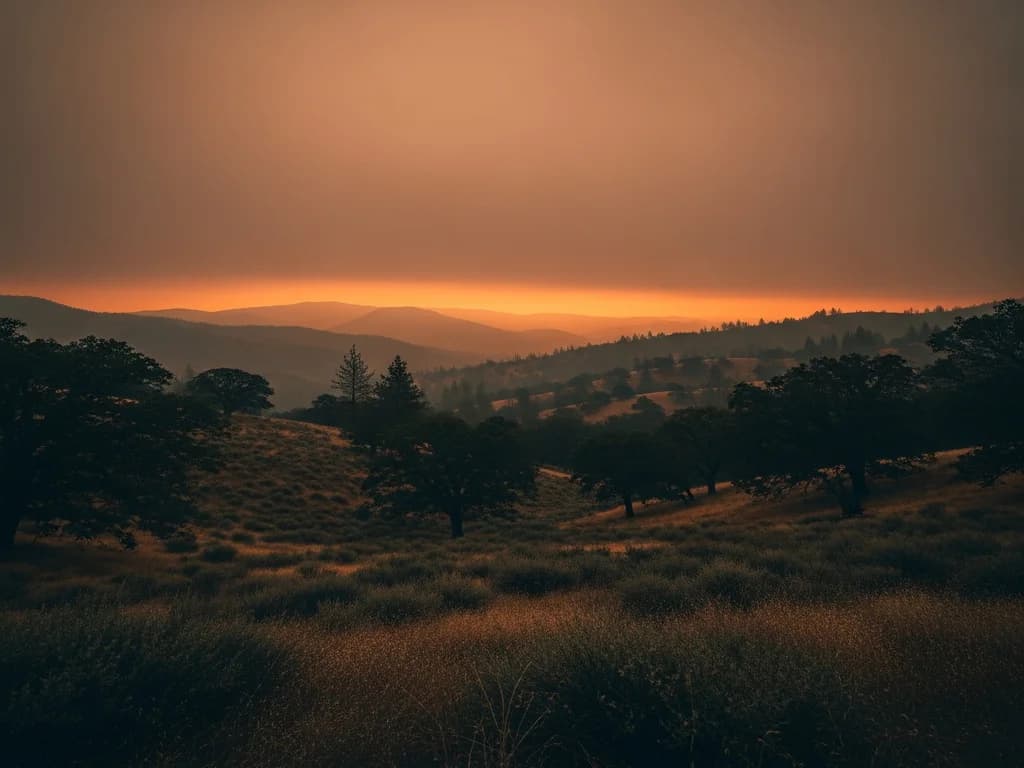
Valley heat and hard-earned fire awareness
Butte County spans the hot Sacramento Valley floor around Chico and Oroville and the foothill ridge communities including Paradise and Magalia. The 2018 Camp Fire makes wildfire exposure an unusually present, non-abstract concern for foothill homeowners here, and rebuilding and hardening continues across the ridge years later. Western valley cities face the familiar sustained-heat and UV profile — long runs of triple-digit afternoons that chalk finishes, cup boards, and open joints on sun-facing walls. The two conditions call for different specifications, and the honest version of exterior work in this county is knowing which one governs before a single board is ordered.
A market split by the foothill line
Where a Butte County home sits relative to the foothill edge decides almost everything about its exterior. Valley cities like Chico, Gridley, and Biggs are heat-and-UV markets first, where fade-resistant fiber cement and disciplined finish selection carry the project. The ridge above Oroville — Paradise, Magalia, Berry Creek — is a fire-hardening market where non-combustible cladding and uncompromising detailing are the entire point, and a large share of the work is rebuilds and surviving-home retrofits. We scope every address for which side of that line it falls on rather than running one template county-wide.
Utility, permit, and fire authorities across Butte County
Butte County has five incorporated cities/towns — Chico, Oroville, Gridley, Biggs, and the Town of Paradise (incorporated 1979, and legally a Town rather than a City) — plus large unincorporated communities including Magalia, Durham, Palermo, Berry Creek, Concow, Cohasset, Forest Ranch, and Butte Meadows. Each city runs its own community development department; unincorporated permits go through Butte County Development Services. Electric and gas are PG&E throughout — Butte County sits at the epicenter of PG&E's PSPS-shutoff footprint since 2018. Water is fragmented: California Water Service (Cal Water) Chico District serves most of Chico, City of Oroville municipal utilities and South Feather Water and Power in Oroville, City of Gridley and City of Biggs municipal water, Paradise Irrigation District (PID) on the ridge, Del Oro Water Company (Magalia District) for Magalia, plus Durham Irrigation District and private wells across rural acreage. Fire response is Cal Fire Butte Unit as the primary wildland responder, alongside Chico Fire, Oroville Fire, Paradise Fire, Gridley Fire, Biggs Volunteer Fire, El Medio FPD (absorbed former Magalia FPD), Durham FPD, and Palermo-Honcut FPD. The post-Camp-Fire rebuilding standards on the ridge are stricter than pre-fire code — every re-side and rebuild there runs under current WUI expectations.
HZ10 climate and the Butte County FHSZ landscape
Every parcel in Butte County is in James Hardie's HZ10 climate zone — the county sits below the HZ5 high-elevation threshold, so installing HZ5 anywhere in the county is a documented warranty misapplication. On the fire side, the valley cities (Chico, Gridley, Biggs, Durham, most of Oroville) sit in Low or Moderate FHSZ territory under California's 2025 LRA Fire Hazard Severity Zone map, while essentially every parcel on the Paradise ridge (Paradise, Magalia, Berry Creek, Concow) and the eastern foothill/canyon country sits in Very High FHSZ, with most surrounding land in State Responsibility Area or Plumas National Forest. The 2018 Camp Fire (18,800 structures destroyed, 85 fatalities — California's most destructive wildfire), the 2020 Bear Fire / North Complex (318,935 acres, 16 fatalities, ~400 homes destroyed in Berry Creek alone), and the 2008 Humboldt-Butte Lightning Complex are the corridor's reference events. On ridge and canyon parcels the 2025 California Wildland-Urban Interface Code governs the exterior wall. Chapter 7A moved into the standalone WUI Code on January 1, 2026.
Climate and exterior risk in Butte County
Long, hot, high-UV valley summers around Chico and Oroville set the pace on the floor: sustained ultraviolet load is what actually ends the life of original wood, hardboard, T1-11, and economy vinyl here, showing up as chalked paint, cupped boards, and joints that have opened enough to let water behind the cladding. South- and west-facing elevations age fastest, and the open, low-canopy lots common across Chico's tract neighborhoods and the Gridley and Biggs farm towns give those walls no relief. Winters are cool and genuinely wet, which keeps drainage-plane detailing on every scope even in a heat-dominated market. On the foothill ridge the same dryness that degrades finishes drives a severe, well-documented fire season, and the autumn offshore wind events that follow a rainless summer are the specific conditions that turn an ignition into a disaster.
Wildfire exposure in Butte County
Foothill exposure is high to extreme, and Butte County holds the reference case for the entire state. The Camp Fire ignited on the morning of 8 November 2018 near Pulga and, pushed by strong dry offshore winds through terrain that had not seen rain in months, reached Paradise within hours and destroyed most of the town — roughly 18,800 structures and 85 lives, the deadliest and most destructive wildfire in California history. The 2020 North Complex burned into Berry Creek with similar speed. Valley cities carry materially lower grassland-edge exposure, though the edge is real where subdivisions meet open field. On ridge projects, hardening eaves, vents, and ground transitions is central — and it is worth being precise about what that buys: non-combustible cladding and hardened detailing improve a home's odds against ember cast and radiant heat as one layer of a whole-property defensible-space strategy. Siding is not a guarantee against fire, and we will not present it as one.
Snow, freeze, and moisture
Snow is not a meaningful factor at populated valley elevations and only an occasional one on the upper ridge, so freeze detailing rarely governs a Butte County scope. Moisture still earns its place: winters here are wet, and a weather-resistive barrier, correct flashing, kickout flashings at roof-wall intersections, and proper bottom-course clearance are what keep a wall drying through a Sacramento Valley rainy season. Feather River and Lake Oroville frontage adds localized exposure on river- and lake-adjacent parcels. None of this changes the cladding recommendation — heat in the valley and fire on the ridge still drive material selection — but the detailing behind the cladding is tuned to the parcel's actual water exposure rather than a county-wide assumption.
Recommended materials for Butte County
Fade-resistant fiber cement is the default across the valley cities for its color stability and dimensional behaviour under Sacramento Valley UV, with factory-applied finishes rather than field paint wherever the elevation takes real afternoon sun — the finish is the part that fails first in this climate, so it is worth specifying deliberately. On the foothill ridge the recommendation is Class A non-combustible fiber cement with full fire-hardening detailing: ember-resistant vents, enclosed or non-combustible eaves and soffits, correct six-inch clearance at ground transitions, and flashing that does not create an ember trap at every penetration. We do not recommend combustible cladding on the Paradise/Magalia ridge, and we will say so plainly rather than quote what a homeowner asked for. Engineered wood remains a reasonable choice on genuinely low-exposure valley parcels where deep wood character is the goal; it is the wrong answer above the foothill line.
Cities We Serve
Communities Across Butte County
FAQ
Butte County — Common Questions
Yes — Paradise, Magalia, and the surrounding ridge, with aggressively hardened non-combustible specifications appropriate to the area's severe fire history.
Chico's valley setting carries lower exposure than the ridge, but non-combustible fiber cement remains a sound, low-regret choice alongside its heat durability.
Class A non-combustible fiber cement with full fire-hardening detailing at eaves, vents, and ground transitions.
The Camp Fire ignited near Pulga on 8 November 2018 and, driven by strong dry offshore winds, destroyed most of Paradise within hours — roughly 18,800 structures and 85 lives, the deadliest and most destructive wildfire in California history. It is why we treat non-combustible cladding and hardened eave, vent, and ground-transition detailing as core infrastructure on ridge homes rather than an upgrade. It is also why we are careful about the claim: hardening improves a home's odds as one layer of a whole-property strategy, and no cladding makes a house fireproof.
It depends on the parcel's fire hazard severity zone designation and the scope of work, and that determination belongs to the Butte County or town building department rather than to us. What we can say is that we specify to the hardened standard on ridge parcels regardless, because the exposure is real whether or not a given permit triggers the requirement.
A correctly installed fiber cement system commonly performs 30+ years in this climate. The variable is the finish, not the substrate — factory-applied finishes hold color substantially longer than field paint on the sun-loaded south and west elevations that dominate Chico, Gridley, and Biggs.
South- and west-facing elevations, and within those the joints, butt seams, and trim details where movement under heat cycling opens a path for water. On older homes it is usually the finish that signals the problem — chronic peeling that returns a season after every repaint means the substrate underneath has stopped holding paint, not that the last painter did poor work.