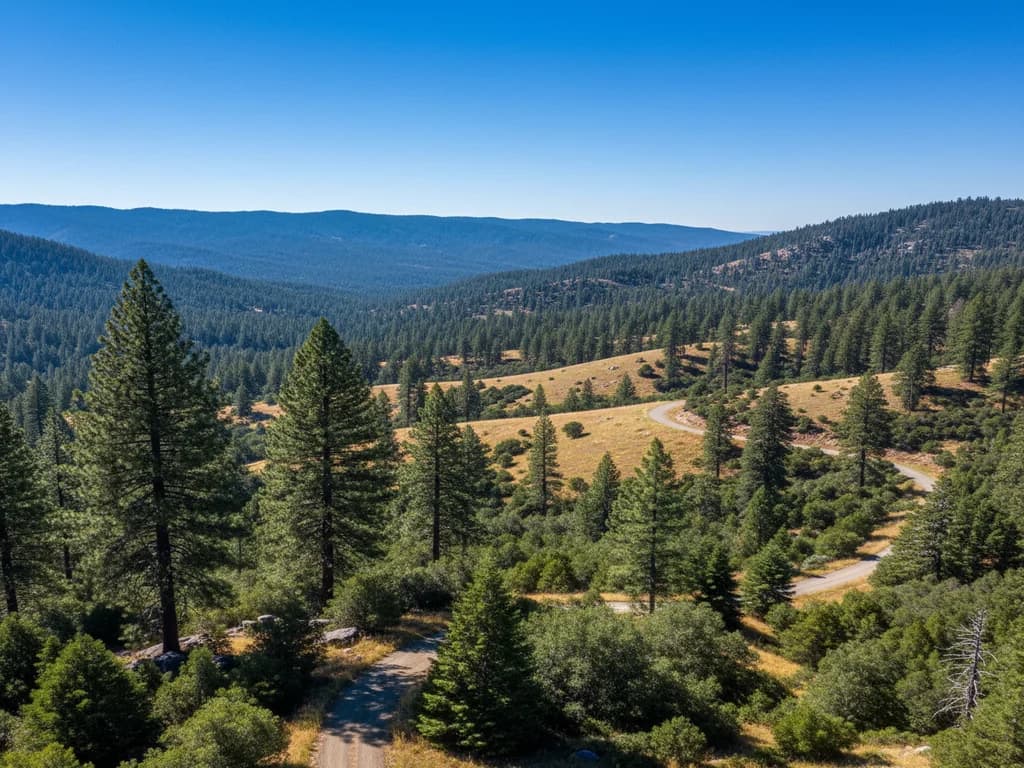
Gold Country forest to alpine crest
Nevada County is overwhelmingly forested and mountainous: the historic communities of Grass Valley and Nevada City sit among dense pine and oak in genuine high fire-hazard terrain, while Truckee, on the eastern side near Tahoe, adds extreme snow load and freeze-thaw to that fire exposure. There is very little low-risk valley housing in this county — almost every project is a hardening and weather-management project.
Where the exterior is defense, not decoration
What makes Nevada County distinctive as a remodel market is that there is almost no low-risk housing to fall back on. From the National Register downtowns of Nevada City and Grass Valley to the gated lake communities of Lake Wildwood and Lake of the Pines, the rural acreage around Penn Valley and Rough and Ready, and the Tahoe Donner and Glenshire neighborhoods of Truckee, the common thread is wildland fuel standing right up against the structure. That changes what a re-side is for: homeowners here are hardening a home as much as refreshing it, and the highest-value move is almost always retiring combustible wood and T1-11 for a Class A non-combustible assembly. We approach every Nevada County project that way — curb appeal that also lowers the home's ignition risk.
Historic districts change the calculus
Nevada City and Grass Valley contain National Register housing where the exterior is not a free choice. Profile, exposure, trim proportion, and color can all be subject to review, and a Victorian's character is carried largely in details that a generic lap board erases. The workable path is usually matching the original profile and reveal in a non-combustible material rather than abandoning the aesthetic — fiber cement is available in profiles and trim dimensions that read correctly on a period elevation. Anything affecting a designated structure should be confirmed with the local review authority before ordering material, and we treat that as a design constraint rather than an obstacle.
Utility, permit, and fire authorities across Nevada County
Nevada County has three incorporated cities — Grass Valley, Nevada City, and Truckee (incorporated 1993) — plus large unincorporated communities including Penn Valley, Alta Sierra, Lake Wildwood, Lake of the Pines, Rough and Ready, North San Juan, Washington, and the Donner Summit corridor. Each city runs its own community development department; unincorporated permits go through Nevada County Community Development. Electric splits between PG&E on the western Gold Country side and Liberty Utilities (Sierra region) around Truckee, with Truckee Donner Public Utility District (TDPUD) as the customer-owned utility serving the town of Truckee for water and electric; gas is PG&E where available, with propane throughout the mountain communities. Water is served by Nevada Irrigation District (NID) across most of the western county, City of Grass Valley, City of Nevada City, TDPUD in Truckee, and small mutual and community systems in outlying areas — private wells common on rural acreage. Fire response varies: Cal Fire Nevada-Yuba-Placer Unit (NEU) as the primary wildland responder; Grass Valley Fire, Nevada City Fire, and Truckee Fire Protection District on structure calls; Peardale-Chicago Park FPD, Penn Valley FPD, Rough and Ready FPD, and Higgins FPD in the outlying areas; Northstar FPD covers the Northstar-and-adjacent Placer/Nevada boundary. Historic-district design review is layered on top of the standard permit path in Nevada City and Grass Valley.
HZ climate and the Nevada County FHSZ landscape
Nevada County spans both HZ climate zones: Grass Valley, Nevada City, Penn Valley, Lake Wildwood, and the western Gold Country belt are HZ10, while Truckee and the eastern Donner corridor are HZ5. Installing the wrong zone product is a documented warranty misapplication. On the fire side, essentially every parcel in Nevada County sits in High or Very High FHSZ territory under California's 2025 LRA Fire Hazard Severity Zone map — the county is overwhelmingly forested Sierra terrain with State Responsibility Area on nearly every side. The 2020 Jones Fire (705 acres, 21 structures destroyed near Grass Valley), 2017 Lobo Fire, and the 2021 Caldor Fire (which came within striking distance of eastern Nevada County) are the recent regional reference events; the 1994 49er Fire and 2001 Ponderosa Fire are longer-memory examples of what a wind-driven event does here. On every parcel here the 2025 California Wildland-Urban Interface Code governs the exterior wall. Chapter 7A moved into the standalone WUI Code on January 1, 2026.
Climate and exterior risk in Nevada County
Hot, dry, high-UV summers across the western Gold Country; long, snowy, freeze-thaw winters in the Truckee high country. Severe, lengthy fire seasons countywide. The exterior must handle dryness and fire everywhere and add full mountain detailing on the eastern side. The county's two halves are separated by several thousand feet of elevation and behave like different climates: a Grass Valley wall is contending with UV, ember exposure, and forest debris accumulation, while a Truckee wall adds months of snow contact, repeated freeze-thaw at the fastener line, and meltwater working at every horizontal transition. Specifying both ends of the county from a single template is the most common way exterior work underperforms here.
Wildfire exposure in Nevada County
Exposure is high to extreme across nearly all populated areas — Grass Valley, Nevada City, Penn Valley, and the Truckee corridor are forest-embedded WUI communities. Hardening eaves, soffits, vents, and ground transitions is integral to every project. Requirements for parcels in mapped fire severity zones come from the current California WUI provisions in Title 24 Part 7; what applies to a specific address depends on the jurisdiction and the scope of work, and the local building department is the authority on that. Ember-resistant venting and clearing combustible material from the immediate perimeter frequently deliver more risk reduction per dollar than cladding replacement alone, and we will say so even when it means a smaller job.
Snow, freeze, and moisture
The Truckee high country sees heavy snow and prolonged freeze-thaw requiring mountain-grade detailing. The western Gold Country is snow-light but still benefits from rigorous drainage-plane detailing given forest moisture and seasonal swings. Two conditions do disproportionate damage in this county. The first is meltwater at elevation, which cycles daily against a wall for months and finds any clearance or flashing shortcut. The second is forest debris — needles and duff accumulating at roof-wall intersections, in gutters, and against the base of walls, holding moisture through the wet season and doubling as ember fuel in the dry one. Both are maintenance problems as much as construction problems, and both are worth inspecting annually.
Recommended materials for Nevada County
Class A non-combustible fiber cement is the standard recommendation throughout Nevada County. On the Truckee side it is detailed with mountain-grade clearances and freeze-aware flashing. Combustible cladding is not a category we recommend anywhere in this county. On the Gold Country side, profile and trim selection is often driven by the surrounding architecture — the Victorian and Craftsman stock around Nevada City and Grass Valley needs proportions that a stock lap profile will not deliver. On the Truckee side, the priority shifts to clearances tall enough to keep cladding above the season's snow line, flashing and fasteners chosen for freeze cycling, and joint detailing that tolerates movement without opening.
Cities We Serve
Communities Across Nevada County
FAQ
Nevada County — Common Questions
Yes — Grass Valley, Nevada City, Penn Valley, Lake Wildwood, and Truckee, with specifications tailored to Gold Country fire and Truckee-area snow.
Effectively yes. Most of the county is forest-embedded high to extreme wildfire terrain, so hardened non-combustible exteriors are the standard rather than an upgrade.
Yes. The Truckee high country requires the fire strategy and the mountain snow strategy to be designed together in a single assembly.
In most cases yes. Fiber cement is made in profiles, exposures, and trim dimensions that read correctly on Victorian and Craftsman elevations, so matching the original character in a non-combustible material is usually achievable. Where a structure is designated or sits in a review district, the design should be confirmed with the local review authority before material is ordered — that is a constraint worth planning around rather than discovering late.
Usually ember-resistant venting and clearing combustible material away from the first few feet around the structure. Embers entering through vents or igniting debris at the base of a wall are among the most common ignition paths, and both are inexpensive relative to full cladding replacement. Non-combustible siding is the more durable step, but on a limited budget it is often not the first one.
We do not recommend it anywhere in the county given the pervasive fire exposure. Non-combustible fiber cement also handles the heat and freeze-thaw without trade-off.