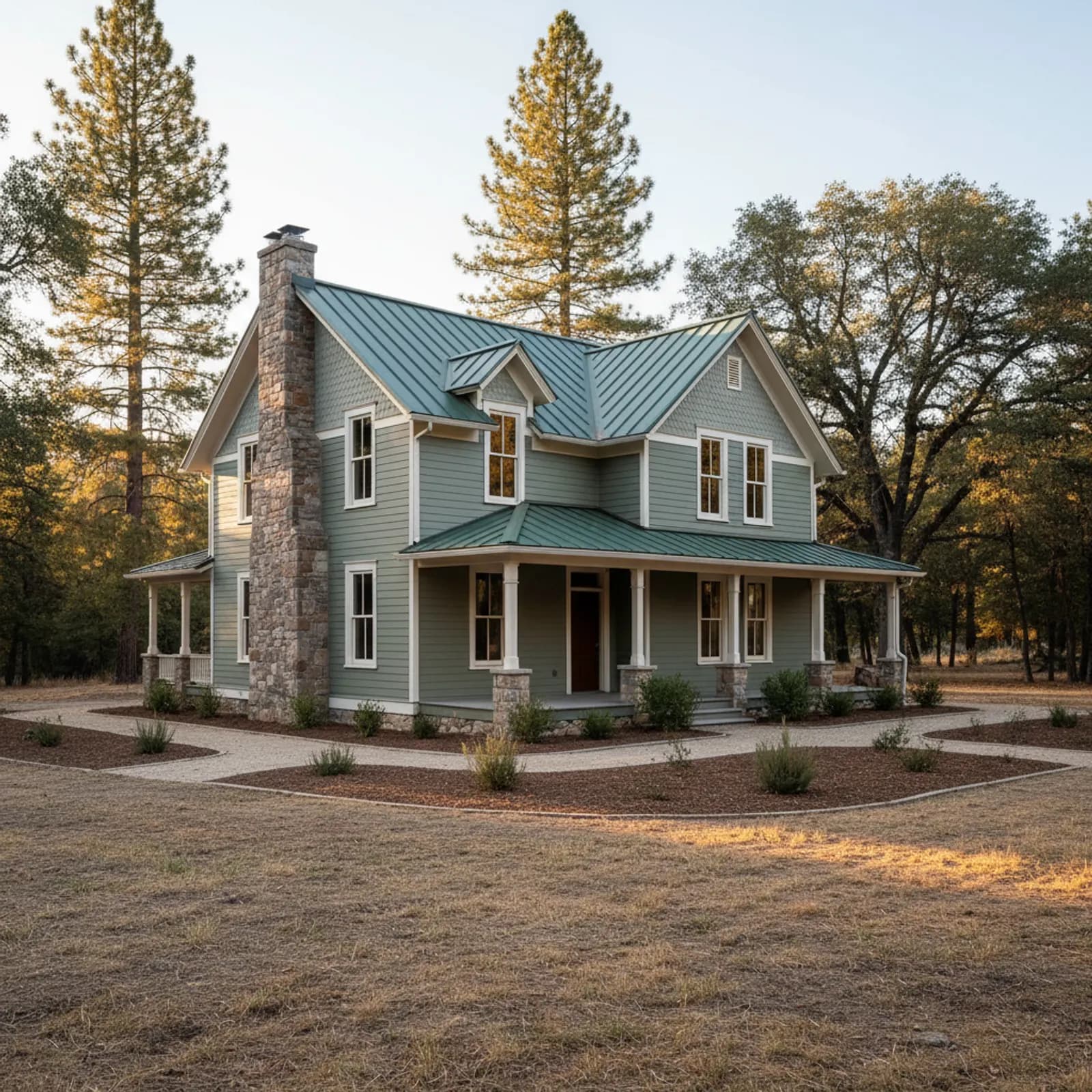
Exterior renovation in Grass Valley
Grass Valley is the larger of Nevada County's twin Gold Country towns, set among dense pine and oak at roughly 2,400 feet. Wildfire is the defining exterior consideration here, and it's baked into the geography: a National Register historic downtown, wooded residential streets, and a wide ring of rural-residential and acreage parcels reaching toward Penn Valley and Nevada City — almost all of it embedded in or against the forest. For most Grass Valley homeowners a re-side is, in practical terms, a home-hardening project as much as a cosmetic renovation, and we scope it that way from the first walk of the property.
Why the approach is different here
Unlike a valley tract, a Grass Valley home usually sits in or against the tree line, on terrain that slopes and channels wind. That changes ember behavior, drainage, and how trim and venting want to be detailed. We treat the exterior as a connected system rather than a list of separate products, because in this forested foothill setting the weakest detail — an open eave, an unprotected vent, an old wood-to-soil contact — is what actually decides how the assembly performs in a fire or a wet winter.
Considering an exterior project in Grass Valley?
Grass Valley housing and architecture
Grass Valley's stock blends character-rich Victorian-era and early-1900s homes near the downtown core, mid-century and later forest-embedded subdivisions, and a large body of rural acreage homes on wooded lots out toward the county margins. The historic homes carry real detail — narrow-reveal lap, decorative trim, and steep gable lines — that period-sensitive fiber cement profiles can honor. Many of the older and rural homes still wear combustible wood, board, or T1-11 siding, which is precisely the cladding we prioritize replacing in this forested environment without flattening the home's original lines.
Grass Valley's Gold Country climate
The controlling stressor in Grass Valley is the long, forest-fueled dry season. Summers are hot, high-UV, and rain-free for months, curing the surrounding pine and oak into available fuel and making non-combustible cladding and hardened detailing the baseline rather than an upgrade. Winters reverse the picture — cooler than the valley, genuinely wet, with occasional light snow — so the same project has to manage real water as well as fire. That dual demand is why a sound drainage plane, flashing, and ground clearance matter as much here as the cladding choice itself.
Hardening a Grass Valley home
For Grass Valley homes we specify Class A non-combustible fiber cement and harden the ignition-prone points — eaves, soffits, vents, and ground-to-wall transitions — recognizing that forest-embedded and rural parcels see heavy ember loading in a wind-driven event. Wind funnels along the ridgelines and drainages around town, so we coordinate cladding with soffit, fascia, and vent detailing so the assembly behaves as one hardened envelope rather than a strong wall with a weak edge. We document materials and assemblies so the work supports your defensible-space planning and insurability conversations.
Recommended materials for Grass Valley
Non-combustible fiber cement is the recommendation for Grass Valley given the forested fire exposure — in period-appropriate profiles for the historic core and durable, straightforward profiles for rural and subdivision homes. We generally advise against combustible cladding here; there is no durability trade to make, because fiber cement also rides out the heat, the UV, and the winter freeze-and-wet cycles. The result is that the safer material is also the sounder one on every count, which simplifies the decision for most homeowners.
What an exterior project costs in Grass Valley
Grass Valley projects carry the standard drivers plus fire-hardening scope, period-sensitive trim on historic homes, and frequently rural and wooded site access that complicates staging and material delivery. Sloped, tree-tight lots can mean more setup and protection time, and older homes commonly reveal substrate, sheathing, and dry-rot issues once the old siding comes off. We assess all of this on site and provide a written, itemized estimate; in this forested setting the hardening scope is core to the value rather than an add-on line.
Downtown-adjacent historic blocks
The older residential streets near the downtown core hold some of Grass Valley's most detailed homes, and they read at a walking pace — close to the sidewalk and visible to neighbors. On these we lean on period-appropriate lap reveals and warm trim so a hardened re-side strengthens the streetscape instead of standing out as a modern intrusion. Matching the original profile and shadow line is usually the difference between a re-side that disappears into the historic fabric and one that fights it.
Forest subdivisions and acreage parcels
Out from the core, mid-century and later subdivisions and a deep belt of rural acreage homes sit directly in the pine-and-oak canopy toward Penn Valley and the county edges. These are the parcels where combustible wood and T1-11 are still common and where re-cladding delivers the largest single hardening gain available short of a full rebuild. We pair the cladding with the eave, vent, and ground-transition work so the most exposed homes get a genuinely connected hardened envelope.
Access and winter staging
Wooded, sloping lots and narrow foothill drives shape how we stage a Grass Valley job — where material lands, how we protect mature trees and defensible-space clearing, and how we sequence around weather. The wet winters also narrow the working window, so we plan the schedule around the dry months when the drainage-plane and flashing details can be set and dried-in cleanly. We talk through that timing on site so the plan fits your property rather than a generic calendar.
PG&E + PSPS, NID water, and Historic Grass Valley review
Working exteriors in the City of Grass Valley coordinates with a few local authorities. Electric and gas both come from PG&E, and Grass Valley sits in one of the highest-PSPS corridors in Northern California. Water is supplied by the Nevada Irrigation District (NID), a customer-owned public agency. Fire response is Grass Valley Fire Department alongside CAL FIRE's Nevada-Yuba-Placer Unit. On the permit side, the City of Grass Valley Community Development Department handles building permits, and Downtown Grass Valley — one of California's most intact Gold Rush-era commercial and residential districts — carries Historic Preservation review, with material, profile, and color regulated on contributing structures. We flag utility, permit, and heritage items at the estimate stage.
HZ10 climate, the Gold Country fire history, and 2025 FHSZ
Grass Valley is in James Hardie's HZ10 climate zone; installing HZ5 is a documented warranty misapplication. On the fire side, Grass Valley and virtually all of Nevada County's Gold Country foothill belt sit in Moderate to Very High FHSZ under California's 2025 LRA Fire Hazard Severity Zone map, with surrounding unincorporated territory largely in State Responsibility Area. On designated parcels the 2025 California Wildland-Urban Interface Code governs the exterior wall. The code frame changed on January 1, 2026, when Chapter 7A moved into the standalone WUI Code.
Our process in Grass Valley
- Step 1
Consultation
We listen to your goals and assess your home on site — exposure, substrate, and architecture.
- Step 2
Design & Proposal
A clear written proposal with the right system specified for your climate and a transparent scope.
- Step 3
Expert Installation
Trained crews install to manufacturer best practices with careful weather-management detailing.
- Step 4
Walkthrough & Support
A final walkthrough, full cleanup, and a clear written record of the scope completed — work we stand behind.
In Grass Valley the goal is an exterior that is genuinely hardened against a forested fire season and still true to a historic Gold Country town. We design for both, and we scope every Grass Valley project on site so the plan fits your specific lot, stock, and exposure.
FAQ
Grass Valley — Common Questions
High. Grass Valley is embedded in Gold Country pine-and-oak forest, which is why non-combustible cladding with hardened detailing is the baseline for our work here.
Class A non-combustible fiber cement with hardened eave, soffit, vent, and ground-transition detailing — period-appropriate profiles for historic homes.
Re-cladding combustible wood or T1-11 in non-combustible fiber cement is one of the highest-value hardening steps available for a forested acreage property.
Occasional light snow and meaningful winter precipitation, so we include sound drainage-plane and flashing detailing alongside the fire strategy.
Yes — we use non-combustible fiber cement in period-appropriate profiles and trim so a hardened re-side respects the home's and the town's character.
We generally advise against it given the forested fire exposure; fiber cement carries no durability penalty and adds genuine protection.
Yes. We document the materials and assemblies used so the exterior work complements broader home-hardening and defensible-space programs.
A correctly installed fiber cement system commonly performs 30+ years here while materially reducing ignition risk over that lifespan.
Explore