
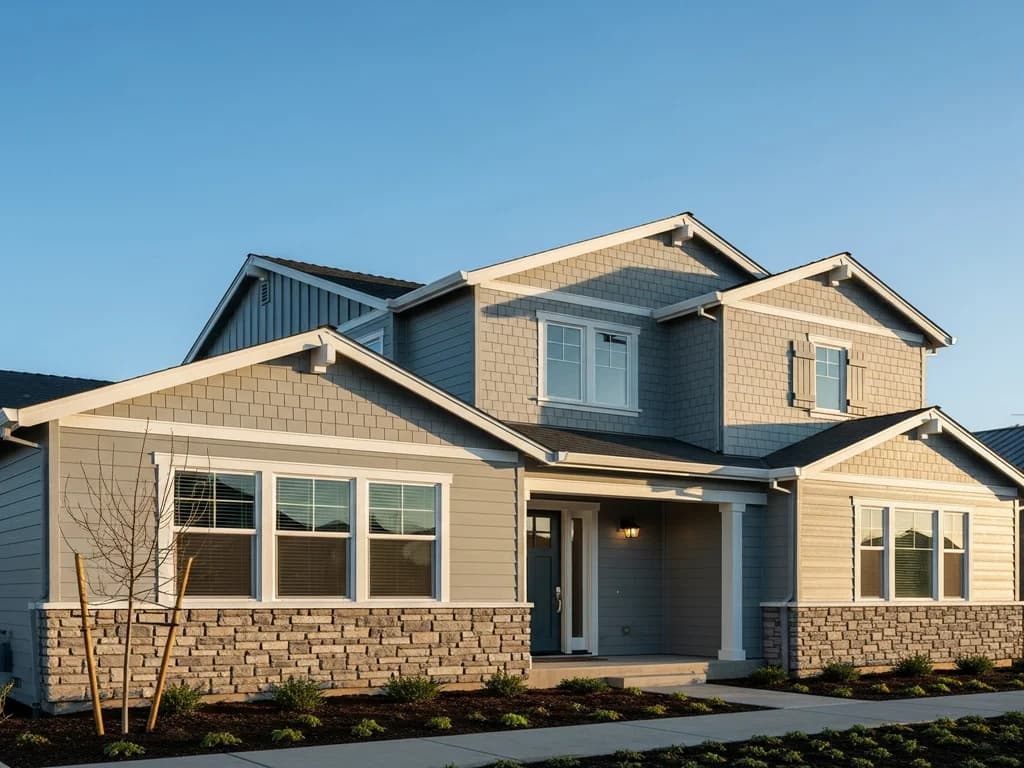
Why homeowners choose this with Sierra Siding
- A continuous weather-resistive barrier lapped shingle-style so every layer sheds onto the one below
- Window, door, and penetration flashing detailed in the correct sequence — not just caulked
- A drainage gap and clear drying path built into the wall so trapped moisture can escape
- Climate-matched detailing for valley heat, foothill fire exposure, coastal fog, or alpine freeze-thaw
- Bulk-water entry points found and sealed before new siding ever goes up
- The behind-the-board system that determines whether your siding lasts a decade or three
How we build the wall assembly, layer by layer
A weather-resistant exterior is a system, not a product, and we install it in sequence. We start with the sheathing, confirm it is sound and dry, then apply the weather-resistive barrier lapped shingle-style so upper courses always overlap lower ones. Flashing is integrated into the WRB in the right order — sill pan first, then jambs, then head flashing tucked under the barrier above. Over that we set the siding on a drainage plane so water that gets behind the boards can run down and out. Each step is detailed before the next covers it, because once the siding is on, none of this is fixable without taking the wall apart again.
What our scope includes that cheap bids leave out
A low bid usually quotes siding and paint and treats everything behind it as an afterthought. Our written scope spells out the WRB type, how it laps, sill-pan and head flashing at every opening, kick-out flashing where roofs meet walls, sealed penetrations for vents and hose bibs, and the drainage detail behind the cladding. We also include removing the old siding so we can inspect and correct the sheathing and any reverse-lapped flashing underneath. The corners cut on a thin bid — skipped pans, face-nailed flashing, caulk standing in for proper laps — are exactly the details that cause callbacks, so we put them in writing instead of leaving them out.
Materials and detailing matched to your NorCal climate
Northern California is not one climate, and the wall assembly has to answer the one your house actually sits in. In the valley we plan for intense solar heat and thermal cycling that work fasteners and sealant loose, specifying UV-stable barriers and movement-tolerant flashing. In the foothills we favor non-combustible flashing and tight detailing at vents and eaves where embers gather. Near the coast and Bay we prioritize drainage and drying capacity to handle persistent fog-driven dampness. At Tahoe and the higher elevations we detail for freeze-thaw and snow loading at the base of walls. We pick the components after we see where and how your home is exposed.
Our process from estimate to final walkthrough
We begin with an on-site assessment, not a phone quote — we look at existing flashing, signs of past water entry, and how the walls drain. From there you get a written estimate that names the materials and the detailing, so you know what you are buying. During the work we sequence the WRB and flashing before any cladding goes up, and we are glad to show you the assembly mid-job before it is covered. We protect landscaping and clean the site daily. At the end we walk the exterior with you, point out the key details we installed, and explain what to watch for so small issues stay small.
Why homeowners hire Sierra Siding for this work
Most siding failures we are called to fix are not material failures — they are detailing failures behind the board, and that is precisely the part many crews rush. We treat the weather-resistive system as the job, not the prep. Our team brings 20 years of combined experience across the valley, foothills, Bay Area, and Tahoe, so we have seen how each climate finds the weak point in a wall. We scope honestly on site, put the assembly in writing, and would rather lose a bid than skip a flashing detail that will leak in two winters. The goal is a wall that performs long after the job is paid for.
Honest answers to the common objections
The most common pushback is that this work is invisible, so why pay for it. That is fair — and it is exactly why it gets skipped and why siding fails early. We will show you the details as we install them so you can see what you are paying for. If you only need part of a wall addressed, we will tell you honestly rather than pushing a full re-wrap. And if we open a wall and find the sheathing or framing is worse than expected, we stop and show you before we proceed; your written estimate governs, and any change gets agreed in writing first. We would rather have a slower, clearer conversation than a surprise.
The moisture pattern by service area — where the drainage plane earns its keep
Bulk-water and vapor stress varies sharply across California, and the WRB and flashing detail we specify follows the parcel's actual pattern. Along the immediate Pacific coast (Aptos, Santa Cruz, Monterey, Carmel, Pacific Grove, Stinson Beach, Sausalito, Belvedere, Tiburon), chloride corrosion plus persistent marine fog is the driver — corrosion-resistant fasteners, kickout flashings at every roof-to-wall junction, and drainage capacity that lets a slow-drying wall breathe. In the North Bay wine country and canopy-shaded valleys (Santa Rosa, Napa, Healdsburg, Petaluma, Mill Valley, Kentfield, Ross, Kenwood, Glen Ellen), sustained damp under mature canopy rots shaded walls first, so a proper drainage gap and back-priming matter more than any single membrane brand. Along the Sacramento–San Joaquin Delta edge (Stockton, Yuba City, Sacramento Pocket/Greenhaven, the valley river corridors), tule fog and high humidity in cool months compound valley heat cycling. And at Tahoe (Truckee, South Lake Tahoe, Kings Beach, Tahoe City, Serene Lakes, Homewood, Northstar), snow-driven meltwater at roof-to-wall junctions and prolonged freeze-thaw cycling force ice-and-water-shield and generous ground clearances. The stucco-to-siding transition and head flashing references walk the specific detail patterns.
The utility, permit, and code framework behind the wall
A weather-resistant exterior coordinates with the same authority framework as any other exterior project — a detail our city hubs enumerate in full. Building permits go to the city building department for incorporated cities and to the county Community Development agency for unincorporated communities (Cameron Park, Meadow Vista, Auburn's outlying areas, Alta Sierra, Kentfield, Stinson Beach, Aptos, Live Oak, Pebble Beach). Water and sewer coordination goes through the parcel's actual provider — PCWA / NID / EID / TCPUD / NTPUD / MMWD / San Juan Water District / Soquel Creek Water / Cal-Am / municipal water depending on address. Electric coordination for any envelope-adjacent work runs through SMUD, Roseville Electric, CPAU, MID, REU, Healdsburg Electric, Lodi Electric, Liberty Utilities on the Tahoe side, or PG&E elsewhere. And on fire-designated parcels, the 2025 California Wildland-Urban Interface Code — which took effect January 1, 2026 when Chapter 7A was deleted from the Building Code — requires the WRB and cladding assembly to also meet non-combustible detailing at eaves, vents, and ground-to-wall transitions. We name the applicable authorities in the estimate rather than at the wall.
FAQ
Common Questions
Sometimes, but it depends on the assembly. The WRB and flashing live behind the cladding, so reaching them usually means removing siding in the affected area. On a sound wall we can often address a specific elevation or problem opening; on a failing wall it is more cost-effective to do it as part of a re-side. We will tell you on site which case yours is.
Caulk and paint are surface defenses that wear out and were never meant to be the primary water barrier. A real weather-resistant system manages water with lapped barriers, properly sequenced flashing, and a drainage path so the wall can dry. Caulk has a place at certain joints, but relying on it instead of flashing is the shortcut that leads to hidden rot.
At each opening we install a sill pan to catch any water that gets past the window, integrate the jamb flashing, and lap head flashing under the barrier above so everything drains outward. The sequence matters as much as the materials — flashing installed out of order can funnel water into the wall instead of out of it. We detail every window and door this way, not just the obvious ones.
We match the assembly to your exposure. Valley homes get UV-stable barriers and movement-tolerant detailing for heat cycling; foothill homes get non-combustible flashing and tight eave and vent detailing; coastal and Bay homes get maximum drainage and drying for fog; alpine homes get freeze-thaw and snow-base detailing. We decide after seeing your site, not from a one-size template.
We stop and show you. Hidden rot or damaged sheathing is fairly common when old flashing has failed, and the right move is to repair the substrate before new layers go on. We document what we find, explain the options, and get any added scope agreed in writing before continuing — your written estimate governs, and we do not bury surprises in the final bill.
A correctly detailed weather-resistant system is the single biggest factor in long-term performance and dramatically lowers the risk of hidden water damage. No exterior is permanent, though — sealant, paint, and trim still need periodic attention. We will point out the maintenance touchpoints at your final walkthrough so the system keeps doing its job year after year.
Keep Exploring
Related services, guides & areas
Helpful Exterior Guides