
Why homeowners choose this with Sierra Siding
- Source-first diagnosis so the rot is stopped at the cause, not just the symptom
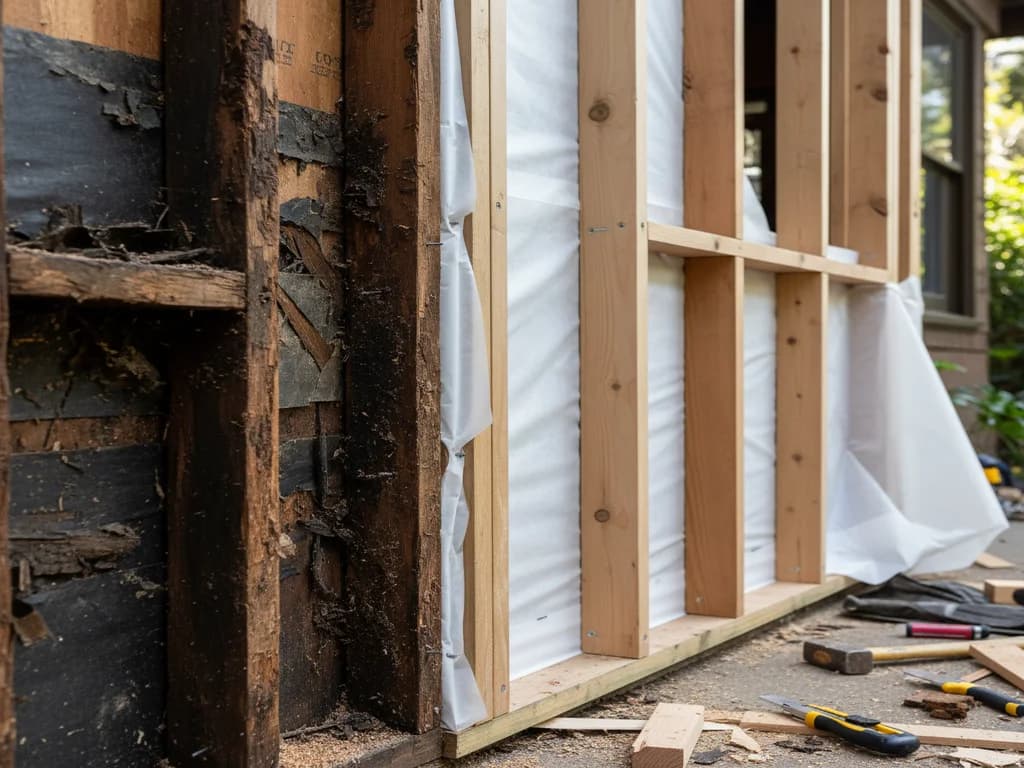
- Compromised framing, sheathing, fascia, and trim cut out and rebuilt to sound wood
- Flashing and weather-resistive barrier re-detailed where the leak actually started
- Repaired wall re-clad and finished so it reads as one continuous surface
- Photo-documented extent and a written scope that matches the conditions we find
- Climate-matched detailing for valley heat, foothill freeze-thaw, and coastal moisture
How we diagnose before we cut
We start at the wall, not the wallet. On a dry rot call we probe the soft area, then trace the water path that fed it — flashing laps around windows and doors, the deck-to-wall connection, the base of the wall below a gutter, penetrations like hose bibs and light boxes, and the weather-resistive barrier behind the cladding. We open only as much as we need to read the assembly, photograph what we find, and show you the same evidence we used to write the scope. If the moisture source is plumbing or grading rather than the envelope, we say so plainly, because replacing wood without closing the water path just buys you a repeat visit in a couple of seasons.
What our scope includes — and what cheap bids skip
A real dry rot repair is three trades stacked: demolition back to sound material, carpentry to rebuild structure, and envelope work to make the wall watertight again. Our scope covers all three. We remove every punky stud, sill, and sheathing panel until we hit solid wood, rebuild the framing and re-sheath, then re-lap the weather-resistive barrier and rebuild flashing in shingle fashion so water sheds outward. Finally we re-clad and refinish. Low bids commonly stop at the visible rot, paint over the rest, and leave the failed flashing in place — which is why that wall rots again. We'd rather quote the honest extent than win the job and lose your trust.
Materials and detailing we specify for NorCal
Wood that rotted once will rot again in the same conditions, so we upgrade where it counts. We favor rot-resistant or treated lumber at sills and ground-adjacent framing, properly back-primed trim, and corrosion-rated fasteners and flashing for the exposure. Detailing changes by region: in the Sacramento valley we plan for heat-driven movement and big wet-dry swings; in Tahoe and the foothills we account for freeze-thaw and snow load that drive water behind drip edges; near the coast and the Bay we assume prolonged marine moisture and ventilation that has to keep drying. The goal is a wall assembly that sheds, drains, and dries — not one that just looks repaired.
Dry rot in the Placer foothills — from Auburn to Foresthill
The Placer foothill belt — Auburn, Loomis, Newcastle, Penryn, Meadow Vista, Applegate, Colfax, Weimar, and Foresthill — sits in a climate the valley and the coast do not share, and its dry rot presents differently. At elevation, real winter freeze-thaw drives water behind drip edges and up under lap joints that a Sacramento-flat exterior never has to survive, so failures cluster at flashings, deck ledgers, and the lower courses of long horizontal runs. Rural and cabin-construction homes in the eastern foothills often carry decades of aging wood cladding that has quietly concealed substrate damage the owner has never seen; opening these walls at demolition regularly reveals more scope than the surface suggested. Fire seasons compound the picture: post-fire-season inspection turns up rot at eaves, soffits, and lower-wall transitions where suppression water, retardant residue, and delayed re-siding kept an assembly wet for weeks. On these homes we scope for both the moisture source and the fire-hardening rebuild in the same pass — the WUI-listed assembly that goes back on has to survive the same conditions that produced the rot in the first place. Neither Sacramento nor Tahoe nor the Bay is quite this problem, and we treat the Placer foothills as its own service area rather than fold it into either.
Our process from estimate to walkthrough
It starts with a free assessment where we probe non-destructively and look for the moisture source. We give you a written estimate that reflects what we actually found, and we flag honestly that hidden rot can extend further once the wall is open — if it does, we stop, document it, and discuss before adding cost, so there are no surprise charges. On site we protect landscaping and contain debris, demo to sound material, rebuild structure, redo the envelope, then re-clad and finish. We close with a walkthrough where we show you the corrected flashing and barrier detail and explain what changed so you understand why this wall should stay dry.
Why homeowners hire Sierra Siding for rot
Dry rot sits at the intersection of carpentry and building science, and a lot of contractors are strong at one and weak at the other. Our crews carry roughly 20 years of combined experience across siding, framing, and exterior envelope work, so we read the assembly the way it was built and rebuild it the way it should drain. We document the extent, scope to the real conditions, and treat the moisture source as the actual job. You get one accountable team for diagnosis, structural repair, and finish — and a clear explanation of what failed and what we changed so the fix holds.
Honest answers when the news isn't simple
Sometimes the rot is contained to a single stud bay and a square of sheathing, and the repair is straightforward. Other times it has run along a sill plate for several feet or climbed behind the cladding, and the only durable fix is to open a larger section. We won't oversell a small job, and we won't paper over a big one. If we believe the smarter move is a broader re-clad of that wall rather than a patch, we'll explain the trade-offs and let you decide. Your written estimate governs the work, and if conditions change once the wall is open, you hear it from us first.
FAQ
Common Questions
We stop and document it before doing anything beyond the agreed scope. You see photos of the additional damage and we discuss the revised approach and cost together, so nothing gets added quietly. Your written estimate governs, and changes only happen with your sign-off.
Both — and the cause comes first. We trace and close the moisture path, whether it's failed flashing, a reverse-lapped barrier, a deck-to-wall detail, or a leaking gutter, then rebuild the structure and re-clad. Replacing wood without correcting the water source just sets up the same failure again, which is why we won't quote a wood-only patch when the flashing is the real problem.
Often, yes. When the damage is limited to fascia, trim, or an isolated sheathing panel we can correct it without pulling whole walls. Larger rot zones usually mean removing siding around the area to expose and properly rebuild the assembly and flashing, and we'll show you why that's necessary before we commit to it.
We re-clad with siding that matches your profile and exposure as closely as the product allows, then prime and finish so the patch blends. On older or discontinued siding, an exact factory match isn't always possible, and we'll tell you that up front and discuss options like blending into a natural break or refinishing a larger section for a uniform look.
Usually not. Most policies treat long-term moisture damage as a maintenance issue rather than a covered loss, though a sudden event like a pipe burst or storm impact may qualify. We document conditions clearly so you can have an informed conversation with your carrier, but we don't promise coverage we can't control.
It depends entirely on the extent, which is why we probe before quoting. A contained repair at fascia or a single bay can be a short job; rot that has traveled along a sill plate or behind several feet of cladding takes longer because the structural and envelope work has to be rebuilt correctly. Your written scope will give a realistic timeframe for your actual conditions.
Keep Exploring
Related services, guides & areas
Helpful Exterior Guides
Resources
- Weatherproofing a Tahoe Mountain Exterior
- Best Siding for Bay Area Fog, Moisture, and Coastal Salt
- Siding Types for California Homes
- What Dry Rot Repair Costs in Sacramento
- What Dry Rot Repair Costs in San Jose
- What Dry Rot Repair Costs in Roseville
- What Dry Rot Repair Costs in Santa Rosa
- What Dry Rot Repair Costs in Folsom
- What Dry Rot Repair Costs in Auburn