
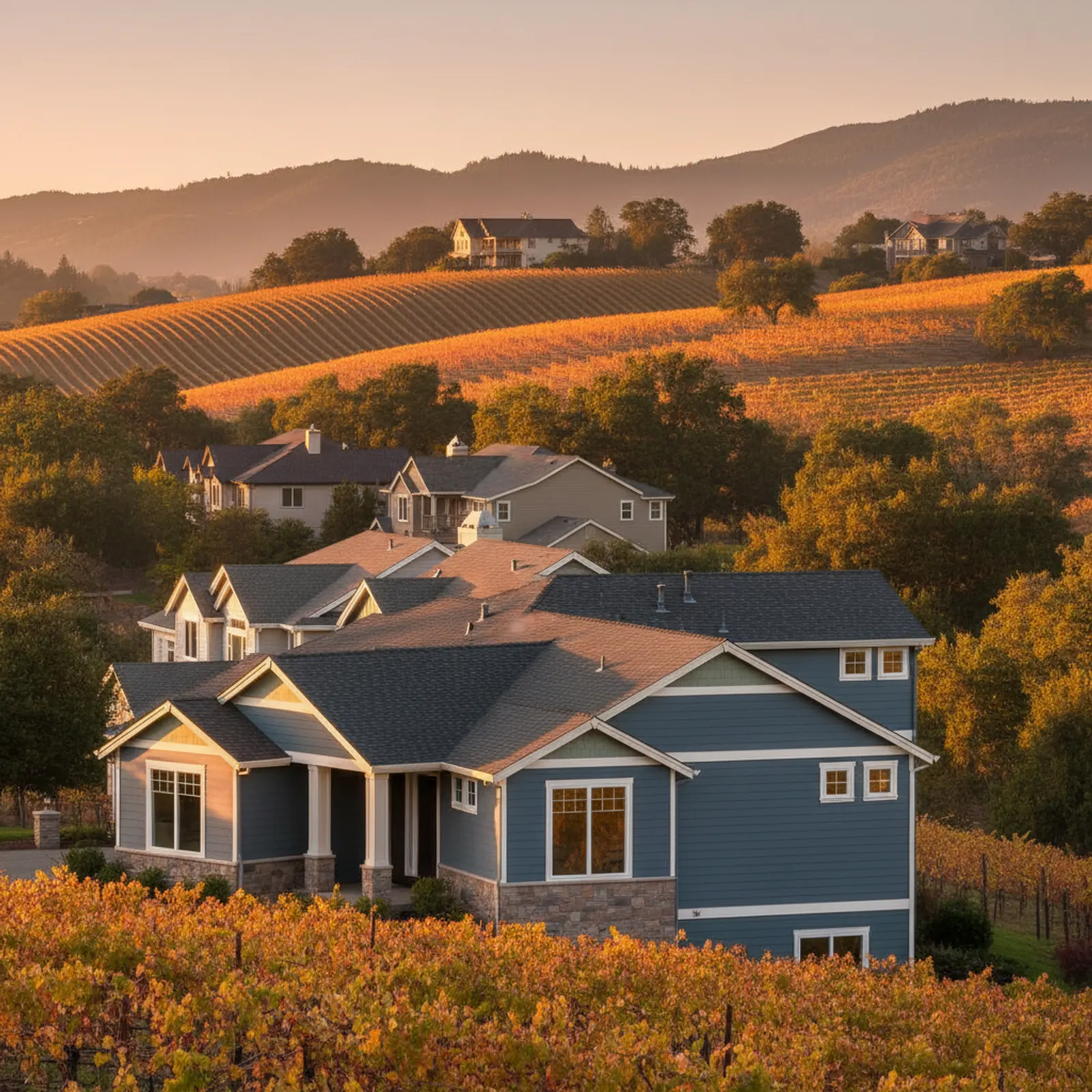
Siding in Santa Rosa
Santa Rosa's re-side conversation is shaped by recent history more than almost anywhere we work. The 2017 Tubbs Fire devastated Fountaingrove, Coffey Park, and surrounding neighborhoods, and rebuilding and hardening continue years later. For Santa Rosa homeowners — rebuilding, hardening, or simply replacing aging siding — wildfire performance is a present, concrete consideration.
What makes Santa Rosa distinct from foothill fire towns is that the exterior must satisfy two demands at once: hillside and valley-edge fire exposure, and meaningful North Bay seasonal moisture. A correct Santa Rosa re-side is both non-combustible and rigorously drained.
Rebuild standard vs. hardening older stock
Post-fire Santa Rosa rebuilds are frequently already non-combustible. The biggest gains now are on surviving and older hillside and tract homes still wearing wood, T1-11, or hardboard — where re-cladding delivers both the hardening and the moisture-durability upgrade in one project.
Fire and moisture, designed together
We don't trade one risk against the other. Santa Rosa assemblies pair Class A non-combustible cladding with a rigorously detailed, drying-capable drainage plane — the hillside fire strategy and the North Bay moisture strategy resolved in a single envelope.
Working a re-side on the Fountaingrove ridgelines
The grade is half the job on the eastern hills. Fountaingrove and the slopes climbing toward the Rincon Valley line put crews on cut-and-fill lots where one elevation faces a downhill drop and the wind funnels uphill through the canyon in the afternoon. That changes how a Santa Rosa re-side is staged. Scaffold has to be tied and leveled on a slope rather than set flat, material gets walked rather than craned to the high gables, and the downslope wall is usually the most exposed face we detail first. Established in-town and east-side homes off Sonoma Avenue are gentler ground, but the older lots come with mature oaks crowding the eaves and tight side yards that limit how much board can be staged at once. We size the staging plan to the lot before quoting, because a steep Fountaingrove parcel and a flat Rincon Valley street are genuinely different days of labor even when the wall area matches on paper.
What the WUI map does to your wall assembly
Much of Santa Rosa east and north of Highway 12 sits inside a mapped wildfire-urban-interface zone, and that designation drives the siding spec long before anyone picks a color. In those areas we build toward an ignition-resistant exterior: non-combustible cladding such as fiber cement or mineral-faced board, backed by attention to the parts that actually catch a fire, the soffits, the open eaves, and the vent screens where embers collect during a wind-driven event like the one that crossed the city in 2017. A re-side here is really a chance to close those gaps while the wall is already open. We also keep the bottom course detailed away from bark mulch and fence returns so a ground ember has nowhere to climb. Neighboring communities like Sonoma and Sebastopol share the same interface logic on their hill edges, so the approach is consistent across the area, but Santa Rosa's recent burn history means homeowners here tend to want the hardening done thoroughly rather than to the minimum the map allows.
Why this matters in Santa Rosa
- Specified for Wine Country / North Bay conditions
- Class A non-combustible fiber cement as the recommended system
- Correctly detailed weather-resistive barrier and flashing
- Installed by a crew with 20 years combined experience
Recommended systems for Santa Rosa
- Class A non-combustible fiber cement
- rigorous drainage-plane detailing
- fire-hardened eave and vent detailing
- durable factory finishes
Fiber Cement Siding for Santa Rosa homes
The full fiber cement siding approach — materials, weather-resistive detailing, and the manufacturer standards we install to — is covered on the main service page, then specified for Santa Rosa's conditions on this one.
Our Santa Rosa process
- Step 1
Consultation
We listen to your goals and assess your home on site — exposure, substrate, and architecture.
- Step 2
Design & Proposal
A clear written proposal with the right system specified for your climate and a transparent scope.
- Step 3
Expert Installation
Trained crews install to manufacturer best practices with careful weather-management detailing.
- Step 4
Walkthrough & Support
A final walkthrough, full cleanup, and a clear written record of the scope completed — work we stand behind.
FAQ
Siding in Santa Rosa — FAQ
Hillside and valley-edge Santa Rosa homes carry real wildfire exposure, underscored by the Tubbs Fire — for those, non-combustible cladding with hardened detailing is strongly advised. We assess per address.
Yes — we install non-combustible, hardened assemblies appropriate to current rebuilding standards and document the materials used.
Yes — the North Bay setting brings real seasonal moisture, so we detail the drainage plane and flashing rigorously alongside the fire strategy.
Yes — including rebuilds and hardening of existing homes throughout the fire-affected neighborhoods and citywide.
Keep Exploring
More for Santa Rosa homeowners
More in Santa Rosa
Other exterior services in Santa Rosa
Nearby Service Areas
Siding near Santa Rosa
Helpful Exterior Guides