
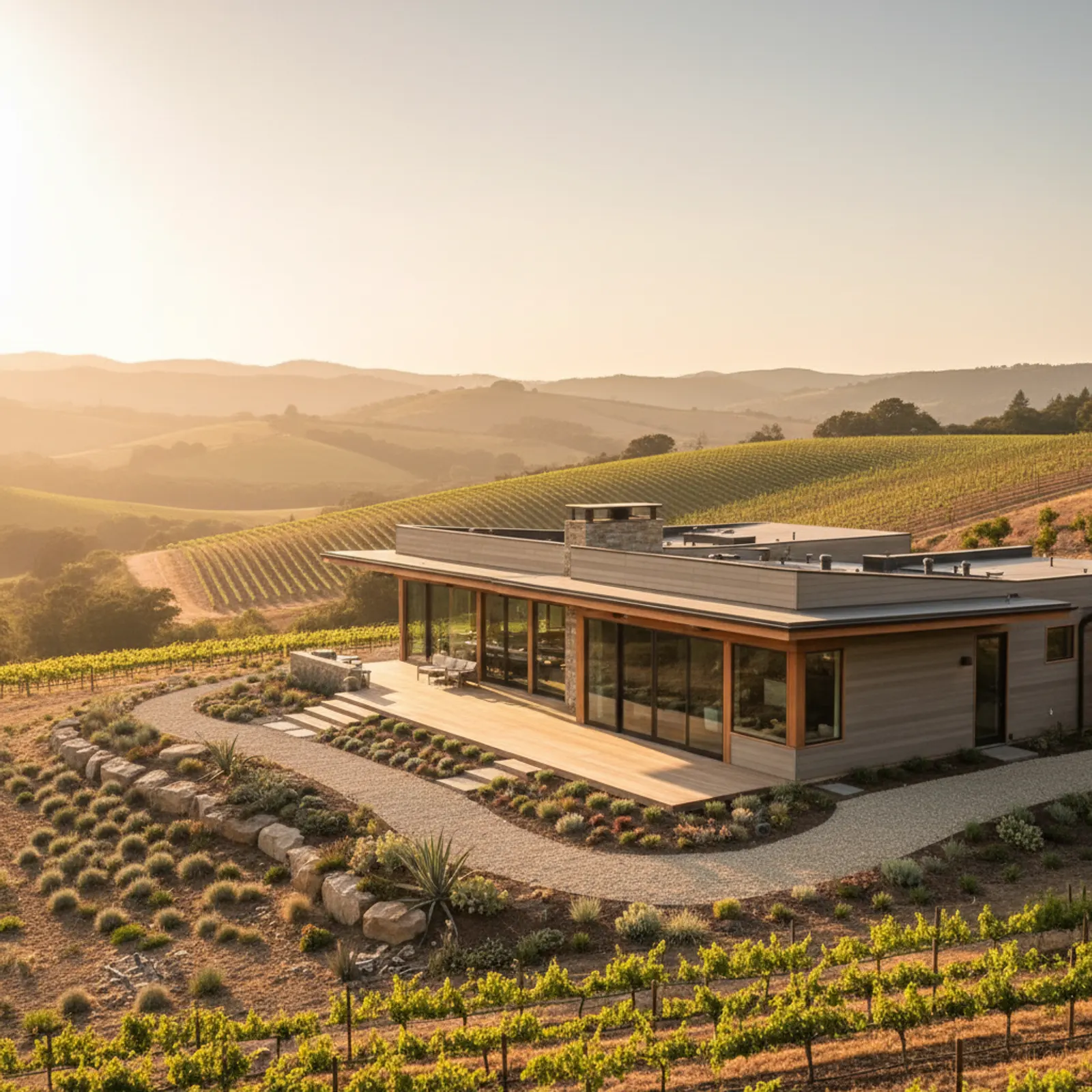
Exterior renovation in Santa Rosa
Santa Rosa is the largest city in Sonoma County and the commercial center of the North Bay, and its exterior-renovation conversation is shaped by recent history more than almost anywhere we work. The 2017 Tubbs Fire devastated Fountaingrove, Coffey Park, and surrounding neighborhoods, and the rebuilding and hardening of the city's housing stock has continued for years since. For Santa Rosa homeowners — whether rebuilding, hardening an existing home, or simply replacing aging cladding — wildfire performance is a present, concrete consideration rather than an abstraction.
Fire and moisture in one assembly
What makes Santa Rosa distinct is that the exterior has to satisfy two demands at once. The hillside and valley-edge neighborhoods that climb toward Fountaingrove and the eastern ridges carry real wildfire exposure, while the city's North Bay setting brings meaningful seasonal moisture and humidity through the cooler months. A correct Santa Rosa exterior is therefore both non-combustible and rigorously drained — the two strategies engineered together from the start rather than traded off against one another at the end of a project.
Considering an exterior project in Santa Rosa?
Santa Rosa housing and architecture
Santa Rosa's stock spans a wide range: hillside custom and Fountaingrove-area homes, extensive postwar and later tract neighborhoods across the west side and Rincon Valley, established in-town districts near downtown and the McDonald Avenue area, and a large body of post-Tubbs rebuilds constructed to current standards. The rebuilds are frequently already non-combustible. The older hillside and tract homes — many still wearing wood lap, T1-11, or aging hardboard — are exactly where re-cladding delivers the biggest hardening and durability gain, often with profile and trim choices that respect the original ranch or craftsman lines while upgrading the material underneath.
Santa Rosa's wine-country climate
Santa Rosa summers are warm and dry, with significant hillside fire windows opening in late summer and through the diablo-wind season of early fall — the same conditions that drove the 2017 firestorm. The cooler months reverse the picture, bringing North Bay moisture and humidity that settles along the Santa Rosa Creek and the valley-floor corridors. The dryness dictates the fire detailing that dominates hillside specs, while the wet season makes a properly lapped drainage plane a genuine performance factor rather than an afterthought, especially on the lower, creek-adjacent neighborhoods.
Hardening a Santa Rosa home
For at-risk Santa Rosa homes we specify Class A non-combustible fiber cement and harden the ignition-prone points — eaves, vents, and the ground-to-wall transition — recognizing that the city's recent fire history makes this a priority for the Fountaingrove ridges and valley-edge parcels in particular. We coordinate cladding with soffit, fascia, and vent detailing so the assembly behaves as one hardened system rather than a set of disconnected parts, and we document materials and assemblies to support insurability and rebuilding-standard conversations. We won't overstate the risk on flatter in-town lots, but on the hillsides it is real and we treat it that way.
Recommended materials for Santa Rosa
Non-combustible fiber cement over a rigorously detailed drainage plane is the core recommendation for Santa Rosa, because it addresses the hillside fire exposure and the North Bay moisture together with no durability trade-off. Durable factory finishes hold up to the warm, dry summers and the UV that comes with them, while the drainage-plane and flashing work carries the wetter months. On hillside and valley-edge parcels we generally steer away from combustible cladding regardless of aesthetic preference, given the city's exposure, and we align eave and vent materials to match the wall's fire class.
What an exterior project costs in Santa Rosa
Santa Rosa pricing follows the standard drivers — overall size and number of stories, trim complexity, substrate condition and any hidden dry rot, window integration, and the weather-management scope — plus fire-hardening scope on hillside and valley-edge parcels. Steep Fountaingrove-area lots and tight in-town streets can add access and staging cost, and post-fire parcels sometimes carry substrate or detailing surprises. We provide a written, scoped estimate after an on-site assessment; in Santa Rosa the hardening line items are not where we recommend economizing, and the written estimate governs the work.
Fountaingrove and the eastern hillsides
The Fountaingrove ridges and the slopes east of town are where Santa Rosa's wildfire conversation is sharpest. Many parcels here are custom or semi-custom homes on steep, view-oriented lots, and a number are post-Tubbs rebuilds already built to current fire standards. For the homes that survived or predate the fire, re-cladding is a chance to bring the older wall assembly up to a hardened, non-combustible standard. Steep grades and narrow hillside streets shape how we stage material and scaffold, which we walk and plan during the on-site scope.
Coffey Park, Rincon Valley, and the in-town neighborhoods
Down on the valley floor, neighborhoods like Coffey Park and the Rincon Valley and west-side tracts are dominated by postwar and later tract housing, much of it on flatter, more accessible lots. Fire exposure is lower here than on the ridges, so the emphasis shifts toward moisture management, substrate repair, and matching the established streetscape. Coffey Park's rebuild history means new and older construction sit side by side, and we tailor the spec to each home rather than assuming the whole block is alike.
Working within rebuilding and design context
Because so much of Santa Rosa has rebuilt or hardened since 2017, exterior work here often intersects with insurance, documentation, and current building-standard conversations more than in cities untouched by major fire. We document the materials and assemblies we install so homeowners have a clear record, and we scope each project to the specific parcel — ridge or valley floor, survivor or rebuild — rather than applying one template across a city with this much variation.
PSPS, historic districts, and the post-Tubbs code posture
Working exteriors in Santa Rosa runs into three local realities most cities do not share to the same degree. Electric and gas both come from PG&E, so any work near the service mast, meter, or overhead drop coordinates through the same utility much of the state runs on — but Santa Rosa is also in high-PSPS territory, where PG&E's Public Safety Power Shutoffs during diablo-wind events can affect job scheduling in late summer and through early fall (a real consideration on a two- to three-week re-side). Water is served by Santa Rosa Water, the city-owned utility. On the permit side, the City of Santa Rosa's Planning & Economic Development Department handles building permits, and any visible exterior work in one of the city's designated historic districts — McDonald Avenue, Cherry Street, Ridgway, St. Rose, and Railroad Square among them — falls under the Cultural Heritage Board's design review, where material, profile, and color can be regulated on contributing structures. And the code frame carries recent weight: Santa Rosa is one of the California cities that lived through a full code cycle during the post-Tubbs rebuild years, so a re-side on a home that stood through the fire is not automatically at current standard. We check the parcel and the assembly against today's expectations rather than the era's.
HZ10 and the 2025 WUI Code on Santa Rosa hillsides
Santa Rosa's cladding conversation runs on two axes: fire class (non-combustible required where the parcel is designated) and the North Bay moisture-plus-UV cycle (finish durability and drainage-plane discipline). On the material side, Santa Rosa is in James Hardie's HZ10 climate zone — the West's hot-summer belt with mild wet winters — and HZ10 is the correct spec for a Santa Rosa home; installing the alternative HZ5 line is a documented warranty misapplication. On the code side, the 2025 California Wildland-Urban Interface Code governs exterior walls on designated parcels — and the code frame changed on January 1, 2026, when Chapter 7A was deleted from the Building Code and its provisions moved into the standalone WUI Code (the substance carried forward; the citation changed). A Fountaingrove or eastern-hillside re-side in 2026 or later runs under the new frame; a valley-floor re-side outside a designated zone does not, though non-combustible cladding remains a low-regret upgrade there. California's 2025 LRA Fire Hazard Severity Zone map — a first comprehensive revision since 2007 — covered Sonoma County alongside the rest of the state, so we check the address against the current designation at scoping and match the assembly to the parcel rather than to a citywide average.
Our process in Santa Rosa
- Step 1
Consultation
We listen to your goals and assess your home on site — exposure, substrate, and architecture.
- Step 2
Design & Proposal
A clear written proposal with the right system specified for your climate and a transparent scope.
- Step 3
Expert Installation
Trained crews install to manufacturer best practices with careful weather-management detailing.
- Step 4
Walkthrough & Support
A final walkthrough, full cleanup, and a clear written record of the scope completed — work we stand behind.
In Santa Rosa, a re-side done right is often a meaningful reduction in ignition risk and a moisture-durable upgrade at the same time. We design for both, and we scope every Santa Rosa project on site so the spec fits the actual parcel. Your written estimate governs the work.
FAQ
Santa Rosa — Common Questions
Hillside and valley-edge Santa Rosa homes carry real wildfire exposure, underscored by the Tubbs Fire. For those parcels non-combustible cladding with hardened detailing is strongly advised.
Yes. We install non-combustible, hardened exterior assemblies appropriate to current rebuilding standards and document the materials used.
Yes — the North Bay setting brings seasonal moisture and humidity, so we design the drainage plane and flashing rigorously alongside the fire strategy.
Class A non-combustible fiber cement over a rigorously detailed drainage plane, with hardened eave and vent detailing.
Home hardening can support insurability in this market. We document the materials and assemblies used, though insurers set their own criteria.
Yes — including rebuilds and hardening of existing homes throughout the fire-affected neighborhoods and citywide.
On hillside and valley-edge parcels we generally advise against it given the exposure. Non-combustible fiber cement carries no durability penalty here.
A correctly installed fiber cement system commonly performs 30+ years here while materially reducing ignition risk over that lifespan.
Explore