
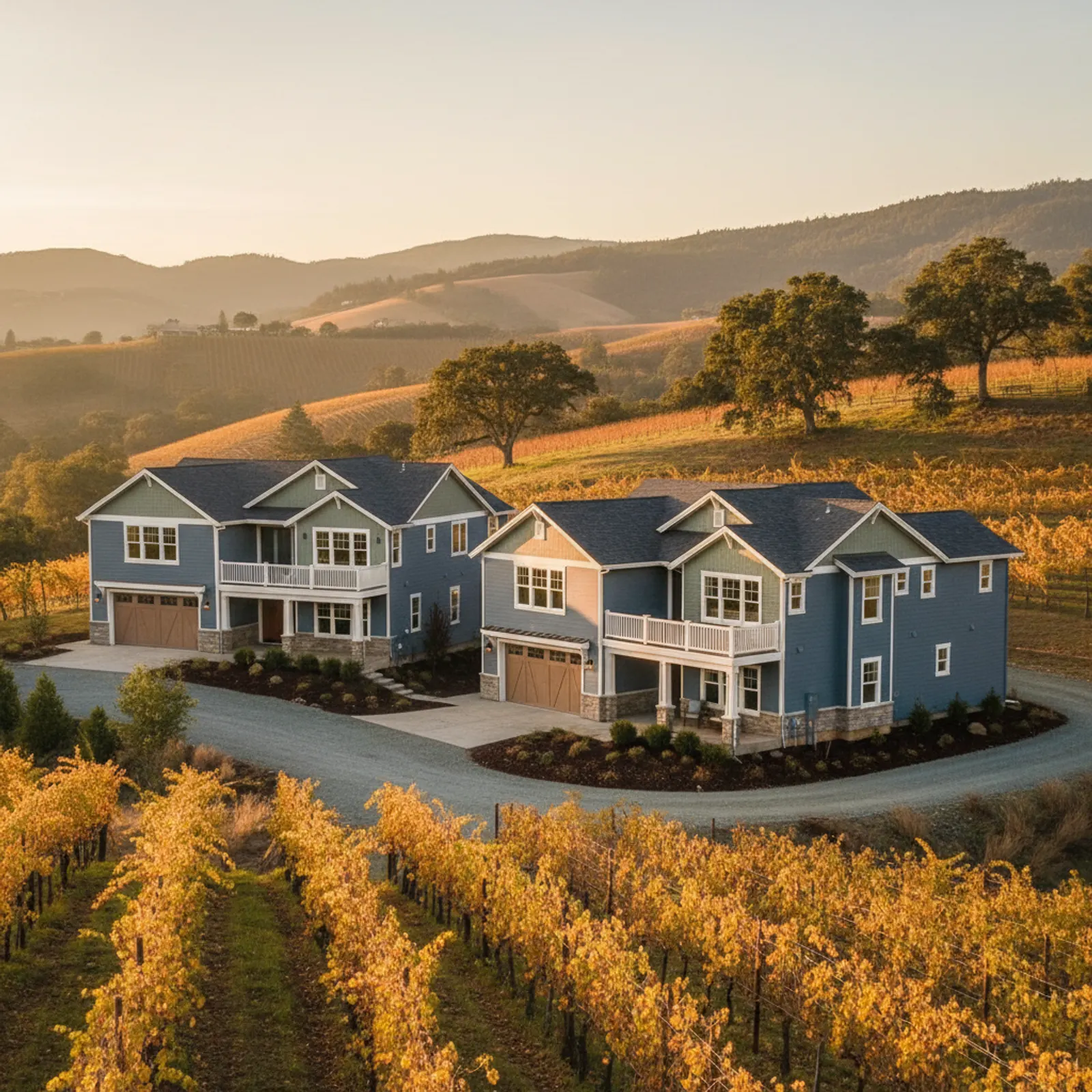
James Hardie Siding in Santa Rosa
Santa Rosa learned something most fire-zone cities haven't: in 2017 the Tubbs Fire jumped a freeway and burned Coffey Park — a flat, ordinary suburban subdivision nowhere near open wildland. That reframes the James Hardie conversation here. The threat isn't only the Fountaingrove hillsides; it's ember-driven, house-to-house spread in dense neighborhoods that thought they were safe.
The Coffey Park lesson: dense ≠ safe
Once embers ignite one home, closely-spaced houses spread fire to each other regardless of how far the wildland is. Class A non-combustible cladding matters most exactly where it's least expected — interior subdivision lots, not just the ridge. We scope Santa Rosa re-clads and rebuilds around radiant and ember exposure from neighboring structures, not only from brush.
Rebuild-grade detailing, drying-capable wall
Many Santa Rosa projects are rebuilds or hardening of homes whose owners lived through this — they want it documented and right. We install Hardie to clearance and fastening spec with hardened eaves and vents, over a continuous drainage plane so North Bay wet seasons don't undo the assembly, and document it for the insurer conversation that inevitably follows here.
Fountaingrove ridgelines and the hillside access problem
Above the valley floor, Fountaingrove and the upslope hillside lots present a different James Hardie job than a flat Rincon Valley or east-side parcel. These are the homes that sit closest to open ground, often on narrow switchback driveways where a delivery truck cannot simply pull alongside the gable. Material staging, scaffold footing on a grade, and protecting the downhill neighbor from debris all become part of the scope before a single plank goes up. Many of these properties are post-Tubbs rebuilds where the fiber-cement cladding was specified as part of the original permit, so a re-side or repair has to match an existing hardened detail rather than improvise one. We walk the slope and the approach first, because the wind-driven ember path on a Fountaingrove ridge runs uphill toward the eaves and soffits, not just at the wall plane. Getting Hardie board onto a steep Santa Rosa hillside is as much a logistics and sequencing question as a cladding one, and we plan the lift before we quote the panels.
Wine Country swings: hot afternoons, damp mornings, one wall that handles both
Santa Rosa is not coastal and it does not see snow, but the inland Wine Country pattern still works a fiber-cement wall hard. Summer afternoons push real heat against a south or west elevation, while overnight fog and morning damp roll in off the Russian River corridor and the gaps toward Sebastopol and Sonoma. James Hardie planks shrug off both, but the assembly behind them is what actually keeps a Santa Rosa wall dry. We detail a rainscreen gap so the back of the board can breathe and any wind-driven moisture has a drainage path out, then flash the window heads and band joints to shed water rather than trap it. Paint and caulk chemistry get matched to that daily heat-then-damp cycle, because a joint that opens in the afternoon and wets at dawn is where coastal-adjacent inland homes fail first. The goal is a cladding that reads as a fire-hardening upgrade on the outside while quietly managing the North Bay moisture load underneath, season after season.
Why this matters in Santa Rosa
- Specified for Wine Country / North Bay conditions
- Class A non-combustible fiber cement as the recommended system
- Correctly detailed weather-resistive barrier and flashing
- Installed by a crew with 20 years combined experience
Recommended systems for Santa Rosa
- Class A non-combustible fiber cement
- rigorous drainage-plane detailing
- fire-hardened eave and vent detailing
- durable factory finishes
James Hardie Siding for Santa Rosa homes
The full james hardie siding approach — materials, weather-resistive detailing, and the manufacturer standards we install to — is covered on the main service page, then specified for Santa Rosa's conditions on this one.
Our Santa Rosa process
- Step 1
Consultation
We listen to your goals and assess your home on site — exposure, substrate, and architecture.
- Step 2
Design & Proposal
A clear written proposal with the right system specified for your climate and a transparent scope.
- Step 3
Expert Installation
Trained crews install to manufacturer best practices with careful weather-management detailing.
- Step 4
Walkthrough & Support
A final walkthrough, full cleanup, and a clear written record of the scope completed — work we stand behind.
FAQ
James Hardie Siding in Santa Rosa — FAQ
Coffey Park proved it can be. Once embers reach a dense neighborhood, homes ignite each other independent of the wildland distance. Class A cladding on interior lots is exactly the under-appreciated protection the Tubbs Fire exposed.
It's a common one here precisely because it's non-combustible and the rebuild community has lived the reason. We install to hardening and warranty standards and document the assemblies, which matters for both peace of mind and insurance.
Only if hardening is done without a drying strategy. We run a continuous drainage plane behind the Class A board so the damp season can't trap moisture in the very assembly that protects the home.
Keep Exploring
More for Santa Rosa homeowners
More in Santa Rosa
Other exterior services in Santa Rosa
Nearby Service Areas
James Hardie Siding near Santa Rosa
Helpful Exterior Guides