California's second-home capital, and what that means for a wall
Per U.S. Census data covering 2020 through 2024, about two-thirds of Alpine County's housing units are vacant for seasonal, recreational, or occasional use — the highest proportion of any county in the state, ahead of El Dorado County and its South Lake Tahoe basin. The county holds roughly 1,200 year-round residents and no incorporated cities at all. Practically, that means most of the buildings here are owned by people who are somewhere else, and the exterior consequences are specific rather than abstract: a flashing failure that begins in November is not discovered until the owner arrives at Christmas, or in some cases until spring. A primary residence gets a homeowner walking past its walls every day. An Alpine County home does not, so the assembly has to be right the first time and it has to fail gracefully when it eventually fails.
Three distinct areas, one set of extremes
The county is usually described locally in three parts, and they are genuinely different projects. Bear Valley and Lake Alpine sit on Highway 4 at around 7,000 feet, a ski-village market of condominiums, cabins, and custom homes that is almost entirely second-home ownership. Kirkwood and Hope Valley on Highway 88 sit higher still, near 7,800 feet, in a place that records some of the deepest snowpack in the Sierra Nevada. Markleeville and Woodfords occupy the lower eastern side around 5,500 feet, along the West Fork Carson River — Markleeville is the county seat and a surviving 1860s silver-boom town, and Woodfords is the oldest non-native settlement in the region. Population here only really grew from the 1960s, when the Bear Valley and Kirkwood ski resorts were developed, which is why so much of the stock is resort-era and why so little of it is lived in full time.
Utility, permit, and fire authorities across Alpine County
Alpine County has no incorporated cities — Markleeville is the county seat but remains unincorporated, and every community here (Markleeville, Woodfords, Bear Valley, Kirkwood, Hope Valley) is under Alpine County jurisdiction. Building permits come through the Alpine County Community Development Department. Electric is split by geography: Liberty Utilities (Sierra region) serves the East Carson corridor (Markleeville, Woodfords) and PG&E serves the Highway 4 corridor (Bear Valley), while Kirkwood is uniquely served by the Kirkwood Meadows Public Utility District (KMPUD), a customer-owned district providing electric, water, wastewater, and fire response inside the resort. Natural gas is generally unavailable countywide — propane heats most homes. Water is fragmented: Markleeville Public Utility District serves the town, KMPUD serves Kirkwood, small mutual and community systems serve pockets, and private wells cover most rural acreage. Fire response is CAL FIRE Amador-El Dorado Unit (AEU) as the primary wildland responder, alongside Alpine County Fire, KMPUD Fire (Kirkwood), Bear Valley Fire (community district), and cross-boundary coordination with East Fork Fire Protection District (Douglas County NV) on the Highway 88/89 corridor toward the Nevada line.
HZ climate and the Alpine County FHSZ landscape
Alpine County is uniquely an all-HZ5 county in James Hardie's climate zone system — every populated community (Markleeville ~5,500 ft, Bear Valley ~7,000 ft, Kirkwood ~7,800 ft, Woodfords ~5,600 ft) sits above the HZ5 high-elevation/high-snow-load threshold. Installing HZ10 anywhere in Alpine is a documented warranty misapplication — the county's snow depth, freeze-thaw count, and cold-cure conditions require the HZ5 product spec. On the fire side, essentially every parcel in Alpine County sits in High or Very High FHSZ territory under California's 2025 LRA Fire Hazard Severity Zone map, with most surrounding land in State Responsibility Area / Stanislaus National Forest / Eldorado National Forest / Toiyabe National Forest. The 2021 Tamarack Fire (68,637 acres, 23 structures destroyed, 2,439 evacuations across a county of ~1,200 residents) directly threatened Markleeville and is the corridor's reference event. On every parcel here the 2025 California Wildland-Urban Interface Code governs the exterior wall. Chapter 7A moved into the standalone WUI Code on January 1, 2026.
Climate and exterior risk in Alpine County
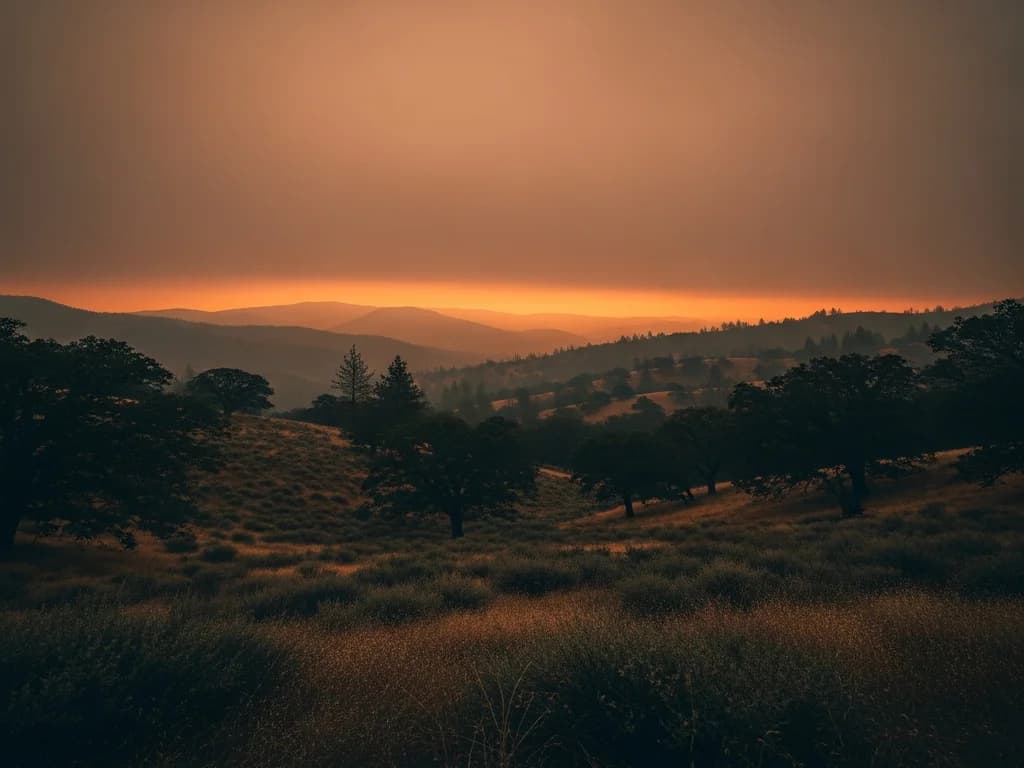
Alpine County has the highest mean elevation of any county in California, and every populated community sits well above 5,000 feet. Snow is the defining load rather than an occasional event: the Kirkwood and Bear Valley elevations accumulate some of the deepest snowpack in the range, and the assembly has to handle sustained snow contact against the wall, meltwater running behind cladding, ice at roof-to-wall junctions, and hundreds of freeze-thaw cycles a season prying at any joint that admits water. Summers are short, dry, and intensely sunny — thin high-altitude air gives ultraviolet radiation far more bite than a valley sample suggests, so finishes that look durable in Sacramento embrittle and chalk here in a fraction of the time. Then the same dryness that ends the snow season opens a genuine wildfire season on a landscape of conifer and brush. Snow, UV, and fire in one place, on buildings nobody is watching.
Wildfire exposure in Alpine County
The reference case is the Tamarack Fire. Ignited by lightning in the Mokelumne Wilderness on 4 July 2021, it grew slowly for nearly two weeks and then, on 16 July, high winds pushed it down the ridge — it reached roughly 21,000 acres within a day and eventually burned 68,637 acres, destroying 23 structures, damaging three, and forcing 2,439 people to evacuate across a county of about 1,200 residents. It threatened Markleeville directly and closed Highways 89, 88, and 395. The most instructive detail is what saved the town: prior fuel-reduction treatment around Markleeville is credited with protecting it. That is worth sitting with, because it says the thing we say on every fire-exposed project — the work in the landscape around a structure generally does more than the material on its walls. Non-combustible cladding and hardened eave, vent, and ground-transition detailing genuinely improve a building's odds, and on a second home they matter more than usual because nobody is there to clear the gutters or move the woodpile before a fire arrives. None of it makes a house fireproof, and we will not describe it that way.
Snow, meltwater, and freeze-thaw
Snow is the governing design condition across Alpine County, and it damages walls in ways rain never does. Snow drifted against a wall keeps the bottom courses in sustained contact with moisture for weeks rather than hours. Meltwater runs behind cladding and refreezes overnight, and water that has found its way into a joint expands as ice and levers the joint further open — repeat that a few hundred times a season and a detail that would last decades in the valley fails in a handful of winters. Roof-to-wall junctions collect the worst of it, because snow accumulates there and melts against the cladding. Snow shedding off a steep roof can also strike and damage walls, trim, and anything projecting from them. The practical answers are unglamorous: clearances set for real snow depth, flashing detailed for meltwater and ice, kickout flashings that actually work, and joint treatment that assumes freeze-thaw rather than hoping to avoid it.
Recommended materials for Alpine County
Non-combustible fiber cement is the default across the county, and the reason it fits here is that it answers all three stressors with one material — it does not burn, it is dimensionally stable through freeze-thaw cycling, and it takes a factory finish that survives high-altitude UV far better than field paint. On a second home the maintenance argument matters more than it does anywhere else, because there is no owner on site to catch a failing coating or reseal a joint before water gets in. Detailing is where an Alpine project is actually won: back-primed and gapped butt joints that can move without splitting, stainless or properly coated fasteners that will not loosen or bleed through hundreds of freeze cycles, generous clearances at grade set for snow depth rather than valley grade, and flashing designed for meltwater and ice rather than rain. Wood and T1-11 are the materials we most often remove here, not ones we add.
FAQ
Alpine County — Common Questions
Yes — Markleeville, Woodfords, Bear Valley, Kirkwood, and the surrounding high country. Kirkwood is under two hours from Sacramento on Highway 88 and Markleeville a little over two, both comfortably inside the range our crews work, and closer than several markets we already serve. For work far enough out to make a day trip impractical, crews stay overnight.
Because it measurably is one. U.S. Census data covering 2020 to 2024 puts roughly two-thirds of the county's housing units in the vacant-for-seasonal-or-recreational-use category — the highest share of any California county, with El Dorado County second. With about 1,200 year-round residents and no incorporated cities, most buildings here belong to people who live somewhere else.
Three things. Nobody catches early failures, so a small flashing problem runs for months instead of days — which argues for a more robust assembly rather than the cheapest one. Nobody performs the routine maintenance that keeps a coating alive or a gutter clear, which pushes toward factory finishes and non-combustible materials. And the project is managed remotely, so documentation and photographs of what was found behind the wall matter far more than they would if you could walk out and look.
At Kirkwood and Bear Valley elevations it is among the deepest snowpack in the Sierra Nevada. That means sustained snow contact against the lower wall, meltwater behind cladding, ice at roof-to-wall junctions, and hundreds of freeze-thaw cycles a season. Clearances set for valley grade will spend weeks buried, and flashing detailed for rain will fail where meltwater and ice are the real load.
A lightning-ignited fire that started in the Mokelumne Wilderness on 4 July 2021 and, after high winds pushed it down a ridge on 16 July, burned 68,637 acres, destroyed 23 structures, and forced 2,439 evacuations. It threatened Markleeville directly. The part worth taking away is that prior fuel-reduction work around the town is credited with helping protect it — the landscape around a building generally does more for its odds than the material on its walls, and we would rather tell you that than sell you cladding as a solution.
Rarely, and we would not pretend otherwise. The workable season at these elevations is short, sealants and primers need temperatures that Alpine County does not reliably provide outside a few months, and a half-finished wall does not survive a Sierra winter politely. Alpine projects are planned a season ahead and sequenced to get the building weather-tight before the first storms rather than chasing trim into the cold.
It is the least populous county in California, and we will not pretend the volume is large. What it does have is high-value mountain property in punishing conditions, where the work is technical and getting it wrong is expensive. If your house is here, the county's size is not your problem — the snow, the UV, and the fire exposure are.