A county defined by fire and elevation
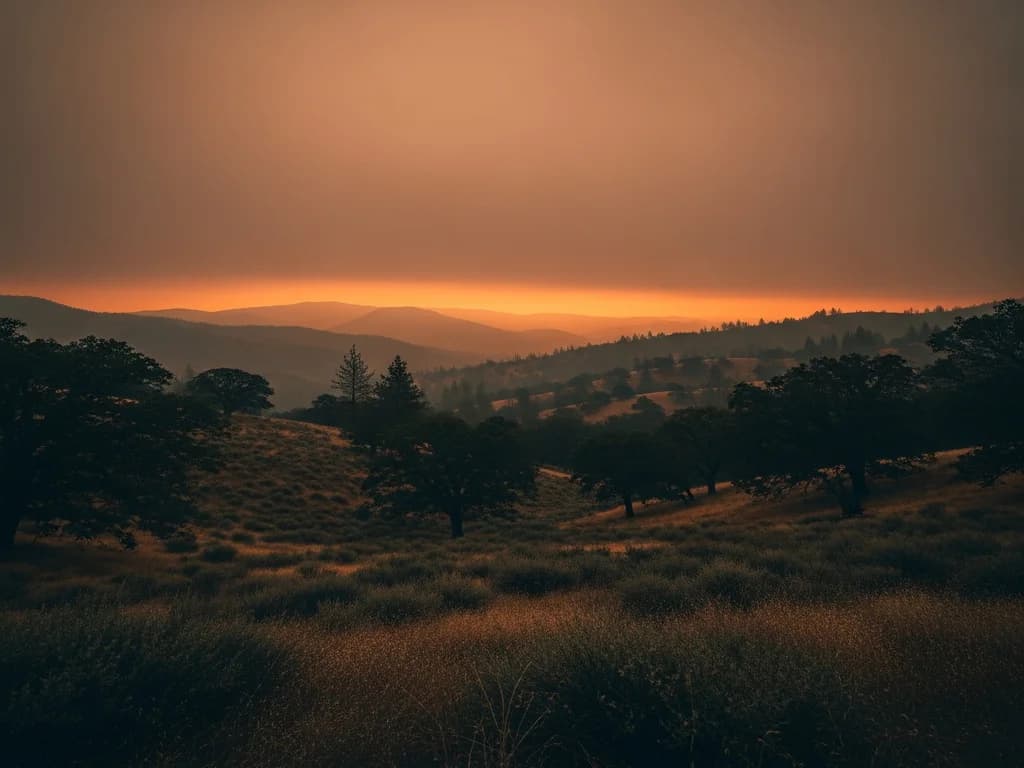
El Dorado County rises from the suburban edge of Sacramento at El Dorado Hills, through the historic Gold Country of Placerville and the forested communities of Pollock Pines and Pollock-area ridges, to the alpine shore of South Lake Tahoe. Across nearly all of it the controlling exterior factor is wildfire, with snow and freeze-thaw added at the higher elevations. For most of the county a re-side is fundamentally a home-hardening project. That reframing matters commercially as well as technically: the question is rarely which color looks best, but which assembly gives the structure the best chance in an ember event.
From suburban WUI to deep forest
El Dorado Hills reads as polished suburbia but its many open-space-adjacent estates carry real ember exposure. Move east and the exposure only intensifies — Cameron Park, Shingle Springs, Placerville, and especially Pollock Pines sit in genuine high-hazard forest. South Lake Tahoe layers extreme snow load on top of high fire risk. We specify accordingly along that entire gradient.
Ember exposure is a whole-envelope problem
Most structures lost in wildland fire are not ignited by a wall of flame arriving at the cladding — they are ignited by embers landing on and entering the building hours before or after the front passes. That is why cladding alone is never the answer here. Vents, eave and soffit assemblies, roof edges, deck-to-wall connections, and the first few feet of ground around the structure all matter, and several of them are cheaper to address than the siding. A homeowner who re-sides in non-combustible material but leaves unscreened vents and a wood deck butted to the wall has bought less protection than the invoice suggests.
Utility, permit, and fire authorities across El Dorado County
El Dorado County has only two incorporated cities — Placerville (the county seat) and South Lake Tahoe — with the vast bulk of the population in large unincorporated communities: El Dorado Hills, Cameron Park, Shingle Springs, Diamond Springs, Pollock Pines, Camino, Somerset, Grizzly Flats, and the west shore Tahoe communities. Placerville and South Lake Tahoe run their own community development departments; everywhere else, permits go through the El Dorado County Development Services Department (or the Tahoe Regional Planning Agency, TRPA, on top of that for parcels within the Tahoe basin — a genuinely distinct regulatory layer). Electric splits between PG&E on the western/foothill side and Liberty Utilities (Sierra region) on the California Tahoe side; gas is PG&E with propane common on rural acreage. Water is fragmented — El Dorado Irrigation District (EID) covers most of the western county, City of Placerville, Grizzly Flats CSD, and South Tahoe Public Utility District (STPUD) on the Tahoe side, alongside private wells on rural parcels. Fire response is Cal Fire Amador-El Dorado Unit (AEU) as the primary wildland responder, alongside El Dorado County Fire, El Dorado Hills Fire, Cameron Park FD, Diamond Springs-El Dorado FPD, Pioneer FPD, Georgetown FPD, and Lake Valley/South Lake Tahoe FD in the basin.
HZ climate and the El Dorado County FHSZ landscape
El Dorado County spans both HZ climate zones: western and foothill communities (El Dorado Hills, Cameron Park, Shingle Springs, Placerville, Diamond Springs, Pollock Pines) are HZ10, while the Tahoe basin (South Lake Tahoe and the west shore) is HZ5. Installing the wrong zone product is a documented warranty misapplication. On the fire side, essentially every parcel outside irrigated El Dorado Hills subdivisions carries High or Very High FHSZ designation under California's 2025 LRA Fire Hazard Severity Zone map, and most surrounding land is in State Responsibility Area or Eldorado National Forest. The 2021 Caldor Fire (221,835 acres, 1,003 structures destroyed) burned directly through Grizzly Flats — a community that lost nearly every home — and pushed into South Lake Tahoe's edge; the 2014 King Fire (97,717 acres) burned Pollock Pines-corridor terrain a decade earlier. On these parcels the 2025 California Wildland-Urban Interface Code governs the exterior wall. Chapter 7A moved into the standalone WUI Code on January 1, 2026.
Climate and exterior risk in El Dorado County
Hot, dry foothill summers with strong UV dominate the western and central county; the eastern Sierra and Tahoe basin bring heavy snow, prolonged freeze-thaw, and intense altitude UV. Across the whole county the dryness that defines the climate also produces the long, severe fire season that sets the exterior agenda. The altitude gradient is steep enough that two homes twenty miles apart in this county face genuinely different assemblies: an El Dorado Hills elevation is fighting UV and ember exposure, while a South Lake Tahoe wall is additionally cycling through freeze-thaw and carrying snow against its lower courses for months. Detailing that is adequate at 800 feet is not automatically adequate at 6,200.
Wildfire exposure in El Dorado County
Exposure ranges from moderate in interior El Dorado Hills to high and extreme across Cameron Park, Shingle Springs, Placerville, Pollock Pines, and the Tahoe basin. Most of the county's populated area is in or adjacent to the wildland-urban interface. Hardening eaves, vents, and ground transitions is integral to every project. Requirements for parcels in mapped fire severity zones come from the current California WUI provisions in Title 24 Part 7, and the applicable details vary by jurisdiction and by whether the work is new construction or a repair — local building officials and, on some projects, a design professional are the right authority on what applies to a specific address. We document what was installed so the homeowner has the paperwork if an insurer asks later.
Snow, freeze, and moisture
Snow and freeze-thaw are major factors in the eastern county and at Tahoe, where clearances and mountain-grade flashing are essential. The western and central foothills are snow-light; moisture countywide is managed through rigorous drainage-plane detailing rather than special materials. At elevation the failure mode that does the most quiet damage is meltwater: snow sits against a wall, melts during the day, refreezes at night, and works its way behind any cladding whose clearances and flashing were specified for a valley climate. Roof-to-wall transitions and deck ledgers are the usual entry points, and they are worth inspecting on any Tahoe-area home that has been through a few winters since its last exterior work.
Recommended materials for El Dorado County
Class A non-combustible fiber cement is the standard recommendation countywide given the pervasive fire exposure. We generally advise against combustible cladding throughout El Dorado County. At Tahoe elevations the same fiber cement is detailed with mountain-grade clearances and freeze-aware flashing — taller ground clearance to stay above the snow line, fasteners and flashing selected for repeated freeze cycles, and joint treatment that tolerates movement. Factory finishes hold up well against foothill and altitude UV alike. Where a homeowner wants wood character in a lower-exposure interior parcel, engineered wood can be discussed, but it narrows the options and we will say so plainly rather than sell it as equivalent.
Cities We Serve
Communities Across El Dorado County
FAQ
El Dorado County — Common Questions
Yes — El Dorado Hills, Cameron Park, Shingle Springs, Placerville, Pollock Pines, and South Lake Tahoe, with specifications tailored to each area's fire and snow exposure.
For most of the county, yes. Exposure ranges from moderate in interior El Dorado Hills to extreme in the forested east and Tahoe basin. Hardened, non-combustible exteriors are the baseline here.
Yes. South Lake Tahoe and the high eastern county require the fire strategy and the snow strategy to be designed together in one assembly.
We cannot promise that, and you should be sceptical of anyone who does — carriers set their own criteria and weigh factors well beyond cladding, including the whole parcel and the surrounding area. What we can do is use materials and assemblies with documented fire performance and give you a clear record of what was installed, which is the information an insurer or inspector will ask for. Whether it changes your premium is the carrier's decision, not ours.
Generally vents and the ground-to-wall transition, because ember entry and ground-level ignition are the most common failure paths and both are far cheaper to address than full cladding replacement. Removing combustible material from the first few feet around the structure costs little and matters a great deal. Cladding replacement is the larger, more durable step, but it is rarely the highest-value first move on a constrained budget.
We generally advise against it countywide given the pervasive wildfire exposure. Non-combustible fiber cement also handles the heat and freeze-thaw, so it involves no durability trade-off.