
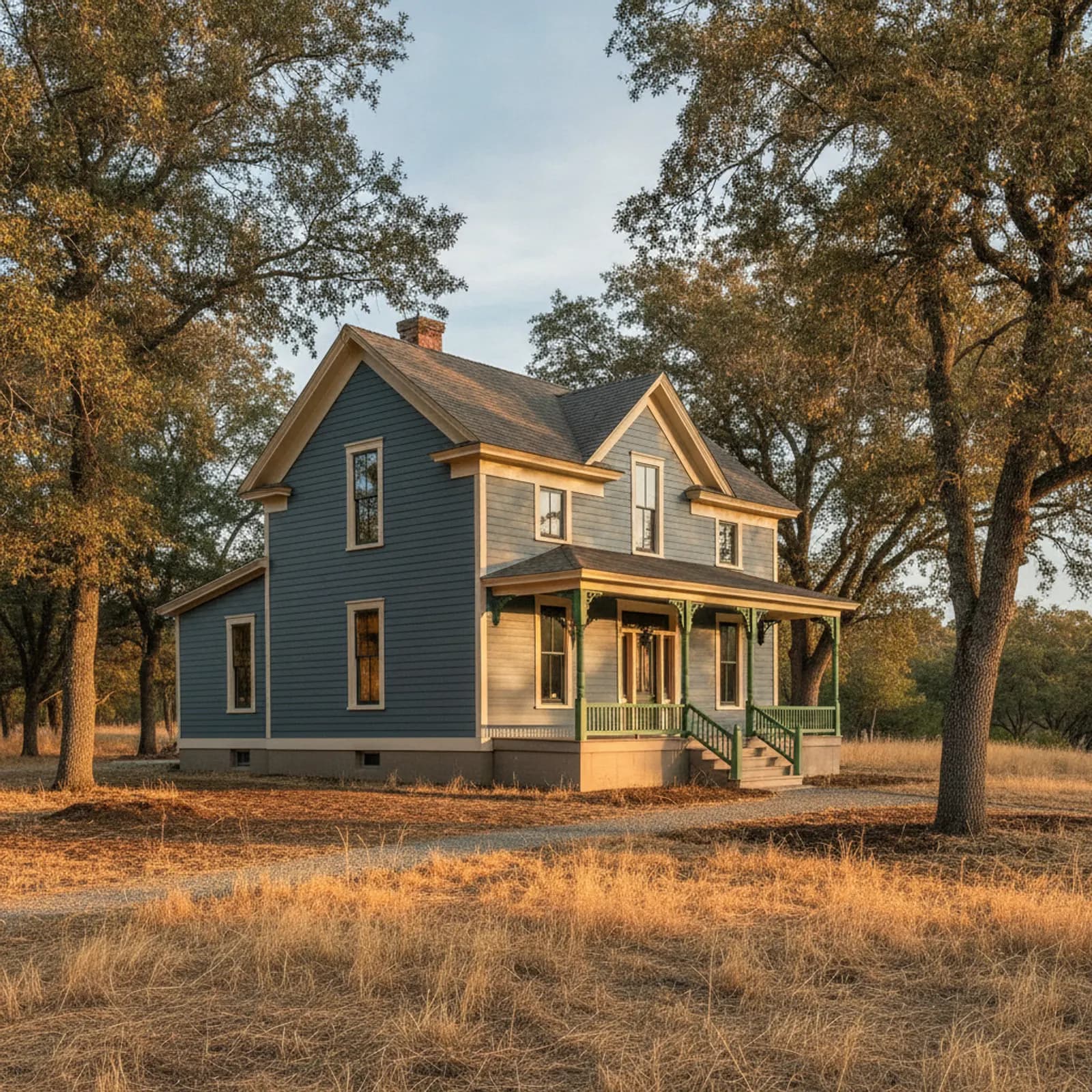
Exterior renovation in Georgetown
Georgetown sits high on the Georgetown Divide, the long forested ridge between the Middle Fork and South Fork of the American River, well above and northeast of Placerville. It is a genuine historic Gold Rush town — a preserved main street and surrounding rural-residential acreage threaded deep into mixed conifer forest. That setting defines everything about exterior work here: Georgetown is real wildland-urban-interface country, where homes sit directly against continuous timber fuel and the fire conversation is not a precaution but the central design problem. Our Georgetown work starts from non-combustible cladding and hardened detailing, then layers in respect for the town's authentic historic character where it matters.
Fire first, history second
On the Divide the order is not negotiable: the fire strategy leads and everything else arranges around it. We specify Class A non-combustible fiber cement and make eaves, soffits, vents, and ground-to-wall transitions the heart of the job, because on a forested ridge that is where embers and contact flame find a way in. The historic character is met by the same wall, not at its expense — period-appropriate profiles hold the reveal and trim of the core's Gold Rush homes, so a faithful streetscape and a hardened envelope come out of one specification rather than a compromise between them.
Considering an exterior project in Georgetown?
Georgetown housing and architecture
Georgetown's stock runs from genuinely historic Gold Rush Divide homes along the old main street — wood-clad, ornamented, close-set — to older farmhouses and a broad belt of rural-residential acreage scattered through the forest, much of it on wells and propane. A large share of these homes still wear combustible wood lap, board-and-batten, or T1-11 set right against the conifer canopy, which makes them among the highest-leverage hardening candidates anywhere in the county. On the historic core homes we match period reveal and trim so a non-combustible re-side stays faithful; on the forested acreage homes we treat the whole envelope as the project rather than the wall field alone.
Georgetown's Divide climate
The Georgetown Divide runs hotter, drier, and longer in its fire season than the towns below it, with the surrounding mixed-conifer forest curing into deep, continuous fuel by midsummer — the single controlling stressor for any exterior here. Elevation tempers the peak summer heat somewhat compared to the valley floor, but UV is intense at the ridge and the seasonal dryness is severe. Winters bring rain and occasional light snow rather than the heavy alpine pack seen at Tahoe, so the assembly must still shed water cleanly at its edges and ground transitions through the wet months. On the Divide, however, fire is the design driver and everything else is detailing arranged around it, which is why we let the fire strategy lead the whole spec.
Hardening deep-WUI homes on the Divide
Georgetown is deep wildland-urban-interface terrain, and its wildfire exposure is high — forested ridge country where embers travel and homes sit against continuous timber. We specify Class A non-combustible fiber cement and treat the ignition-prone points as the heart of the job: eaves, soffits, vents, and ground-to-wall transitions, where ember entry and contact-flame on the Divide concentrate. Because so many Georgetown homes still wear combustible wood or T1-11 against the canopy, re-cladding in a non-combustible wall is one of the most consequential hardening steps a Divide property can take. We document materials and assemblies to support defensible-space, insurability, and ember-resistant retrofit conversations.
Recommended materials for Georgetown
Non-combustible fiber cement — James Hardie systems included — is the clear recommendation for Georgetown given its deep-forest fire exposure. We use period-appropriate profiles on the historic core homes and durable, straightforward profiles on the rural-acreage and farmhouse stock. We advise against combustible cladding on the Divide as a matter of basic exposure, and there is no durability cost to choosing the safer wall: fiber cement also handles the ridge's intense UV, severe summer dryness, and winter wet-and-freeze edges. On every count that matters here, the non-combustible choice is the sound one.
What an exterior project costs in Georgetown
Georgetown projects carry the full fire-detailing scope plus genuine remote-access realities: long forested rural drives, sloped Divide parcels, and tree-tight sites complicate staging and delivery in ways the valley does not. Older historic and farmhouse homes routinely reveal substrate, sheathing, and dry-rot issues once decades-old wood comes off. Period-matching trim adds detail work on the core homes, while protecting existing defensible-space clearing factors into the site plan. We assess all of this on site and provide a written, itemized estimate; on the Divide the hardening scope is the core value of the project rather than an optional add, and your written estimate governs the work.
The historic Georgetown core
Along Georgetown's old main street the homes carry authentic Gold Rush-era detail — narrow-reveal lap, ornamented trim, steep gables — set close together and highly visible to anyone passing through the historic core. On these we match the original profile and proportions so a non-combustible re-side reinforces the historic streetscape instead of erasing it under a contemporary wall. Hardening these homes without flattening their character is the balance the core demands, and it is genuinely achievable with careful profile selection and trim work. We treat these visible core homes as the ones that carry the town's identity, and we scope them so the result reads as preservation rather than replacement.
Forested rural-residential acreage
The bulk of Georgetown's homes sit on rural-residential acreage threaded into the Divide's conifer forest, many still clad in combustible wood or T1-11 against the trees. These are the highest-leverage hardening candidates around Georgetown, and the work nearly always means treating the whole envelope — cladding, eaves, soffits, vents, and ground transitions — as one system. The exposure on these parcels is serious, and we scope them with that fully in view.
Remote access and seasonal timing
Long forested drives, sloped lots, and narrow Divide roads shape how we stage and supply a Georgetown job, and protecting existing defensible-space clearing is part of the plan from the start. The wet, sometimes snowy winters narrow the practical working window, so we schedule the drainage-plane and flashing work into the dry season when it can be set and dried-in properly. We walk that timing with you on site so the plan fits your parcel and your access rather than a generic calendar.
Georgetown is unincorporated: county permits, GDPUD water, HZ10 + Very-High FHSZ
Georgetown is not a city. It is an unincorporated Gold Rush community in El Dorado County on the Georgetown Divide at roughly 2,600 feet. Building permits go through El Dorado County's Community Development Agency in Placerville. Electric and gas are PG&E, and Georgetown is in one of the highest-PSPS corridors in California. Water is supplied by the Georgetown Divide Public Utility District (GDPUD), a customer-owned public agency. Fire response is Georgetown Fire Protection District alongside CAL FIRE for surrounding Eldorado National Forest SRA. Georgetown is in James Hardie's HZ10 zone; installing HZ5 is a documented warranty misapplication. Essentially all of the Georgetown Divide sits in Very High FHSZ or State Responsibility Area, and the 2025 California Wildland-Urban Interface Code governs the exterior wall on nearly every re-side. Chapter 7A moved into the standalone WUI Code on January 1, 2026.
Our process in Georgetown
- Step 1
Consultation
We listen to your goals and assess your home on site — exposure, substrate, and architecture.
- Step 2
Design & Proposal
A clear written proposal with the right system specified for your climate and a transparent scope.
- Step 3
Expert Installation
Trained crews install to manufacturer best practices with careful weather-management detailing.
- Step 4
Walkthrough & Support
A final walkthrough, full cleanup, and a clear written record of the scope completed — work we stand behind.
On the Georgetown Divide the goal is an exterior genuinely hardened against deep-forest fire while staying true to an authentic Gold Rush town. We design for both, and we scope every Georgetown project on site so the spec matches your home's character, your forested terrain, and your real exposure.
FAQ
Georgetown — Common Questions
High. Georgetown sits in genuine deep-WUI forest on the Georgetown Divide, with homes against continuous timber fuel, which is why non-combustible cladding and hardened detailing are our baseline.
Re-cladding combustible wood or T1-11 in non-combustible fiber cement is one of the most consequential hardening steps a Georgetown Divide property can take.
Yes. We use Class A non-combustible fiber cement in period-appropriate profiles and trim so a Divide core home stays faithful while gaining real fire protection.
It affects staging and delivery, which is why we walk access on site and plan supply and scheduling around your forested parcel rather than assuming valley conditions.
Occasional light snow and real winter rain, far less than alpine Tahoe, so we include sound drainage-plane and flashing detailing alongside the fire strategy.
We advise against it on the Divide as a matter of basic exposure. Fiber cement also handles the UV and freeze edges, so it is the sound choice on every count.
Yes. We document the materials and assemblies used so the exterior work complements defensible-space programs and supports insurability conversations.
A correctly installed fiber cement system commonly performs 30+ years on the Divide while materially reducing ignition risk across that lifespan.
Explore
Exterior Services
Helpful Exterior Guides