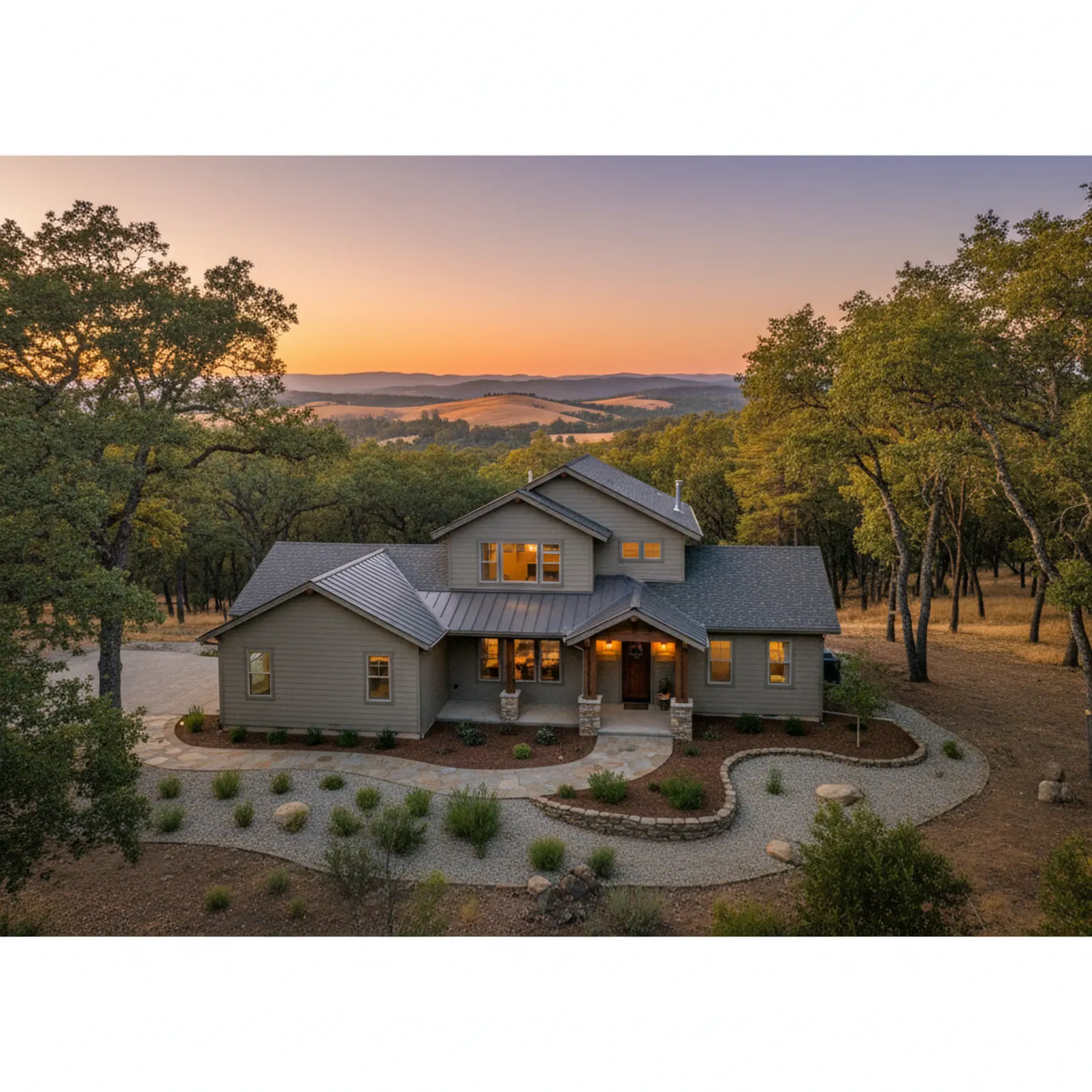
Exterior renovation in Cameron Park
Cameron Park sits in the western El Dorado County foothills between the suburban edge of El Dorado Hills and the Gold Country of Placerville, occupying a distinctive middle ground: more rural and wooded than its neighbor to the west, less remote than Pollock Pines, with a housing stock that spans foothill subdivisions, rural-residential acreage, oak-woodland custom homes, and the well-known Cameron Park Airpark community built around its private airstrip. For most homeowners here a re-side is, first and foremost, an opportunity to harden the home against the area's genuine wildfire exposure while refreshing an exterior that is usually well past its original cladding's service life.
Fire first, then the heat
The spec here follows from the exposure in a clear order. Non-combustibility is the backbone, because oak canopy, outbuildings, and curing grassland put real embers on these lots; the hot, high-UV summer is the durability layer on top of that. A non-combustible fiber cement wall with hardened eaves, vents, and ground transitions answers both at once, so we scope fire detailing as the load-bearing part of the project and let fade-resistant finishes and clean trim ride along with it rather than competing for the budget.
Considering an exterior project in Cameron Park?
Cameron Park housing and architecture
Cameron Park's stock includes 1970s-through-1990s foothill subdivisions on oak-and-pine lots, rural-residential and acreage homes on larger parcels, the airpark's aviation-oriented properties with their hangar-and-home configurations, and a range of oak-woodland custom homes. Many of these still wear original wood, T1-11, or hardboard siding — combustible cladding that is exactly what we want to replace in this environment. The generous lot sizes and oak canopy mean the exterior strategy has to consider how the whole site behaves in an ember event, not just the wall field, and the mix of tract and custom means the trim and profile package gets matched to each home rather than standardized.
Cameron Park's foothill climate
Cameron Park summers are hot and very dry with elevated UV relative to the valley floor, and winters are mild with occasional light frost. The dryness and heat that make the area pleasant also drive the long, severe fire season that dominates exterior strategy from late spring through fall. That combination — sustained high UV plus the fuel-curing dryness — is the controlling stressor here, and it forces two things in the spec at once: fade-resistant, heat-stable finishes for the sun load, and a fully non-combustible assembly for the fire season. We treat fire performance as the non-negotiable backbone and the heat detailing as the durability layer on top of it.
Hardening a Cameron Park home
For Cameron Park homes we specify Class A non-combustible fiber cement and harden the ignition-prone points — eaves, vents, and the ground-to-wall transition — with particular attention to parcels where heavy oak canopy and outbuildings increase ember loading. Re-cladding combustible wood or T1-11 in non-combustible material is one of the highest-value hardening actions available to a Cameron Park property, and we coordinate it with soffit and fascia detailing so the assembly behaves as one hardened system. On airpark and acreage parcels we extend that thinking to how detached structures sit relative to the main house, because the site, not just the wall, is what faces the ember wind.
Recommended materials for Cameron Park
Non-combustible fiber cement is the clear recommendation for Cameron Park given the wildfire exposure. We generally advise against combustible cladding here regardless of aesthetic preference, since fiber cement also delivers the heat-and-UV durability the foothill climate requires and therefore involves no real performance trade-off. Durable factory finishes hold color against the high sun load far better than field paint, and robust flashing and a properly detailed weather-resistive barrier round out a spec built for the rural-residential setting. The result is one material choice that answers both the fire season and the long hot summer.
What an exterior project costs in Cameron Park
Cameron Park projects carry the standard drivers — home size, stories, trim and profile complexity, substrate condition, and window integration — plus fire-detailing scope and, frequently, larger structures, outbuildings, and rural site-access considerations that valley jobs don't have. Acreage and airpark properties can mean longer material runs and more staging room but also more structure to clad. Older foothill subdivision homes routinely reveal dry rot behind original wood or T1-11 at demolition. We assess on site and provide a written, itemized estimate; the fire-detailing scope in Cameron Park is not where we recommend economizing.
The airpark and acreage parcels
The Cameron Park Airpark community is genuinely distinctive — aviation-oriented properties where homes and hangars share the parcel and front the taxiways. These sites carry more outbuilding square footage to consider in an ember event and benefit from the same hardened, non-combustible specification applied across the whole built footprint. On the surrounding rural-residential acreage, generous setbacks and oak canopy change both the staging plan and the way we think about defensible spacing between structures, which we factor into how we scope the exterior.
Older subdivisions ready for a re-side
The 1970s-to-1990s foothill subdivisions make up a large share of Cameron Park's homes, and many are now well past their original siding's service life. T1-11, hardboard, and early wood products on these tract homes show the classic foothill failure pattern — swelling at the joints, delamination, and faded, chalked paint on the sun-facing walls. These are strong re-side candidates where a non-combustible system simultaneously retires the combustible cladding, fixes the weathering, and modernizes the look of an aging subdivision elevation.
Foothill fire-zone realities
Cameron Park's wooded, oak-woodland setting places much of the community in real foothill fire country, and we won't overstate or understate that — we scope the genuine exposure on each parcel rather than apply a blanket assumption. Where a property's canopy, slope, and outbuildings raise the ember risk, the hardening scope reflects it; where the setting is more open, the spec stays focused on the heat-and-UV durability the climate demands. Either way, the written estimate governs what we actually do.
Cameron Park is unincorporated: county permits, EID water, Cameron Park CSD
Cameron Park is not a city. It is an unincorporated community — a Census-Designated Place — in El Dorado County. Building permits, planning review, and code enforcement all run through the El Dorado County Community Development Agency in Placerville. Electric and gas are PG&E, and Cameron Park is in high-PSPS territory. Water and sewer are supplied by the El Dorado Irrigation District (EID), a customer-owned public agency. The Cameron Park Community Services District (CSD) manages parks, recreation, and community services. Fire response is El Dorado Hills Fire Department or Rescue Fire Protection District depending on address, alongside CAL FIRE's Amador-El Dorado Unit for surrounding SRA. We flag county, utility, CSD, and fire items at the estimate stage.
HZ10 and Very-High FHSZ in Cameron Park's foothill setting
Cameron Park is in James Hardie's HZ10 climate zone; installing HZ5 is a documented warranty misapplication. On the fire side, essentially all of Cameron Park sits in the wooded oak-and-pine foothills below the higher Sierra with Moderate to Very High FHSZ under California's 2025 LRA Fire Hazard Severity Zone map. Because Cameron Park is unincorporated, the county map governs directly. The 2025 California Wildland-Urban Interface Code governs the exterior wall on designated parcels. The code frame changed on January 1, 2026, when Chapter 7A moved into the standalone WUI Code.
Our process in Cameron Park
- Step 1
Consultation
We listen to your goals and assess your home on site — exposure, substrate, and architecture.
- Step 2
Design & Proposal
A clear written proposal with the right system specified for your climate and a transparent scope.
- Step 3
Expert Installation
Trained crews install to manufacturer best practices with careful weather-management detailing.
- Step 4
Walkthrough & Support
A final walkthrough, full cleanup, and a clear written record of the scope completed — work we stand behind.
Cameron Park's wooded foothill character comes with real fire exposure, and a hardened, well-detailed exterior is how we protect it. We scope every Cameron Park project on site — main house, outbuildings, and access alike — and put the fire-and-finish strategy in a written, itemized estimate before work starts.
FAQ
Cameron Park — Common Questions
In most cases yes. Cameron Park's foothill, oak-woodland setting carries high wildfire exposure, and re-cladding combustible siding in non-combustible material is one of the highest-value hardening actions available.
Class A non-combustible fiber cement with fire-aware eave and vent detailing — it covers both the wildfire exposure and the hot, dry foothill climate with no durability trade-off.
Yes — including the airpark's aviation-oriented properties, with the same hardened non-combustible specification appropriate to the area.
We generally advise against combustible cladding given the wildfire exposure. Fiber cement carries no durability penalty here, so the safer material is also the sound one.
Yes — hot, dry, high-UV foothill summers. We specify durable finishes and detailing for that heat alongside the fire backbone.
Yes. On Cameron Park properties we consider how the whole site — heavy oak canopy and accessory structures — behaves in an ember event, not just the main house.
Yes, while keeping the spec non-combustible and appropriate to the foothill, rural-residential character of the area.
A correctly installed fiber cement system commonly performs 30+ years in Cameron Park's climate while materially reducing ignition risk over that lifespan.
Explore