
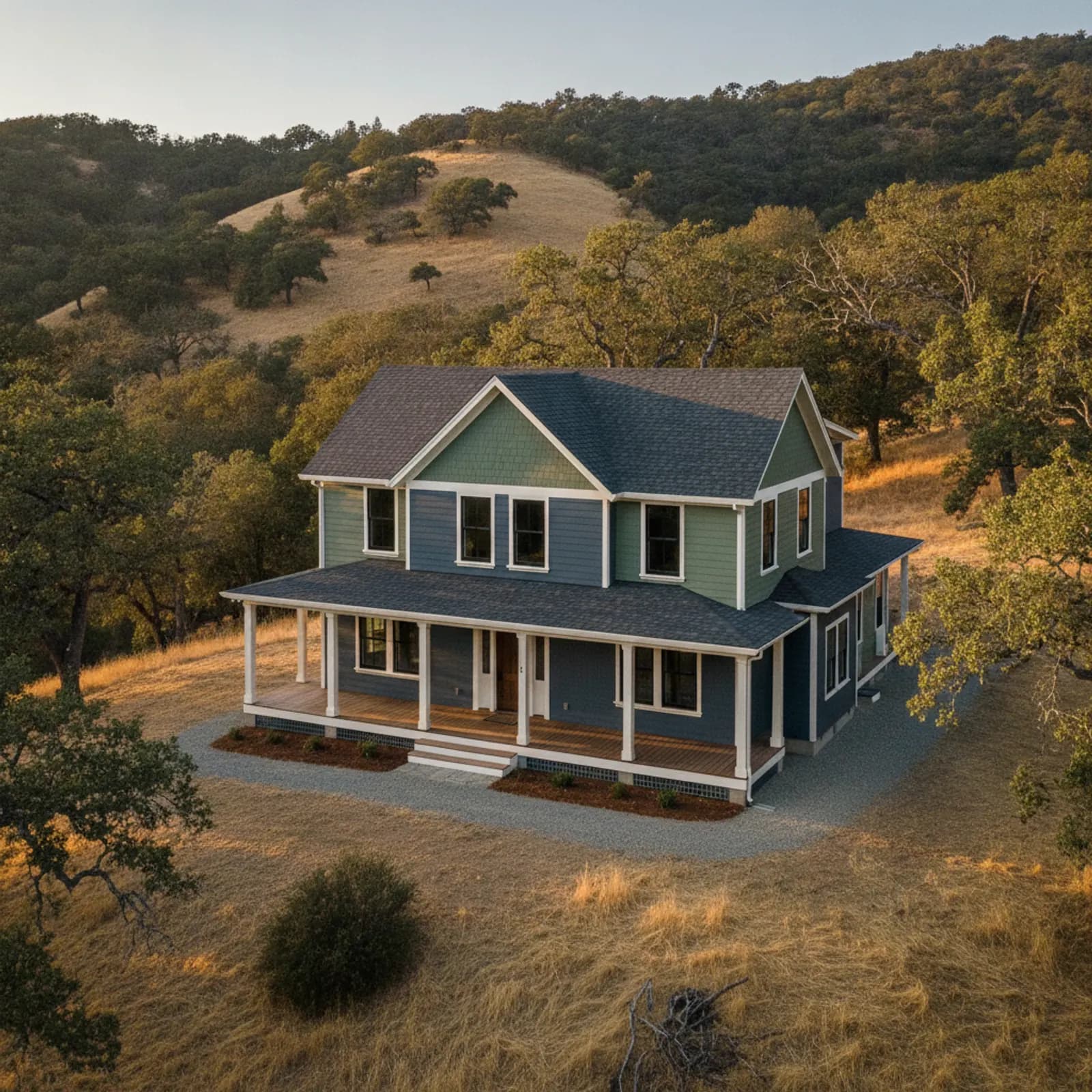
Fiber Cement Siding in Georgetown
Georgetown sits high on the Divide, a historic Gold Rush town ringed by continuous mixed-conifer forest with limited access in and out. That is about as deep into wildland-urban interface terrain as El Dorado County gets, and it means the cladding conversation starts from non-combustible and works outward rather than weighing materials on their merits.
The complication is that Georgetown's historic core deserves better than a generic solution. Fiber cement is the material that lets a period building keep its profile and proportion while the wall itself stops being fuel.
Deep WUI changes the starting point
In most markets a re-side begins with a comparison of materials. On the Divide it does not — continuous conifer fuel on all sides, a single main route in and out, and the response times that come with distance mean a home here is likely to face fire with whatever protection it already has. Fiber cement is non-combustible with a Class A flame-spread rating, so the wall stops adding fuel. That is the floor rather than the achievement. What sits above it is the detailing, and what sits above that is the fuel arrangement on the property, which on a forested Divide parcel is doing more than any building product.
Historic profiles without a combustible wall
Georgetown's historic core carries wood-clad buildings with genuine period character — narrow profiles, specific reveals, trim proportions that belong to their era. Fiber cement reproduces those convincingly when the widths and reveal are specified deliberately rather than defaulted, so the trade is not between fire performance and authenticity. The design work is where the effort goes: getting the board width and casing proportion right on a historic elevation matters more to the result than which manufacturer supplied the board. Where a property carries historic designation, review considerations beyond a standard permit may apply, and that is a question for the county and the relevant body rather than for us to assert.
Off-grid and rural-acreage realities
A meaningful share of Divide properties are off-grid or on well and propane, on long private drives, sometimes with limited turnaround for a delivery truck. That affects a project before it affects the specification: material delivery, staging, power for tools, water availability, and debris removal all need working out in advance rather than on the first morning. Snow and winter weather add a scheduling constraint that lower-elevation towns do not have. These are practical questions worth putting to any contractor bidding a Divide property, because a crew that has not worked up here tends to discover them expensively.
The honest limits on a forested Divide parcel
We would rather set expectations properly than sell confidence. A hardened envelope improves a home's odds and eliminates the failure modes an owner controls — combustible cladding, open eaves, unscreened vents, debris at the base of the wall. It does not make a house fireproof, and on the Divide the variables that most determine an outcome in a severe fire are fuel, weather, terrain, and available suppression resources, none of which a building product addresses. The most valuable work on many parcels up here is vegetation management rather than construction, and we will say so even when it means we are not the ones doing it.
Why this matters in Georgetown
- Specified for Sierra Foothills conditions
- fiber cement as the recommended system
- Correctly detailed weather-resistive barrier and flashing
- Installed by a crew with 20 years combined experience
Recommended systems for Georgetown
- fiber cement
- James Hardie
- LP SmartSide
Fiber Cement Siding for Georgetown homes
The full fiber cement siding approach — materials, weather-resistive detailing, and the manufacturer standards we install to — is covered on the main service page, then specified for Georgetown's conditions on this one.
Our Georgetown process
- Step 1
Consultation
We listen to your goals and assess your home on site — exposure, substrate, and architecture.
- Step 2
Design & Proposal
A clear written proposal with the right system specified for your climate and a transparent scope.
- Step 3
Expert Installation
Trained crews install to manufacturer best practices with careful weather-management detailing.
- Step 4
Walkthrough & Support
A final walkthrough, full cleanup, and a clear written record of the scope completed — work we stand behind.
FAQ
Fiber Cement Siding in Georgetown — FAQ
Continuous conifer fuel on all sides, limited access in and out, and the response times that come with distance. A home on the Divide is likely to face fire with whatever protection it already has, so non-combustible cladding is the starting point rather than one option among several.
Yes, if the board width, reveal, and trim proportion are specified deliberately rather than defaulted. Those variables decide whether a period elevation reads correctly far more than the manufacturer does. Note that a designated property may carry review beyond a standard permit — worth establishing with the county before design.
It changes the logistics more than the specification. Delivery access on long private drives, staging, power for tools, water, and debris removal all need working out in advance, and winter weather adds a scheduling constraint. Worth asking any bidder how they handle a Divide property — crews that have not worked up here tend to find out expensively.
It improves the odds and removes the failure modes you control, which is genuinely worth doing. It does not make a house fireproof. In a severe fire the outcome is driven mostly by fuel, weather, terrain, and available suppression — and on many Divide parcels the highest-value work is vegetation management rather than construction. We will tell you when that is the case.
Keep Exploring
More for Georgetown homeowners
More in Georgetown
Other exterior services in Georgetown
Nearby Service Areas
Fiber Cement Siding near Georgetown
Back to
El Dorado County & Georgetown
Helpful Exterior Guides