
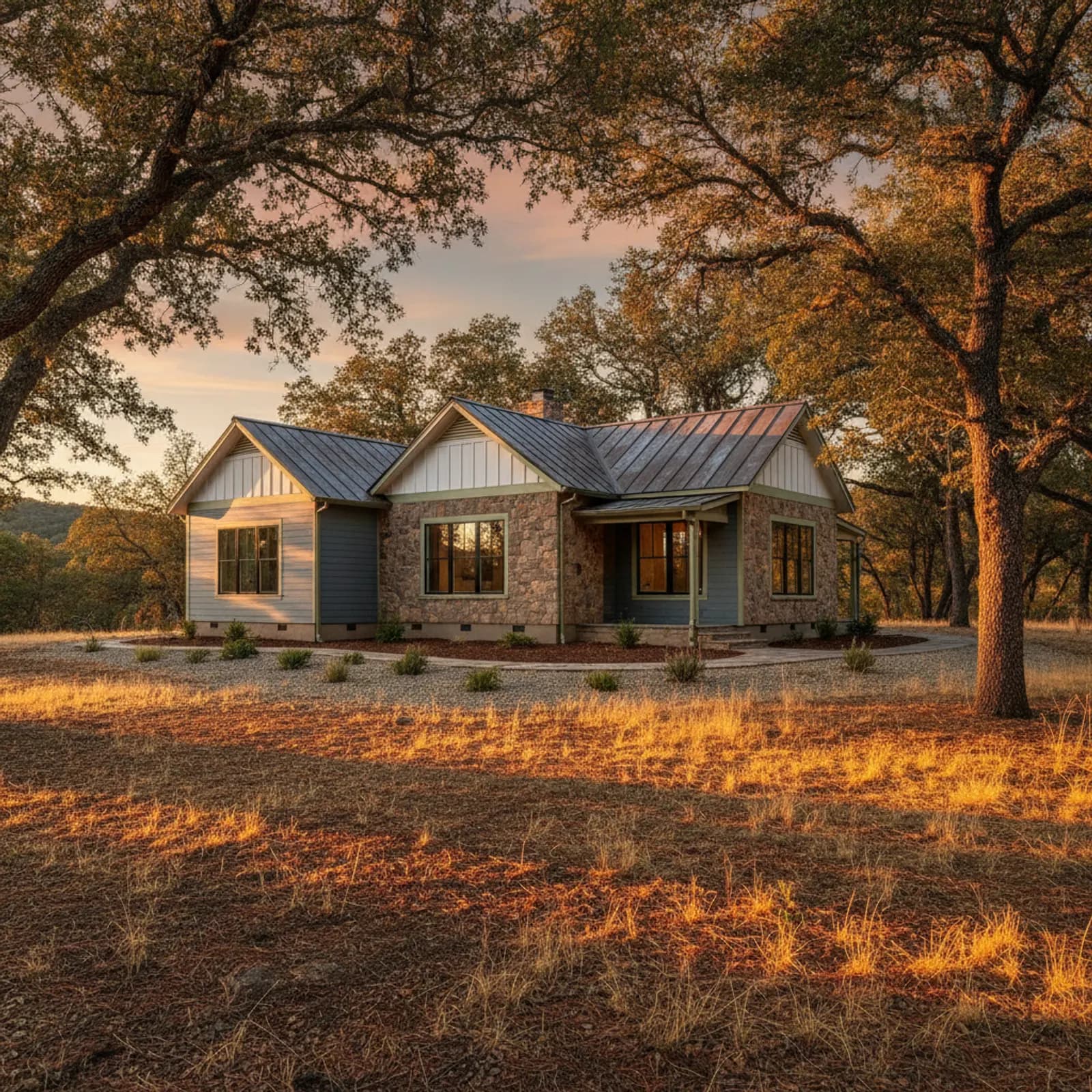
Window Replacement in Georgetown
On the Georgetown Divide, windows sit at the intersection of three requirements that pull in different directions: they have to hold heat through cold winters at elevation, resist radiant heat as part of a wildland-interface envelope, and — in the historic core — look right on a building whose proportions were set in the nineteenth century.
Most of the Divide's older homes and cabins are losing on the first two, and a fair number of well-meaning replacements have compromised the third.
Glazing as hardening on a forested parcel
Windows are the component of a wall most likely to fail first under radiant heat, and a failed window is a direct opening for embers and flame into the interior — which is why wildland-interface construction treats glazing as part of the hardened envelope and generally favours multi-pane and tempered assemblies. On a Divide property ringed by conifer, that is not an abstract consideration. Whether a specific parcel and scope trigger a code requirement is El Dorado County's determination and not something a contractor should assert. Our position is that on a deep-WUI parcel the glazing belongs in the hardening conversation whatever the permit says.
Cold nights at elevation put U-factor first
Georgetown's elevation gives it genuinely cold winter nights, and that reverses the usual Northern California priority. U-factor — how readily heat escapes through the whole assembly — governs the heating season and matters more here than on the valley floor, where solar heat gain dominates. Solar heat gain coefficient still applies on sun-exposed elevations, but for most Divide homes the heating side is the expensive one. Older single-pane glass and failed dual-pane units are the usual finding, and the practical symptom owners describe is rooms that never quite hold heat overnight.
Historic openings deserve design attention
In Georgetown's historic core, a window replacement is a design decision before it is a performance one. Sash proportion, muntin pattern, frame depth, and how the unit sits within the opening are what make a period elevation read correctly, and a modern unit installed without regard to those can undo the character of a whole facade. Depending on a property's designation there may be review considerations beyond a standard permit — a question for the county and the applicable body rather than for us. It is worth establishing before selection, because it genuinely constrains the options.
The flashing behind the unit
Whatever else is decided, the flashing at the opening determines whether the wall behind it stays dry. A sill pan beneath the window, head flashing above it lapped correctly against the weather barrier, and jamb detailing that maintains the layering are what keep water out — and on older Divide construction those details are often minimal or absent entirely. A replacement that installs a better unit into an unimproved opening has bought thermal performance and left the water problem in place. When siding is coming off anyway, that is the affordable moment to rebuild the opening properly.
Why this matters in Georgetown
- Specified for Sierra Foothills conditions
- fiber cement as the recommended system
- Correctly detailed weather-resistive barrier and flashing
- Installed by a crew with 20 years combined experience
Recommended systems for Georgetown
- fiber cement
- James Hardie
- LP SmartSide
Window Replacement for Georgetown homes
The full window replacement approach — materials, weather-resistive detailing, and the manufacturer standards we install to — is covered on the main service page, then specified for Georgetown's conditions on this one.
Our Georgetown process
- Step 1
Consultation
We listen to your goals and assess your home on site — exposure, substrate, and architecture.
- Step 2
Design & Proposal
A clear written proposal with the right system specified for your climate and a transparent scope.
- Step 3
Expert Installation
Trained crews install to manufacturer best practices with careful weather-management detailing.
- Step 4
Walkthrough & Support
A final walkthrough, full cleanup, and a clear written record of the scope completed — work we stand behind.
FAQ
Window Replacement in Georgetown — FAQ
U-factor, for most homes here. Georgetown's elevation brings genuinely cold winter nights, so the heating side is the expensive one — which reverses the usual Northern California priority. Solar heat gain coefficient still applies on sun-exposed elevations, but it is generally the secondary concern up here.
Yes. Glass is the component of a wall most likely to fail first under radiant heat, and a failed window is a direct opening for embers and flame. On a parcel ringed by conifer that matters, which is why wildland-interface construction favours multi-pane and tempered assemblies.
Often, but treat it as a design decision first. Sash proportion, muntin pattern, and frame depth are what make a period facade read correctly, and the wrong unit can undo a whole elevation. Depending on designation there may be review beyond a standard permit, which is worth establishing with the county before you select anything.
If both are due, yes, and the reason is the flashing. With the cladding off, the sill pan and head flashing can be rebuilt properly — which on older Divide construction is usually needed and is not practical to retrofit later without opening the wall again.
Keep Exploring
More for Georgetown homeowners
More in Georgetown
Other exterior services in Georgetown
Nearby Service Areas
Window Replacement near Georgetown
Back to
El Dorado County & Georgetown
Helpful Exterior Guides