Two counties wearing one name
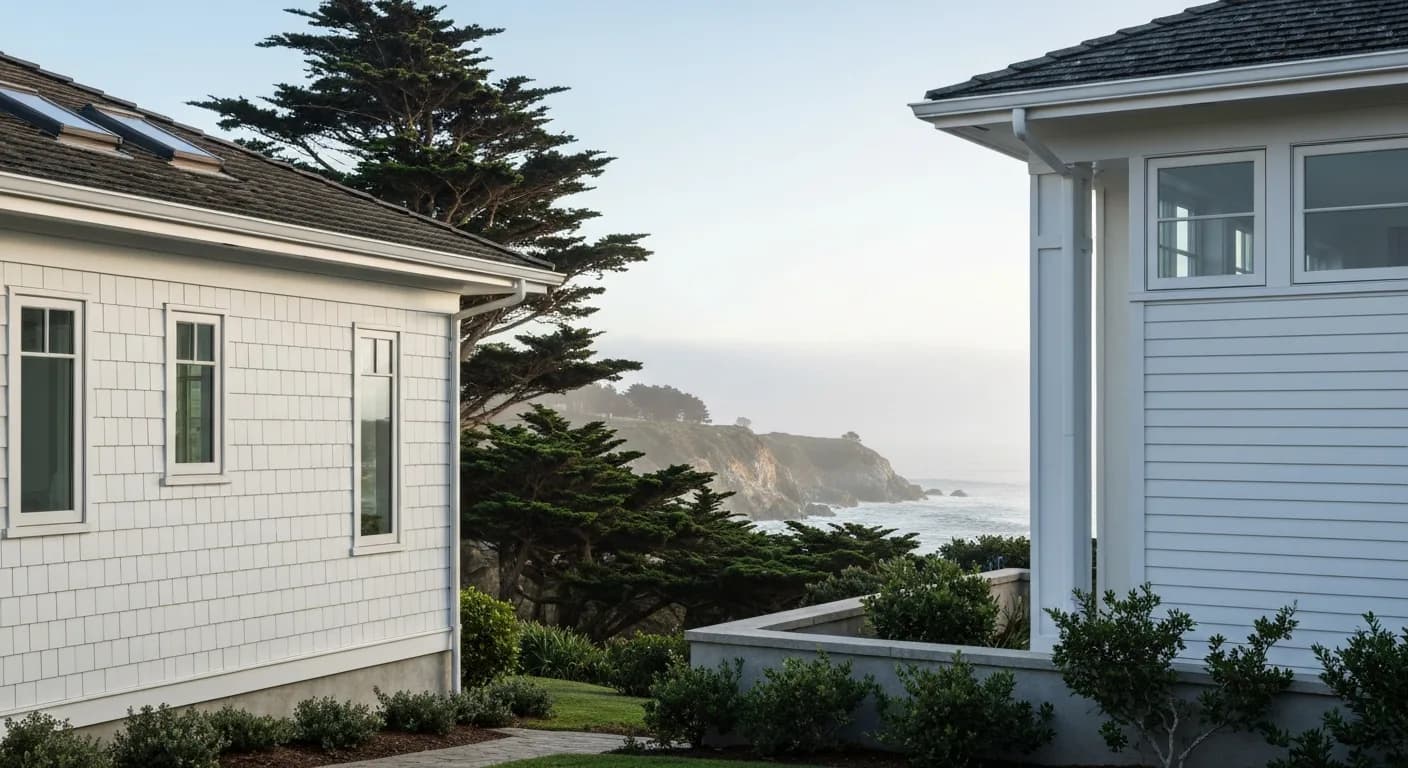
Practically speaking, Monterey County is two different jobs. On the Peninsula — Monterey, Pacific Grove, Carmel, Pebble Beach — the ocean runs the show: daily fog, wind-driven salt, and marine moisture that corrode fasteners and flashing long before the siding itself wears out. Drive inland to Salinas and the valley and the problem flips to heat, sun, and dust. Same county, opposite failure modes. A wall built right for Carmel would be over-built and over-priced in Salinas, and a valley spec would rot out on the coast. So we start every Monterey job by asking which of the two environments the address actually lives in — then build for that one.
A demanding remodel market
The Peninsula is one of the most design-conscious exterior markets in the state — Carmel cottages, Pacific Grove Victorians, Pebble Beach estates, and historic downtown Monterey homes where the finished exterior has to read as architecture, not a patch job. Inland, Salinas and the valley towns are a working-home market: re-cladding aging stucco, T1-11, and tired wood with something that survives the heat and stops needing a repaint every few years. We work across both — high-character coastal re-sides and durable, no-drama valley exteriors — and scope each on its own terms.
Utility, permit, and fire authorities across Monterey County
Monterey County has twelve incorporated cities — Salinas (the county seat), Monterey, Pacific Grove, Carmel-by-the-Sea, Marina, Seaside, Sand City, Del Rey Oaks, Soledad, Gonzales, Greenfield, and King City — plus large unincorporated communities including Pebble Beach, Carmel Highlands, Big Sur, Carmel Valley, Prunedale, Castroville, Moss Landing, Pajaro, Las Lomas, and Chualar. Each city runs its own community development department; unincorporated permits go through Monterey County Housing and Community Development. Electric and gas are PG&E throughout. Water is unusually complex: California-American Water (Cal-Am) serves the Monterey Peninsula under state Cease-and-Desist orders that constrain new connection permits; Marina Coast Water District, Seaside Groundwater Basin, City of Salinas / Cal Water Salinas, Castroville CSD, and various valley municipal utilities cover the rest; the Salinas Valley Basin Groundwater Sustainability Agency (SVBGSA) manages regional groundwater. Fire response is Cal Fire San Benito-Monterey Unit (BEU) as the primary wildland responder, alongside Monterey County Regional Fire District (Mid-Coast + Cypress divisions), Salinas Fire, Monterey Fire, Pacific Grove Fire, Carmel Fire (contracted to Monterey Fire), Marina Fire, Seaside Fire (also to Monterey Fire), North County FPD, Aromas Tri-County FPD, and Big Sur Volunteer FD along the coast. California Coastal Commission overlays coastal parcels.
HZ10 climate and the Monterey County FHSZ landscape
Every parcel in Monterey County is in James Hardie's HZ10 climate zone despite the Peninsula's coastal fog — installing HZ5 anywhere in the county is a documented warranty misapplication. On the fire side, the coastal Peninsula (Pacific Grove, Carmel-by-the-Sea, downtown Monterey) and irrigated Salinas Valley floor (Salinas, Gonzales, Soledad, Greenfield, King City) sit in Low or Moderate FHSZ territory under California's 2025 LRA Fire Hazard Severity Zone map, while wooded and foothill parcels — Carmel Highlands, upper Carmel Valley/Cachagua, the Santa Lucia Range, western Gabilan Range — carry High to Very High designations. The 2016 Soberanes Fire (132,127 acres in the Los Padres and Big Sur) and 2020 River Fire (SCU Lightning Complex, 396,624 acres — California's second-largest recorded fire) are the corridor's reference events. On designated hillside parcels the 2025 California Wildland-Urban Interface Code governs the exterior wall. Chapter 7A moved into the standalone WUI Code on January 1, 2026.
Climate and exterior risk in Monterey County
The Monterey Peninsula runs cool, foggy, and intensely salt-laden — Pacific Grove, Carmel, Pebble Beach, and the Monterey waterfront take onshore wind straight off open ocean, and the airborne salt that comes with it is chemically aggressive in a way inland homeowners rarely appreciate. Salt accumulates on surfaces between rains, stays wet longer than fresh water because it is hygroscopic, and attacks metal continuously rather than seasonally. Add near-permanent summer fog that suppresses solar drying and you get assemblies that live wet. Inland the picture reverses completely: the Salinas Valley bakes through long, dry, high-UV summers with agricultural dust in the air, and finish degradation rather than corrosion becomes the failure mode. Salt-air corrosion and moisture govern the coast; heat governs inland. The transition is compressed enough that Marina and Castroville sit in a genuine blend zone.
Wildfire exposure in Monterey County
Exposure varies more than the county's coastal reputation suggests. The Peninsula and the valley floor carry low exposure. The wooded inland fringes — Carmel Valley, the Santa Lucia foothills, and the rural-residential margins toward Big Sur — carry meaningfully more, and the county's record supports that: the 2020 River and Carmel Fires burned in the inland hills and Carmel Valley area, and the Big Sur coast has a long history of fires in steep, difficult terrain. On those wooded and foothill parcels non-combustible cladding with fire-aware detailing at eaves, vents, and ground transitions is advisable, and the steep terrain and limited access that characterize the area are part of why. Elsewhere in the county, non-combustible cladding is a sound low-regret choice rather than a necessity. As always, hardening is one layer of a whole-property strategy and not a guarantee.
Salt air and marine layer
Snow is not a factor anywhere in Monterey County. The Peninsula's persistent fog and salt air make corrosion-aware fastening and drying-capable assemblies first-order: the wall has to shed bulk water, tolerate continuous salt deposition, and still dry despite very little solar help. That means a drained and vented cavity, properly lapped weather-resistive barrier, kickout flashings, head flashing over openings, and bottom-course clearances that stay clear of soil and landscaping. Inland the Salinas Valley is drier and heat-driven, but the winter rainy season still demands a correctly integrated drainage plane — the difference is that an inland detailing error takes years to show up, while a Peninsula detailing error shows up fast.
Recommended materials for Monterey County
Non-combustible fiber cement with corrosion-resistant fastening and rigorous drainage detailing is the recommendation on the Peninsula, and the fastening is not a footnote — stainless or appropriately rated fasteners, corrosion-resistant flashings, and hardware selected for a marine environment are what determine whether the assembly reaches its expected service life. On a Peninsula home the cladding routinely outlasts the metal holding it up if the metal was chosen carelessly. Inland, fade-resistant fiber cement with factory-applied finishes is the right call, because in the Salinas Valley the finish is the component under attack. In both zones a drained, drying-capable cavity behind the cladding does more for longevity than any brand decision. On Carmel cottages, Pacific Grove Victorians, and historic downtown Monterey homes, narrow period-appropriate profiles and carefully proportioned trim carry the architectural expectation.
Cities We Serve
Communities Across Monterey County
FAQ
Monterey County — Common Questions
Among the most aggressive in California. We specify corrosion-resistant fastening and drying-capable non-combustible assemblies for peninsula homes.
Yes — the Salinas Valley is hot and dry, so the spec there is heat- and fade-focused rather than salt- and moisture-focused.
Generally yes — it performs poorly against persistent salt air and moisture compared to a properly fastened non-combustible fiber cement assembly.
Because salt attacks metal continuously, and on a coastal home the cladding will often outlast the fasteners and flashings holding it up if those were chosen without regard to the environment. Corrosion-resistant hardware is a specification decision on the Peninsula, not an upgrade — and it is one of the few places where the invisible components determine the visible outcome.
There is no clean line. Marina and Castroville sit in a genuine blend zone where onshore wind still carries salt but heat and UV are climbing. We treat those addresses individually rather than assigning them to one regime, which usually means coastal-grade hardware with an inland-grade finish specification.
On the Peninsula and the valley floor, not meaningfully. On the wooded inland fringes — Carmel Valley, the Santa Lucia foothills, the rural margins toward Big Sur — yes. The 2020 River and Carmel Fires burned in that inland terrain, and the combination of steep ground and limited access is part of why hardened detailing is warranted on those parcels.
Salt is hygroscopic, so it pulls moisture from the air and keeps surfaces damp longer than rain alone would. It also conducts, which accelerates the electrochemical process behind metal corrosion. The practical effect is that a coastal wall spends far more time wet than the rainfall figures suggest, and its metal components degrade year-round rather than seasonally.