
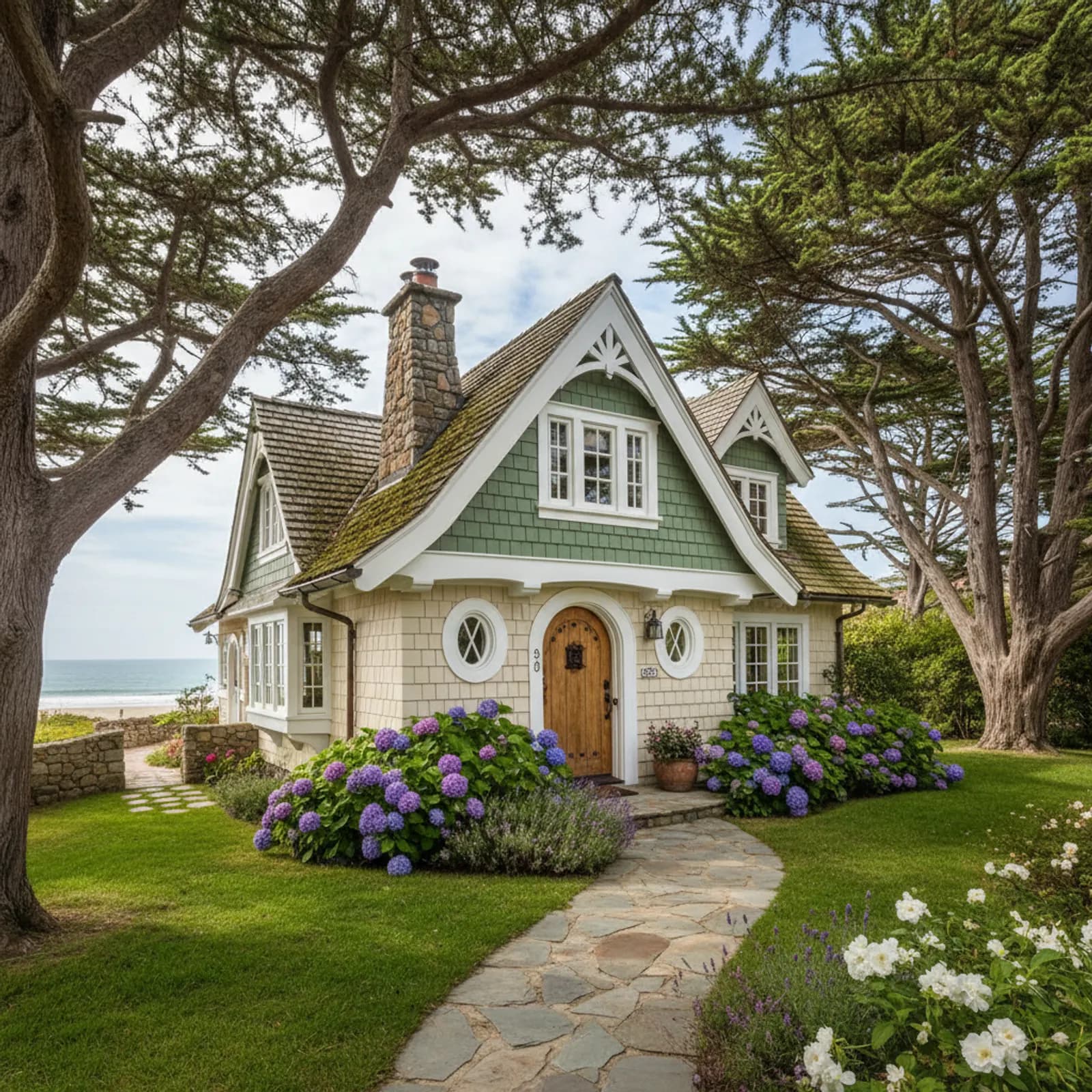
Exterior renovation in Carmel-by-the-Sea
Carmel-by-the-Sea is a square-mile village of storybook cottages, hand-built Comstock fairy-tale homes, and oceanfront estates tucked among cypress and Monterey pine — and one of the most aesthetically scrutinized towns in California. It is also one of the most corrosive places in the state to own a wall. The village sits directly on the Pacific, so every exterior decision gets pulled two ways at once: it has to look right to a town that watches closely, and it has to hold up to salt and fog that punish anything built to an ordinary inland spec.
The half of the job you never see
Carmel's looks get the attention, but the part that decides how long a re-side actually lasts is hidden inside the wall. This close to open ocean, the village takes near-constant salt and wind-driven fog, and salt goes after metal first — fasteners, flashing, and trim corrode and bleed long before a good cladding wears out. On the wooded interior streets toward the Mission, deep tree canopy keeps walls damp and slow to dry, which only compounds it. So the spec that matters most here is the one nobody sees: stainless or hot-dip fastening, a real drainage plane that lets the wall dry between fog cycles, and corrosion-aware flashing at every penetration. Get the visible profile right and the hidden metallurgy wrong, and a beautiful Carmel re-side still fails early.
Considering an exterior project in Carmel-by-the-Sea?
Carmel housing and architecture
Carmel's character runs on detail: storybook and Comstock-style cottages, board-and-batten and shingle homes, and premium oceanfront and Carmel Point estates, all set among cypress and pine. Because the village's design review reads profile, texture, and trim closely, the cladding has to be exact — right shingle exposure, right trim depth, right reveals — while the assembly underneath still has to survive direct ocean salt and fog. Getting one without the other is not an option on these streets.
Carmel's coastal climate
Carmel sits right on the Pacific, so the ocean runs the spec, not the sun. It is cool, foggy, and intensely salt-laden essentially year-round, with wind-driven marine moisture rolling straight in off the water — heat is a non-issue here. Salt-driven corrosion and persistent damp govern every decision, hardest on the seaward elevations and the oceanfront blocks toward Carmel Point that take spray head-on.
Recommended materials for Carmel
Non-combustible fiber cement with corrosion-resistant stainless or hot-dip fastening over a rigorously detailed, drying-capable drainage plane is the core recommendation — character-sensitive profiles that satisfy Carmel's design expectations while withstanding direct ocean salt and moisture far better than wood.
What an exterior project costs in Carmel
Carmel projects carry premium scope: design-review-sensitive detailing, tight village access, corrosion- and moisture-management, and substantial substrate and rot discovery on older salt-exposed cottages. Pricing is established in a detailed written proposal after an on-site assessment; craftsmanship and corrosion engineering carry the value.
Navigating Carmel's design review and permitting
Few California towns scrutinize an exterior the way Carmel-by-the-Sea does. Most projects route through the city's Design Review Board, and changes visible from the street invite close reading of profile, color, and material against the village's forest-cottage character. Even a re-side that looks like a simple swap can trigger review when it alters shingle exposure, trim depth, or paint tone. We plan for that from the first site visit: documenting the existing assembly, preparing material samples and elevations that match what the board expects to see, and sequencing demolition so a home is never left open during a long approval window. Carmel also lacks street addresses in the traditional sense, which complicates deliveries, inspections, and dumpster placement. Many lots sit on narrow, tree-lined lanes with protected Monterey cypress and pine that cannot be disturbed for staging. Building the permit package and the access plan together, rather than treating them as separate problems, keeps a Carmel exterior project moving without forcing a homeowner to choose between schedule and the town's strict aesthetic expectations.
Neighborhood realities from the village core to Carmel Point
Carmel reads as one village, but exterior work changes block by block. In the densely built core near Ocean Avenue, cottages sit close together on small lots, so scaffolding, lifts, and material drops have to be choreographed around neighbors and constant pedestrian traffic. Homes here are often the storybook and Comstock-style cottages where shingle pattern and hand-detailed trim define the whole look, and matching that craft matters more than speed. Move toward Carmel Point and the oceanfront, and the priority shifts: these estates take the full force of salt spray and wind-driven fog, so wall assemblies, flashing, and corrosion-resistant fasteners carry the project. The wooded interior streets toward the Mission add a third reality, where deep tree canopy keeps siding damp and slow to dry, raising the bar on ventilation and back-priming. Knowing which Carmel you are working in shapes everything from the staging footprint to the detailing we recommend. We walk each property in its specific setting before quoting, because a one-size approach does not survive this peninsula or this town's expectations.
Cal-Am Water, PG&E, and Carmel's design-review culture
Working exteriors in Carmel-by-the-Sea coordinates with a few local authorities that shape scope early. Electric and gas both come from PG&E. Water is supplied by California American Water (Cal-Am), a private investor-owned utility that serves the Monterey Peninsula under a long-standing regulatory framework tied to the Carmel River water rights, so meter and backflow coordination goes through Cal-Am rather than the city. Fire response is the Monterey Fire Department under a shared-services agreement with the city. On the permit side, the City of Carmel-by-the-Sea's Community Planning and Building Department handles building permits, and essentially all visible exterior work in the village runs through the Historic Resources Board and the Design Review process — Carmel has one of the most involved design-review cultures in California. Material samples, elevation drawings, color chips, and mockups are standard submittal items, and reviews can take multiple hearings. Carmel is also famously without street addresses (parcels use lot-and-block or descriptive locations), which affects deliveries and inspections. We flag utility, permit, and heritage items at the very first estimate visit rather than at the wall.
HZ10 and Carmel's low-fire, high-salt reality
Carmel is in James Hardie's HZ10 climate zone despite the fog and salt — HZ10 covers the West's mild coastal areas — and HZ10 is the correct spec for a Carmel home; installing HZ5 is a documented warranty misapplication. On the fire side, the village square-mile and coastal blocks sit outside high-hazard FHSZ territory under California's 2025 LRA Fire Hazard Severity Zone map — the salt-and-moisture spec is the entire game there. The wooded inland fringes climbing toward the Carmel Valley entrance and the Del Monte Forest can pick up Moderate designations, and Cachagua and unincorporated inland Monterey County territory carries Very High designations, but those are outside Carmel-by-the-Sea proper. The code frame did change on January 1, 2026, when Chapter 7A was deleted from the Building Code and its provisions moved into the standalone WUI Code, but on a village re-side the corrosion, moisture, and design-review work is where the real focus lives.
Our process in Carmel-by-the-Sea
- Step 1
Consultation
We listen to your goals and assess your home on site — exposure, substrate, and architecture.
- Step 2
Design & Proposal
A clear written proposal with the right system specified for your climate and a transparent scope.
- Step 3
Expert Installation
Trained crews install to manufacturer best practices with careful weather-management detailing.
- Step 4
Walkthrough & Support
A final walkthrough, full cleanup, and a clear written record of the scope completed — work we stand behind.
Carmel rewards an exterior that honors the village's storied character and is engineered for direct ocean salt and fog.
FAQ
Carmel-by-the-Sea — Common Questions
Character-sensitive non-combustible fiber cement profiles with corrosion-resistant fastening over a rigorously detailed drainage plane — they satisfy Carmel's design expectations and withstand the direct ocean salt.
Among the harshest in California — Carmel sits directly on the Pacific. We specify corrosion-resistant fastening and drying-capable assemblies for these homes.
Yes — fiber cement comes in shingle, board-and-batten, and lap profiles that can be detailed to honor Carmel's storybook and cottage character; we plan with the village's review expectations in mind.
Salt-driven corrosion and trapped marine moisture in poorly detailed assemblies — not the cladding alone. Corrosion-aware, drying-capable detailing fixes the cause.
Against constant direct salt and fog it degrades quickly compared to a properly fastened, character-matched fiber cement assembly.
Low for the coastal village; wooded inland and Carmel Valley fringes carry more. We specify per address.
Yes — access and staging in the dense village are real scope factors, planned and estimated explicitly.
A correctly detailed, corrosion-aware fiber cement system commonly performs 30+ years even in Carmel's direct-ocean environment.
Explore
Exterior Services
Helpful Exterior Guides