
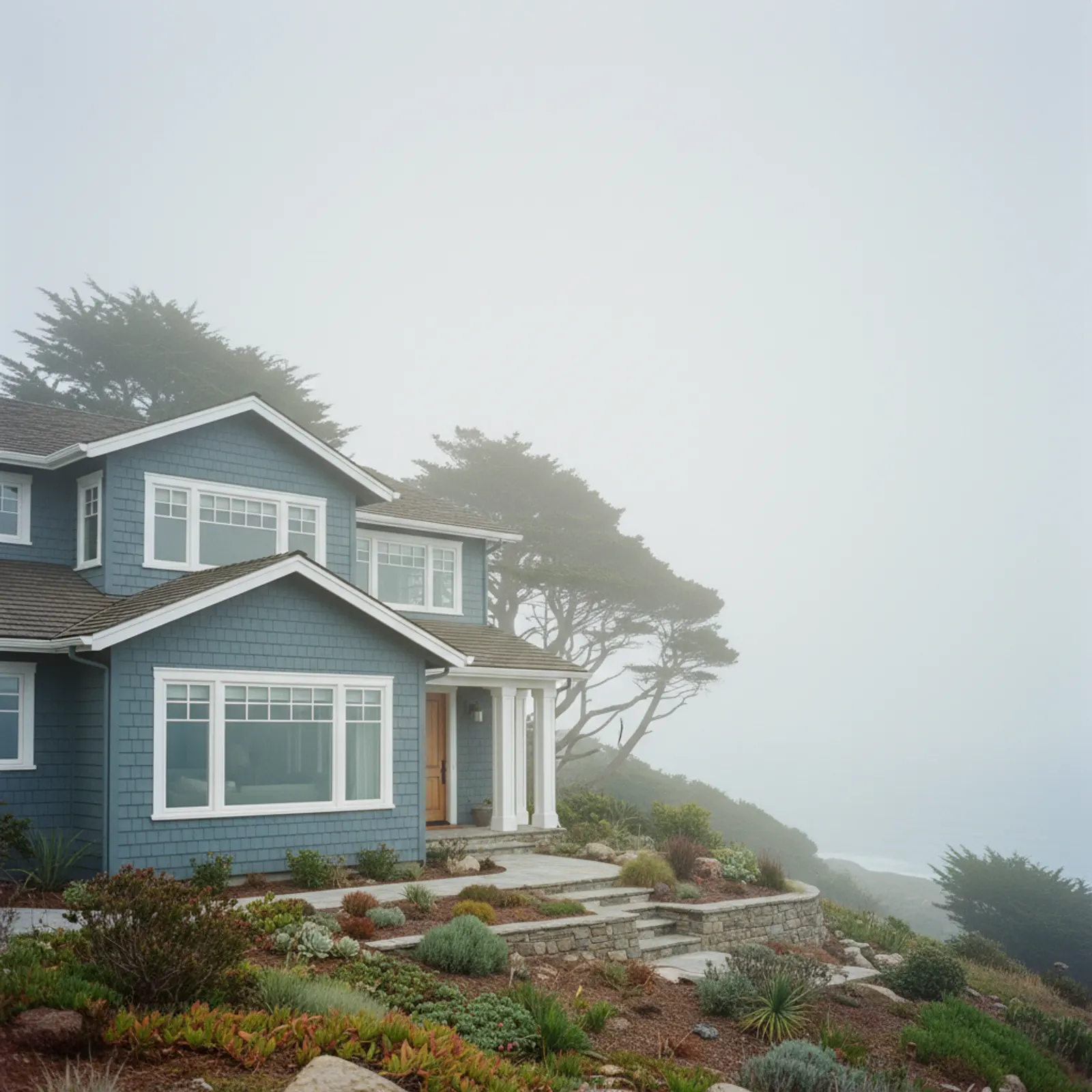
Exterior renovation in Monterey
Monterey's homes face among the most aggressive salt air in the state, and that single fact reshapes how an exterior should be built here. From the historic adobes and older homes near the downtown waterfront to the coastal hillside neighborhoods that climb above the bay, Monterey cladding fights constant marine moisture, fog, and wind-driven salt. A re-side here is less about heat and more about building a wall and a fastening system that can survive a corrosive coastal environment for the long term.
Why Monterey demands a coastal spec
On the Monterey Peninsula the marine layer is a near-daily presence, and salt deposition reaches well past the immediate shoreline. Homes that were sided with standard fasteners or moisture-trapping materials show it fast: corroded nail heads, staining streaks, swollen substrate, and failing finishes on the windward elevations. The honest answer for most Monterey homes is a non-combustible, corrosion-resistant, drainage-detailed system designed specifically for salt-air service rather than a generic inland package.
Considering an exterior project in Monterey?
Monterey housing and architecture
Monterey's housing spans centuries — from historic adobes and early downtown homes near the old waterfront and Cannery Row area, through mid-century cottages and bungalows, to coastal hillside homes that step up the slopes above the bay. The older downtown stock carries real architectural character that re-side work must respect with appropriate profiles and trim, while the hillside homes present steeper sites and wind-and-fog-exposed elevations. Across all of it, the maritime setting argues for clean, durable cladding and crisp trim that reads well in flat coastal light rather than busy detailing that just collects more salt and moisture.
Built for Monterey's salt air and marine moisture
Monterey's controlling stressor is the coastal marine environment: persistent fog, high humidity, wind-driven rain, and above all airborne salt that corrodes metal and degrades finishes. Heat is barely a factor; moisture and corrosion are everything. That forces a specific spec — corrosion-resistant fastening so connections don't bleed and fail, a rigorous drainage plane so the wall sheds and dries between fog cycles, and a cladding that doesn't swell or rot when it stays damp for days. On the windward sides especially, the assembly has to be built to manage salt, not just shed rain.
Recommended materials for Monterey
Non-combustible fiber cement with corrosion-resistant fastening and rigorous drainage detailing is the right system for Monterey. Fiber cement won't rot or swell in sustained marine damp the way wood-based cladding does, and pairing it with corrosion-resistant fasteners and flashing addresses the salt-air failure mode that ends most coastal re-sides early. A well-built drainage plane behind the boards lets the wall dry between foggy mornings, and durable factory finishes hold up far better than field coatings in the constant moisture and UV-diffused glare off the bay.
What an exterior project costs in Monterey
Monterey pricing is driven less by raw size and more by site and exposure. Coastal hillside lots can mean steep access and difficult staging; older downtown homes can carry architectural detail and historic-character considerations; and the salt environment justifies upgraded corrosion-resistant fastening and flashing that a valley job wouldn't need. Substrate condition behind decades of marine exposure is often the biggest variable, since hidden moisture damage is common here. We provide a written, scoped estimate after an on-site assessment so the coastal-specific scope is clear and bids compare on substance.
Downtown and waterfront-area homes
The older homes near downtown Monterey and the historic waterfront carry genuine character — adobes, early cottages, and period homes — and sit closest to the most aggressive salt exposure. Re-side work here has to balance durability with respect for the home's era, choosing profiles and trim that suit the architecture while upgrading the assembly to a true coastal spec. We scope these individually because substrate condition behind older cladding this close to the bay is rarely what the surface suggests.
Coastal hillside neighborhoods
Homes that climb the slopes above the bay trade easy access for views and added wind-and-fog exposure on their seaward elevations. Steep sites mean staging, scaffolding, and material handling all take more planning, and the windward walls take the brunt of salt and driven rain. We plan access and sequencing for these lots up front and concentrate the most rigorous corrosion and drainage detailing on the elevations that face the weather hardest.
Salt-air detailing is the whole job
More than anywhere inland, a Monterey re-side lives or dies on the details a homeowner never sees. Corrosion-resistant fasteners and flashing, generous bottom-course clearances, properly lapped drainage planes, and sealed penetrations do more for the wall's lifespan than the visible siding does. We treat the water-and-salt management layer as the real product and the cladding as the finish over it, because that is the assembly the coast actually tests.
Cal-Am Water, Monterey Fire, and Coastal Commission oversight
Working exteriors in the City of Monterey coordinates with a few local authorities. Electric and gas both come from PG&E. Water is supplied by California American Water (Cal-Am), the same private investor-owned utility serving the Monterey Peninsula under the long-standing Carmel River regulatory framework, so meter and backflow coordination goes through Cal-Am rather than the city. Fire response is the Monterey Fire Department. On the permit side, the City of Monterey Community Planning and Development Department handles building permits, and Coastal Zone parcels along the waterfront additionally fall under California Coastal Commission oversight — a coastal-development permit can be triggered by scope that alters the building envelope. The city also protects designated historic resources through its Historic Preservation program, and the historic adobes and Cannery Row area carry particular character considerations. We flag utility, permit, coastal, and heritage items at the estimate stage rather than at the wall.
HZ10 climate and Monterey's low-fire, high-salt reality
Monterey is in James Hardie's HZ10 climate zone despite the fog and salt — HZ10 covers the West's mild coastal areas — and HZ10 is the correct spec for a Monterey home; installing HZ5 is a documented warranty misapplication. On the fire side, the peninsula's exposed coastal setting keeps most of the city outside high-hazard FHSZ territory under California's 2025 LRA Fire Hazard Severity Zone map — the salt-and-corrosion spec is the entire game there. The wooded hills toward Highway 68 and the inland fringes can carry Moderate designations. The code frame changed on January 1, 2026, when Chapter 7A moved into the standalone WUI Code, but on a Monterey re-side the corrosion, moisture, and drainage-plane work carries the day.
Our process in Monterey
- Step 1
Consultation
We listen to your goals and assess your home on site — exposure, substrate, and architecture.
- Step 2
Design & Proposal
A clear written proposal with the right system specified for your climate and a transparent scope.
- Step 3
Expert Installation
Trained crews install to manufacturer best practices with careful weather-management detailing.
- Step 4
Walkthrough & Support
A final walkthrough, full cleanup, and a clear written record of the scope completed — work we stand behind.
Monterey's coastal homes — from the historic downtown waterfront to the hillside neighborhoods above the bay — need a non-combustible, corrosion-resistant, drainage-detailed system built specifically for salt air, not a generic re-side. We scope every Monterey project on site, because access, architecture, and substrate condition vary sharply across the peninsula. The goal is a wall and fastening system that stands up to fog, salt, and marine moisture for the long term.
FAQ
Monterey — Common Questions
Among the most aggressive in California. It corrodes standard fasteners, flashing, and trim, so we specify corrosion-resistant fastening and drying-capable assemblies for peninsula homes.
Non-combustible fiber cement with stainless or hot-dip corrosion-resistant fastening over a rigorously detailed drainage plane.
Almost always salt-driven corrosion and trapped marine moisture in poorly detailed assemblies — not the cladding alone. Corrosion-aware detailing fixes the root cause.
Against near-constant salt air and fog it underperforms a properly fastened, drying-capable fiber cement assembly; we generally steer away from it here.
Yes — period-appropriate profiles and trim in non-combustible fiber cement preserve character while solving the corrosion and moisture problem.
Low for the coastal city itself; wooded inland and Carmel Valley fringes carry more consideration, where we add fire-aware detailing.
When feasible, yes — correct flashing integration is especially important in a constant high-moisture marine environment.
A correctly detailed, corrosion-aware fiber cement system commonly performs 30+ years even in Monterey's salt-and-fog environment.
Explore
Exterior Services
Helpful Exterior Guides