
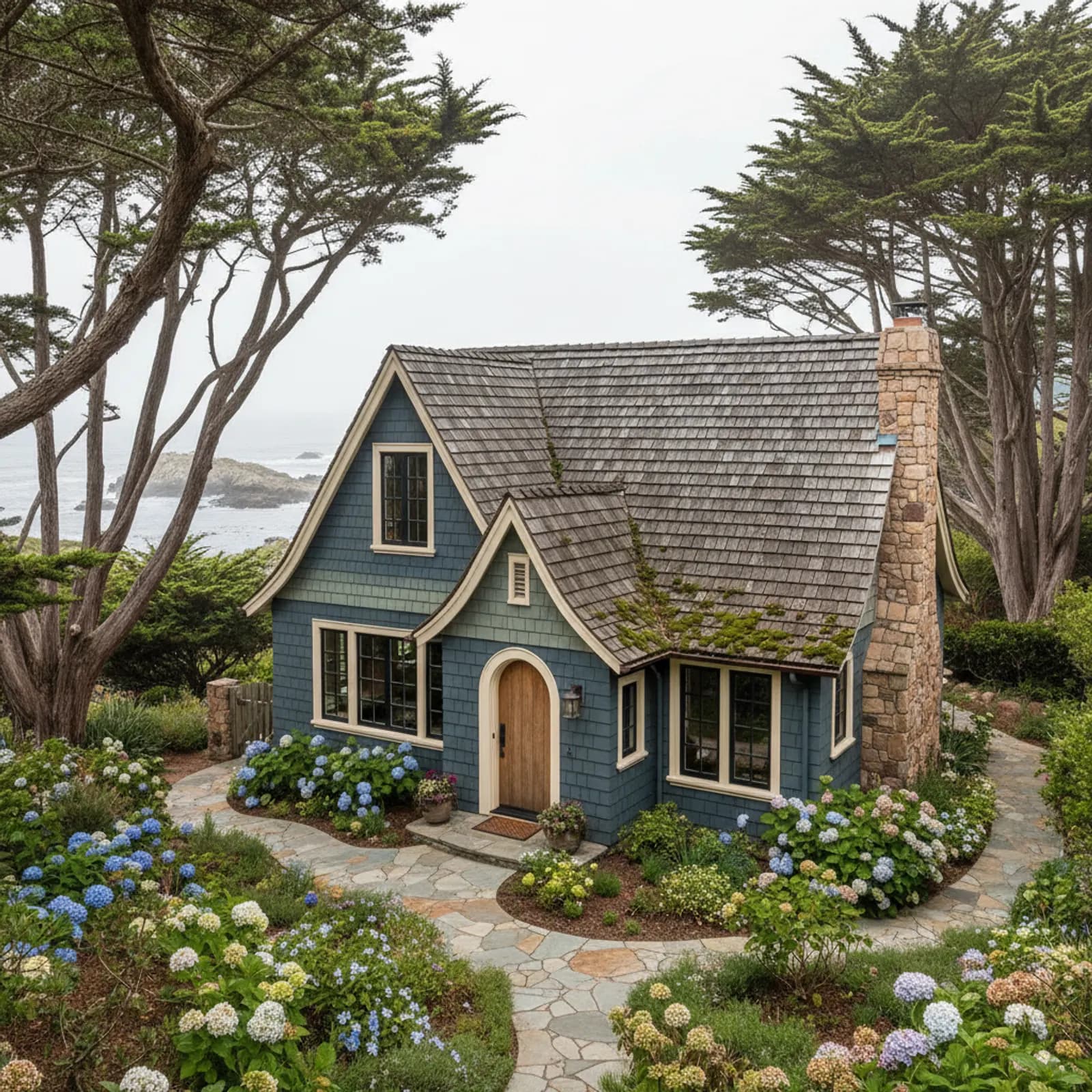
Fiber Cement Siding in Carmel-by-the-Sea
Fiber cement is the core Carmel recommendation because it is inert to open-Pacific salt, resists deep-shade canopy damp far better than the original cottage wood, and can be detailed faithfully enough for the village's strict storybook character when executed correctly.
Character-faithful in a strict village
On Carmel cottages we specify fiber cement in faithful Comstock-era and coastal-cottage profiles with hand-detailed trim and irregular forms so a re-side reads as a sympathetic restoration consistent with the design ordinance.
Inert to salt; detailed for shade-damp
Fiber cement shrugs off the open-Pacific salt; longevity depends on corrosion-rated metal over a rigorous drying-capable plane that copes with the canopy's deep, slow-drying shade.
Engineering that stays invisible
Carmel's brief is design-character compliance first; the salt-and-pine-shade durability must do its work without showing. We detail corrosion-rated metal and a drying plane beneath replicated cottage profiles so the protection is real but the house still reads as the village expects.
Fasteners and flashings that survive the marine layer
On the open-Pacific side of Carmel-by-the-Sea, the panels themselves are the least of the corrosion problem; the metal that holds and protects them is what fails first. Within a few blocks of Scenic Road and Carmel Beach, salt-laden fog drives chloride into anything that rusts, so standard galvanized nails, weep screeds, kickout flashings, and Z-flashings can streak and bleed long before the fiber cement shows any wear. We spec stainless or hot-dip-rated fasteners and corrosion-rated flashing throughout, and we treat every horizontal ledge, window head, and trim intersection as a future water trap that has to drain and dry. Carmel's deep cypress and pine canopy keeps north and east walls damp for hours after the marine layer lifts, which slows drying and rewards generous flashing laps. Getting this hidden hardware right is the difference between a fiber cement re-side that quietly outlasts the original cottage cladding and one that telegraphs rust stains down a freshly painted village elevation within a couple of foggy winters.
Working within a no-numbers village and tight lot access
Carmel-by-the-Sea is unusual even by Peninsula standards: many homes have names rather than street numbers, lots are small and hedged, and the design-protected setting means crews, staging, and material drops have to be planned rather than improvised. A fiber cement re-side here is heavy and dust-generating when boards are cut, so we sequence deliveries to the narrow lanes off Ocean Avenue, protect the mature cypress and understory plantings that give these cottages their storybook setting, and keep cutting stations contained so silica dust does not drift onto neighbors or oceanfront estates. Because so much of the village reads as restoration rather than renovation, we coordinate any exterior change against the city's strict aesthetic review expectations and keep profiles, reveals, and trim faithful to the original character. Access in Pacific Grove and Monterey is comparatively forgiving; in Carmel the constraint is the site itself. We scope the job around protecting the property, the canopy, and the village fabric, not just installing the cladding, so the finished elevation looks like it always belonged.
Why this matters in Carmel-by-the-Sea
- Specified for Monterey Peninsula conditions
- premium non-combustible fiber cement as the recommended system
- Correctly detailed weather-resistive barrier and flashing
- Installed by a crew with 20 years combined experience
Recommended systems for Carmel-by-the-Sea
- premium non-combustible fiber cement
- corrosion-resistant fastening
- custom character-sensitive trim
Fiber Cement Siding for Carmel-by-the-Sea homes
The full fiber cement siding approach — materials, weather-resistive detailing, and the manufacturer standards we install to — is covered on the main service page, then specified for Carmel-by-the-Sea's conditions on this one.
Our Carmel-by-the-Sea process
- Step 1
Consultation
We listen to your goals and assess your home on site — exposure, substrate, and architecture.
- Step 2
Design & Proposal
A clear written proposal with the right system specified for your climate and a transparent scope.
- Step 3
Expert Installation
Trained crews install to manufacturer best practices with careful weather-management detailing.
- Step 4
Walkthrough & Support
A final walkthrough, full cleanup, and a clear written record of the scope completed — work we stand behind.
FAQ
Fiber Cement Siding in Carmel-by-the-Sea — FAQ
Yes — faithful Comstock-era profiles, hand-detailed trim, and irregular forms read as a sympathetic restoration consistent with the village's strict character.
Yes — the board is inert to salt; longevity depends on corrosion-rated metal over a drying-capable plane, which we spec as standard here.
Markedly — it resists the salt-and-shade-damp decay that ages cottage wood and ends the recurring rot-and-repaint cycle.
Slowly — the cool, deeply shaded coastal climate is gentle on factory finish; the substrate keeps performing beyond any refresh.
Keep Exploring
More for Carmel-by-the-Sea homeowners
More in Carmel-by-the-Sea
Other exterior services in Carmel-by-the-Sea
Nearby Service Areas
Fiber Cement Siding near Carmel-by-the-Sea
Back to
Monterey County & Carmel-by-the-Sea
Helpful Exterior Guides