
Why homeowners choose this with Sierra Siding
- Photographic documentation of damage and conditions for your claim
- Written scope that aligns with carrier estimating standards
- Coordination with your adjuster — not an end-run around them
- Line-item scope and supplements when hidden damage surfaces at tear-off
- Ordinance-or-law and code-upgrade items identified and documented for review
- Code-compliant rebuild and paperwork that supports your recoverable-depreciation release
How the claim process actually works
You file the claim with your carrier — that step has to come from you. Once an adjuster is assigned, we meet them on site, walk the damage together, and provide our own written scope and photos. Carrier estimates and contractor estimates often differ; that gap is resolved through supplements, not by cutting corners on the work. We won't pad a scope, and we won't accept one that leaves the wall unsound.
How we document the damage and build the scope
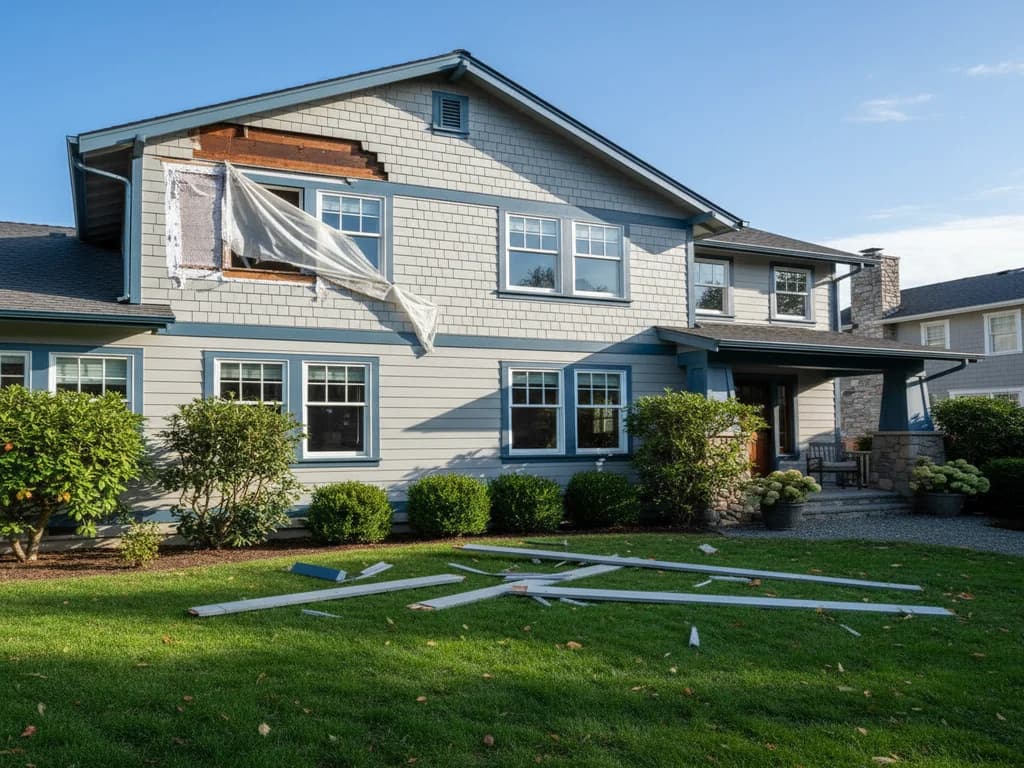
Documentation is what moves a claim, so we build it deliberately. We photograph the damage in context and in detail — wide elevation shots that show the extent, then close-ups of impact points, cracked or punctured boards, displaced flashing, and any water intrusion behind the cladding. We measure and record the affected elevations so square footage is defensible rather than estimated. Then we write the scope as line items — tear-off, disposal, weather-resistive barrier, flashing, cladding, trim, paint, and the labor for each — in the same structure adjusters estimate from, so our number and the carrier's can be compared line by line instead of as two lump sums. Where our scope and theirs diverge, the line-item format shows exactly which item is missing or under-counted, which is what a clean supplement is built on.
Supplements when the carrier estimate falls short
First estimates are written from what is visible, and siding hides its worst damage until tear-off. When we open the wall and find rotted sheathing, failed flashing, or damage that extends past the original scope, that is a supplement — additional documented scope submitted to the carrier for the work the loss actually requires, not an attempt to inflate the claim. We photograph the newly exposed condition before we cover anything, tie it to the covered peril, and submit it with the same line-item discipline as the original. Supplements are a normal, expected part of insurance restoration; the difference is whether they are documented well enough to be approved. We don't proceed on out-of-scope work without your sign-off, and we don't bury surprises in the final invoice.
What carriers do and don't cover
Sudden, accidental damage from a covered peril (wind, hail, impact, certain fire scenarios) is typically covered. Long-term wear, deferred maintenance, and pre-existing dry rot are typically not. Most policies pay actual cash value upfront and recoverable depreciation after work is completed and documented — your policy controls the specifics, and we make sure our paperwork supports your release of holdback.
Code upgrades and matching
California building code may require upgrades during a repair (WUI requirements in fire zones, current flashing and WRB standards) that exceed the pre-loss condition. Many policies include 'ordinance or law' coverage that pays for these. Color-matching across damaged and undamaged elevations is another common dispute we know how to document and present.
ACV, recoverable depreciation, and the holdback release
Most replacement-cost policies don't pay the full amount in one check. The carrier typically issues actual cash value (ACV) first — the replacement cost minus depreciation for the age and wear of the old siding — and withholds the depreciated portion as recoverable depreciation, also called the holdback. That withheld amount becomes payable once the work is actually completed and documented to the carrier's satisfaction. This is exactly why thorough close-out paperwork matters: we provide the completion documentation, photos, and final invoice the carrier needs to release the recoverable depreciation to you. Your policy controls the specifics, and the depreciation is only recoverable if you complete the work — we make sure our records support that release rather than leaving money stranded in the holdback. We can't promise a particular payout, but we can make sure the documentation isn't the reason a release stalls.
What we will not do
We will not waive, rebate, or absorb your deductible — that's illegal in California and a red flag for any contractor. We will not sign over a claim or work as 'the homeowner's representative' on policy negotiations; that's a public adjuster's role. We will do the work correctly, document it thoroughly, and stand behind what we install.
Wildfire claim territory — the named events that shape our documentation
A meaningful share of the insurance claim work we do runs against the backdrop of specific named wildfires that reshaped Northern California's exterior claim landscape: the 2017 Tubbs Fire (Santa Rosa's Fountaingrove and Coffey Park), the 2017 Nuns Fire (Glen Ellen, Kenwood, upper Sonoma Valley), the 2017 Atlas Fire (eastern Napa County), the 2018 Camp Fire (Paradise — California's most destructive wildfire, 18,800 structures), the 2018 Carr Fire (western Redding, 1,600+ structures), the 2019 Kincade Fire (Sonoma County, 77,758 acres, largest county evacuation in modern history), the 2020 CZU Lightning Complex (Santa Cruz Mountains, 86,509 acres, ~1,000 structures), the 2020 SCU Lightning Complex (eastern Santa Clara / Alameda), the 2020 LNU Complex (Sonoma-Lake-Napa), the 2020 Glass Fire (Napa/Sonoma), the 2021 Caldor Fire (El Dorado County — Grizzly Flats was ground zero, 2/3 of the community lost), the 2013 Rim Fire (Tuolumne County), the 2017 Detwiler and 2022 Oak Fires (Mariposa), the 2015 Valley Fire and 2018 Mendocino Complex (Lake County). Documenting a claim in one of these affected zones benefits from knowing the applicable code cycle: pre-Jan-1-2026 losses fall under Chapter 7A of the CBC; on-or-after fall under the standalone 2025 California Wildland-Urban Interface Code. Rebuilding on a 2025 LRA FHSZ-designated parcel may also trigger ordinance-or-law coverage for WUI-compliant assemblies. We document with those distinctions in mind rather than treating every fire claim as one shape.
The permit and code framework a documented rebuild has to meet
Insurance-covered rebuilds run through the same permit authorities as any other exterior work — a detail our city hubs enumerate. Permits go through the city building department for incorporated cities (Sacramento, Santa Rosa, Napa, St. Helena, Healdsburg, Paradise-as-Town, Redding, Auburn, Placerville, Nevada City, Grass Valley, South Lake Tahoe, and the Bay/wine-country cities) and through the county Community Development agency for unincorporated communities (Cameron Park, El Dorado Hills, Meadow Vista, Kentfield, Aptos, Live Oak, and the many CDPs we serve). On parcels designated Moderate or higher under California's 2025 Local Responsibility Area Fire Hazard Severity Zone map, the 2025 California Wildland-Urban Interface Code governs the exterior wall assembly on any rebuild — non-combustible or ignition-resistant cladding (verifiable via the OSFM WUI-Listed Products Handbook), plus hardened eaves, vents, and Zone 0 ground-to-wall detailing. Ordinance-or-law coverage on many replacement-cost policies pays for these code-mandated upgrades where the pre-loss assembly did not meet them, and clean documentation of the code trigger is what unlocks that payout.
FAQ
Common Questions
No, and that's intentional. Preferred-contractor programs often pressure contractors to match the carrier's estimate even when scope is short. Working independently lets us scope the work the home actually needs and document it for your claim on the same footing.
Yes — we encourage it. An on-site meeting with the adjuster, the homeowner, and our project lead resolves most scope and supplement questions in one conversation instead of three rounds of email.
You can request a re-inspection or a supplement, and we provide the documentation to support either. For substantive disputes, a licensed public adjuster (not a contractor) is the right next step — we can point you toward that process honestly.
From claim filing to project completion typically runs four to twelve weeks, dominated by adjuster scheduling and supplement timing rather than the actual install. We schedule the work as soon as scope and approval are in writing.
Wide and close-up photos of the damage, measured elevations, and a line-item written scope structured the way adjusters estimate, so our number and the carrier's compare directly. When tear-off exposes hidden damage we photograph it before covering anything and submit it as a documented supplement. At completion we provide the photos, completion records, and final invoice the carrier needs to release any recoverable depreciation. We document thoroughly; we don't promise a specific coverage outcome.
On a replacement-cost policy the carrier usually pays actual cash value first — replacement cost minus depreciation for the siding's age and wear — and withholds the depreciated portion as recoverable depreciation. That holdback becomes payable after the work is completed and documented. It is only recoverable if you actually complete the repair, so we make sure our close-out paperwork supports the release. Your policy controls the exact terms, and we can't control the carrier's decision — only make sure documentation isn't what holds it up.
Keep Exploring
Related services, guides & areas
Helpful Exterior Guides