
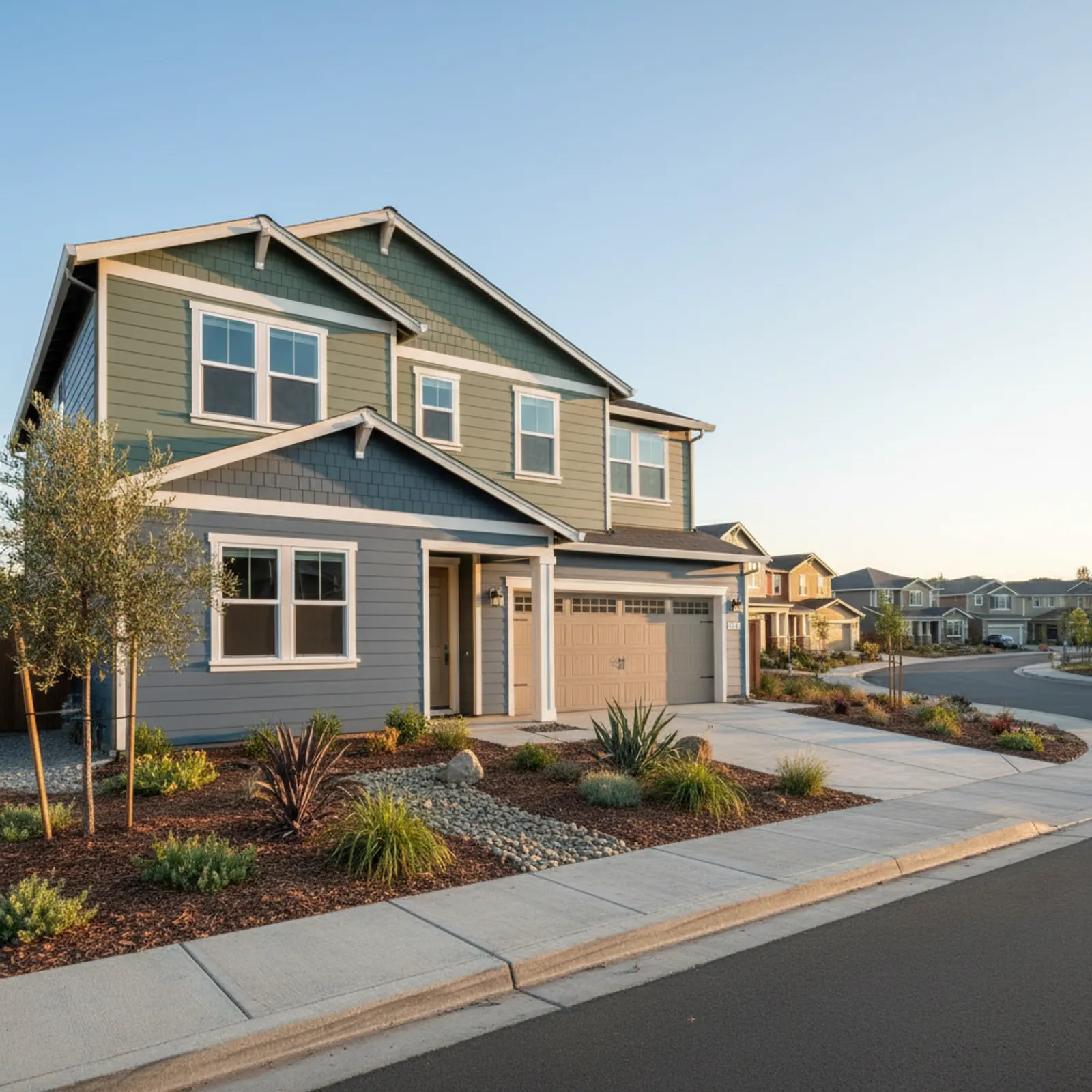
Siding in Elk Grove
Elk Grove's re-side wave is the most predictable in the region. The city grew almost entirely through one long master-planned build-out — Laguna, Laguna West, Laguna Ridge, Laguna Creek, East Franklin — so a vast, near-uniform stock of two-story production homes is reaching end-of-siding-life in the same window, all under unshaded valley sun.
Unlike Sacramento proper, Elk Grove has little historic variety; the job here is almost always the same archetype done well: strip failed builder-grade hardboard or composite, correct the weather barrier and flashing, and re-clad with a modern profile that breaks the tract sameness.
Differentiating near-identical Elk Grove elevations
Whole Elk Grove streets share three or four builder facades. The highest-leverage move is a re-side that mixes lap with board-and-batten gables, tightens reveals, and applies a considered color program — in this market it's the single most effective curb-appeal and resale differentiator available.
Why the unshaded tracts fail fast
Elk Grove's newer subdivisions have minimal mature canopy, so walls and trim take a full, unbroken UV load. That's why original hardboard and composite here shows chalking, swollen butt joints, and fading sooner than in tree-shaded older Sacramento neighborhoods — and why finish selection is critical.
Sequencing a two-story production-home re-side without losing the house to weather
The dominant Elk Grove archetype is the two-story production home, and re-siding one is as much a logistics problem as a carpentry one. These homes have tall gable ends, second-story returns, and tight zero-lot-line setbacks toward neighbors in Laguna and Sheldon-area tracts, so scaffold and lift access has to be mapped before tear-off. We strip and re-clad in controlled sections rather than opening the whole shell at once, keeping the existing weather barrier intact over unworked walls so a surprise Sacramento Valley downpour never reaches bare sheathing. On the unshaded south and west elevations that take the worst valley heat, we prioritize the failed builder-grade hardboard first, since that is where swelling and paint failure show earliest. Garage-forward floor plans common across Elk Grove also mean staging material and a dumpster without blocking the street or a neighbor's drive, which matters on dense cul-de-sacs. Done in the right order, a full two-story re-side stays buttoned up every night, and the homeowner keeps a dry, secure house through the entire job.
Clearing HOA architectural review before a single board comes off
Because so much of Elk Grove was built as master-planned communities, a large share of homes in Laguna Ridge, Laguna West, and East Franklin sit inside HOAs with architectural review committees, and that step shapes the siding scope as much as the wall itself. A re-side that changes color, profile, or material usually needs written approval, and committees in these newer tracts often hold owners to an approved palette or to matching the neighborhood's established look. We plan for that up front: documenting the proposed profile and color, noting where a mixed lap-and-panel treatment stays within guideline intent, and lining the work up with City of Elk Grove permitting so inspection and approval do not collide. The practical payoff is that you avoid the worst case, where a board goes up, a committee objects, and the job stalls mid-project with the house partly exposed. On older non-HOA ranch homes elsewhere in the city the rules are looser, but in the production-tract heart of Elk Grove, getting the paperwork right is part of getting the siding right.
Why this matters in Elk Grove
- Specified for Sacramento Valley conditions
- James Hardie fiber cement as the recommended system
- Correctly detailed weather-resistive barrier and flashing
- Installed by a crew with 20 years combined experience
Recommended systems for Elk Grove
- James Hardie fiber cement
- factory finishes
- board-and-batten accents
Fiber Cement Siding for Elk Grove homes
The full fiber cement siding approach — materials, weather-resistive detailing, and the manufacturer standards we install to — is covered on the main service page, then specified for Elk Grove's conditions on this one.
Our Elk Grove process
- Step 1
Consultation
We listen to your goals and assess your home on site — exposure, substrate, and architecture.
- Step 2
Design & Proposal
A clear written proposal with the right system specified for your climate and a transparent scope.
- Step 3
Expert Installation
Trained crews install to manufacturer best practices with careful weather-management detailing.
- Step 4
Walkthrough & Support
A final walkthrough, full cleanup, and a clear written record of the scope completed — work we stand behind.
FAQ
Siding in Elk Grove — FAQ
Because the city was built in one long master-planned wave with the same builder-grade materials, so streets reach end-of-siding-life together. It's age- and material-driven, accelerated by unshaded valley UV.
Yes — this is one of our most common Elk Grove projects. A modern lap-and-batten program with refreshed trim and color differentiates a repeated builder elevation while upgrading durability.
Generally yes — we work within Elk Grove master-planned community guidelines and prepare the material and color submittals HOAs require.
Most Elk Grove single-family homes are 1.5–2.5 weeks given the prevalence of two-story plans, plus any dry rot found once cladding is off; confirmed after the on-site assessment.
Keep Exploring
More for Elk Grove homeowners
More in Elk Grove
Other exterior services in Elk Grove
Back to
Sacramento County & Elk Grove
Helpful Exterior Guides