Exterior renovation in Elk Grove
Elk Grove is one of the largest and fastest-grown cities in the Sacramento region, and that growth pattern defines its exterior-renovation market. The city expanded enormously through the 1990s and 2000s with master-planned communities — Laguna, Laguna West, Laguna Ridge, Elk Grove Florin, and the East Franklin and Sheldon areas — producing a vast, fairly uniform stock of two-story production homes that are now all reaching the same re-side age at roughly the same time. That makes Elk Grove a deep, steady exterior market with a recurring problem: original builder-grade siding and trim that was never specified for the punishment Elk Grove's climate delivers.
Why it matters here specifically
Elk Grove sits on the open southern Sacramento Valley floor with minimal mature canopy across its newer tracts, so homes take an unshaded, sustained UV and heat load. The original hardboard, composite, and economy stucco-and-siding combinations on these production homes fail in a predictable pattern — chalking, swollen butt joints, cupping, and faded paint, worst on the south and west elevations. Because so many Elk Grove homes share a handful of builder elevations, a thoughtful re-side and color program is also one of the few ways to give a home a genuinely distinct exterior in a sea of similar facades.
Considering an exterior project in Elk Grove?
Elk Grove housing and architecture
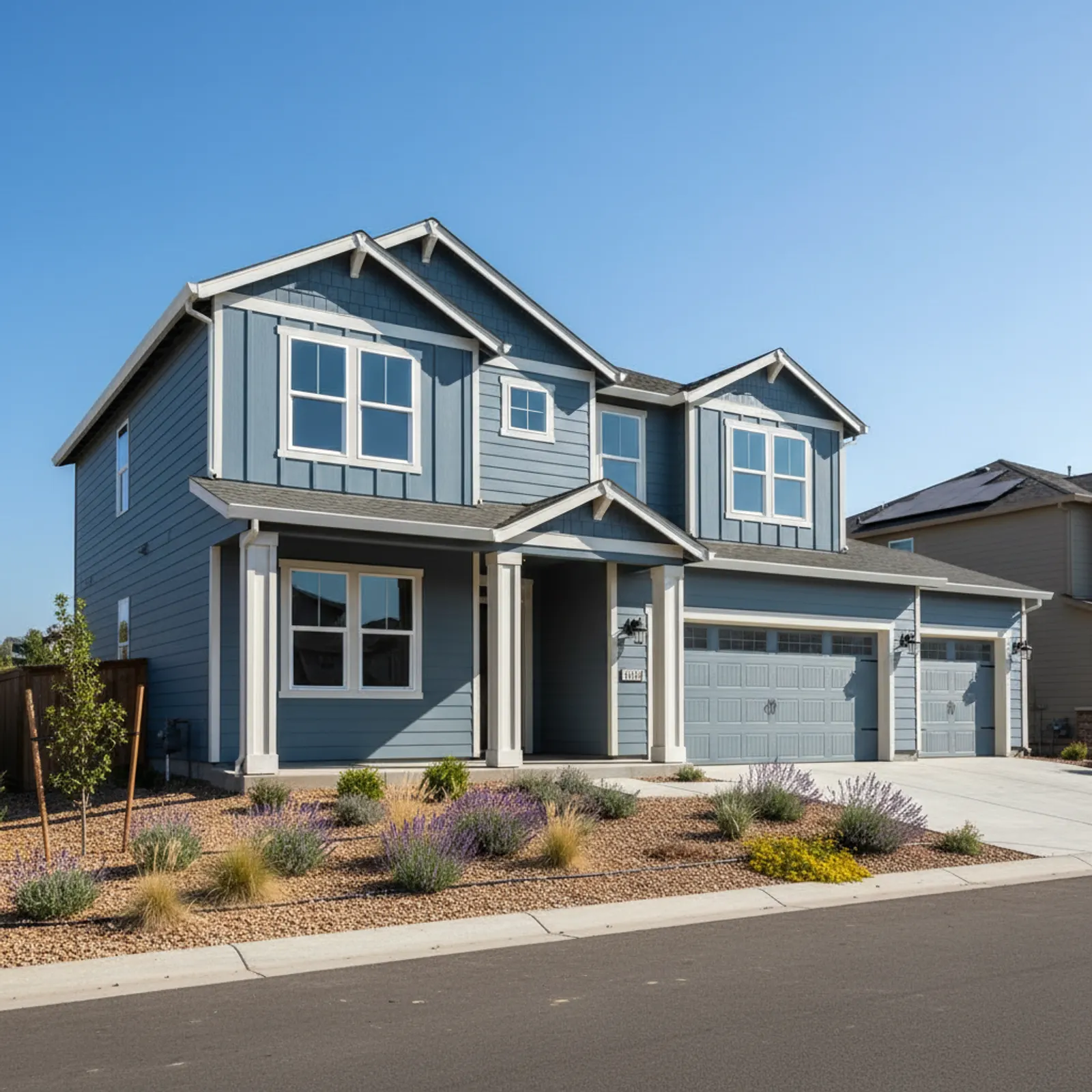
Elk Grove's stock is overwhelmingly 1990s–2000s two-story production homes in master-planned communities, with a smaller set of older single-story ranch homes near the original town core and newer homes still being added on the southern and eastern edges. These production elevations respond dramatically to a modern lap-and-batten re-side with a refreshed, restrained palette and updated trim — the single most effective way to lift a builder-grade Elk Grove home out of its tract uniformity while upgrading durability.
Built for Elk Grove's valley heat
Heat and UV durability is the controlling exterior factor in Elk Grove, arguably even more than in central Sacramento because the newer tracts have so little shade. We specify fiber cement with factory-applied fade-resistant finishes, correct gapping and fastening for large daily and seasonal temperature swings, and finish selection tuned to which elevations face the worst afternoon sun. Moisture is a minor concern, but we still install a continuous, correctly lapped weather-resistive barrier and flash every penetration.
Recommended materials for Elk Grove
James Hardie fiber cement with a factory finish is the core recommendation for Elk Grove's production homes: dimensionally stable in heat, non-combustible, and far more color-stable than field paint. Lap siding with board-and-batten gable and accent treatments is especially effective at differentiating near-identical tract elevations. Engineered wood is acceptable on these low-fire valley parcels where deep wood character is wanted.
What an exterior project costs in Elk Grove
Elk Grove pricing follows the standard drivers: square footage and the prevalence of two-story plans, trim and profile complexity, substrate and dry-rot condition once cladding is removed, window integration, and the weather-management scope. Two-story production homes with significant trim naturally cost more than a single-story ranch. We provide a written, scoped estimate after an on-site assessment so bids can be compared on substance rather than a headline number.
Laguna, Laguna West, and the master-planned core
The Laguna, Laguna West, Laguna Ridge, and East Franklin communities are the heart of Elk Grove's re-side market, and they share a defining trait: thousands of homes built off a handful of builder elevations, now arriving at re-side age together. That repetition is the opportunity. A modern lap-and-batten program with a refreshed palette and considered gable treatment gives a stock front a custom read, and because the plans repeat down the street, a homeowner can usually see the approach realized nearby before committing. Many of these neighborhoods also sit under HOAs whose design review governs exterior color and material, so we confirm the approved palette before scoping.
The original town core and the southern edge
Away from the master-planned grid, the older single-story ranch homes near Elk Grove's original core and along the Sheldon area run on different rules: simpler elevations, larger lots, and fewer design-review overlays, but often the most weathered original cladding in the city. The newer tracts still expanding on the southern and eastern edges are the inverse — well-built but already fading on the unshaded sun-facing walls that define this part of the valley. We scope each by its actual vintage and exposure rather than treating Elk Grove as one uniform tract.
SMUD, permits, and master-planned HOA architectural review
Working exteriors in Elk Grove coordinates with the same electric utility as Sacramento and Folsom: SMUD (Sacramento Municipal Utility District), the customer-owned electric provider — not PG&E — so any work near the service mast, meter, or overhead drop coordinates through SMUD. Natural gas remains PG&E. Water is served by the City of Elk Grove Water Service, Sacramento County Water Agency, or Golden State Water Company depending on the specific address, so meter and backflow coordination goes through the applicable provider. Fire response is the Cosumnes Community Services District, which handles both fire and park services. On the permit side, the City of Elk Grove's Development Services Department handles building permits, and the master-planned communities where most of Elk Grove's re-side work happens — Laguna, Laguna West, Laguna Ridge, East Franklin, and adjacent HOAs — carry architectural review that pre-approves any visible exterior change before a permit issues. Approved palettes, allowed profiles, and trim proportions are typically specified. We pull the actual board profile, trim width, and ColorPlus chip into the submittal early so both the HOA and the city are reviewing what will actually be installed.
HZ10 climate on Elk Grove's low-fire valley floor
Elk Grove is in James Hardie's HZ10 climate zone — the West's hot-summer, low-freeze belt — and HZ10 is the correct spec for an Elk Grove home; installing the alternative HZ5 line is a documented warranty misapplication. That answer does not change across the city. On the fire side, essentially all of Elk Grove sits on the flat valley floor in Low FHSZ territory or unmapped under California's 2025 LRA Fire Hazard Severity Zone map — the WUI Code does not typically apply. Non-combustible fiber cement remains a low-regret upgrade regardless, and the UV/heat spec that HZ10 wraps around drives the rest of the assembly: generous expansion allowance at long horizontal runs, high-movement sealant at every penetration, and factory ColorPlus finishes that outlast field paint on the unshaded south and west walls where builder-grade finishes fail first here. The code frame did change on January 1, 2026, when Chapter 7A was deleted from the Building Code, but on an Elk Grove re-side the heat-and-UV work carries the day.
Our process in Elk Grove
- Step 1
Consultation
We listen to your goals and assess your home on site — exposure, substrate, and architecture.
- Step 2
Design & Proposal
A clear written proposal with the right system specified for your climate and a transparent scope.
- Step 3
Expert Installation
Trained crews install to manufacturer best practices with careful weather-management detailing.
- Step 4
Walkthrough & Support
A final walkthrough, full cleanup, and a clear written record of the scope completed — work we stand behind.
Elk Grove homeowners get the strongest result when a re-side is treated as both heat-durable protection and a way to break out of tract uniformity. That is how we approach every project here.
FAQ
Elk Grove — Common Questions
Fiber cement with a factory fade-resistant finish. Elk Grove's unshaded valley-floor setting delivers sustained UV and heat, and factory-finished fiber cement holds color and integrity far longer than field-painted or economy products.
Yes — this is one of our most common Elk Grove projects. A modern lap-and-batten re-side with a refined trim and color program differentiates a builder elevation while upgrading durability.
Original builder-grade hardboard, composite, and economy materials were never specified for Elk Grove's unshaded UV load. Chalking, swollen joints, cupping, and faded paint on sun-facing elevations is the typical end-of-life pattern.
Elk Grove's valley-floor setting carries low wildfire exposure. Non-combustible fiber cement remains a sound, low-regret choice alongside its heat durability.
When feasible, yes — combining them ensures correct flashing integration, avoids duplicated trim work, and produces a better-looking, better-performing exterior in one project.
South- and west-facing walls take the heaviest unshaded afternoon sun and age fastest; we account for orientation when specifying finishes and detailing.
Yes — Laguna, Laguna West, Laguna Ridge, East Franklin, Sheldon, the original town core, and the newer southern and eastern tracts.
A correctly installed fiber cement system commonly performs 30+ years in Elk Grove's climate, with factory finishes extending the time before any cosmetic refresh.