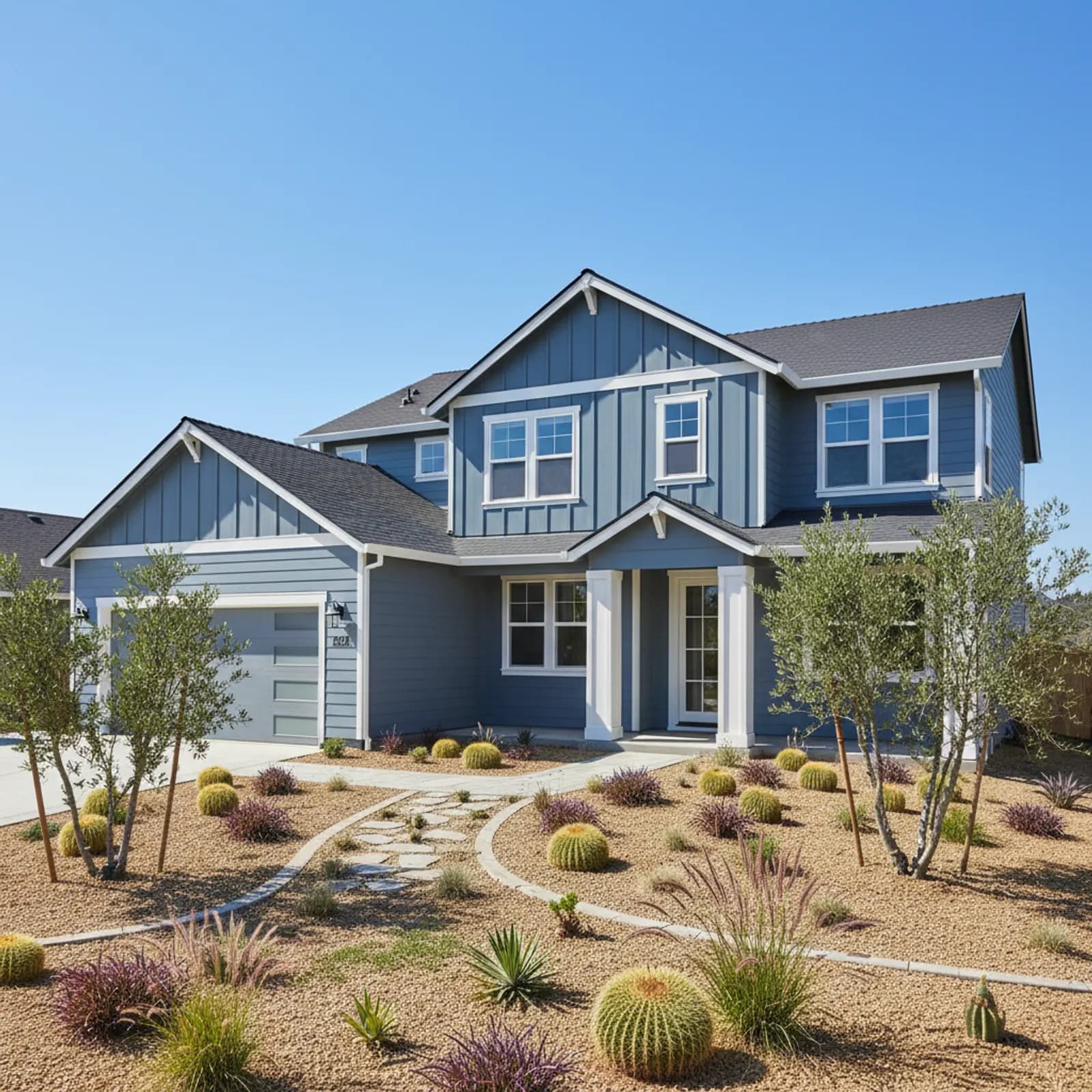
Exterior renovation in Rancho Cordova
Rancho Cordova stretches along Highway 50 east of Sacramento, from older postwar neighborhoods near the original town center to the large newer master-planned communities of Sunridge, Anatolia, and Rio del Oro. That split — aging mid-century tracts and 2000s production homes both reaching re-side age — makes it a deep, steady exterior market squarely in the Sacramento Valley heat belt.
Two housing generations, one heat problem
What unites Rancho Cordova's older core and its newer southern expansions is exposure: every one of these homes bakes through long valley summers with intense, high-UV afternoons. The postwar tracts wear original hardboard or economy cladding that has chalked and cupped, while the production homes carry builder-grade siding that fades to a flat, uniform look. Both generations are prime candidates for a heat-durable, factory-finished re-side that protects the wall and resets curb appeal.
Considering an exterior project in Rancho Cordova?
Rancho Cordova housing and architecture
Rancho Cordova's stock runs from 1950s–1970s single-story tract and ranch homes in the older core to two-story 1990s–2010s master-planned homes in the southern and eastern expansions like Sunridge and Anatolia. The older single-story tracts have simple, low rooflines that modernize dramatically with a clean lap-and-batten re-side; the newer two-story production homes carry more articulated elevations that benefit from a refined trim and color program to break the builder uniformity that repeats down those streets. We match profile scale to each era so a 1960s ranch and a 2000s two-story each read deliberate rather than generic.
Built for Rancho Cordova's valley heat
Rancho Cordova sits in full Sacramento Valley heat — long, intense, high-UV summers that fade finishes and stress joints, worst on the south and west elevations that take the afternoon load. That UV exposure is the single controlling factor in the spec: it forces fade-resistant factory finishes, heat-aware gapping and fastening so boards can move without buckling, and color choices that hold up under relentless sun. The American River corridor along the city's northern edge warrants extra drainage-plane and flashing care where homes sit closer to the river's moisture influence.
Recommended materials for Rancho Cordova
James Hardie fiber cement with a factory fade-resistant finish is the core recommendation — non-combustible, dimensionally stable in heat, and far more color-stable than the original hardboard or economy vinyl on most Rancho Cordova homes. The factory finish is the point in this climate: it resists the chalking and fade that valley UV drives, and it cuts the repaint cycle that sun-baked elevations otherwise demand. Board-and-batten accents and a considered trim package differentiate the repetitive tract and production elevations that define so many of the city's streets.
What an exterior project costs in Rancho Cordova
Rancho Cordova pricing follows the standard drivers — size and stories, since older core homes are often single-story while the Sunridge and Anatolia homes run two-story, plus trim complexity, substrate and dry-rot condition, window integration, and the weather-management scope. Newer master-planned neighborhoods may also carry HOA design review that affects color and material approvals and adds a step to the timeline. We provide a written, scoped estimate after an on-site assessment so bids can be compared on substance rather than headline numbers.
The older town-center tracts
The neighborhoods near Rancho Cordova's original core off Folsom Boulevard hold the city's 1950s–1970s single-story ranch and tract homes, many still wearing the hardboard or economy cladding that valley sun has chalked and cupped. These are the highest-impact re-sides in town: a clean lap-and-batten system on a simple low roofline transforms the elevation, and the predictable mid-century framing usually means few surprises once a wall is opened. We still check substrate condition individually, because decades of UV and seasonal moisture leave very different damage from one block to the next.
Sunridge, Anatolia, and Rio del Oro
South and east of Highway 50, the master-planned communities of Sunridge, Anatolia, and Rio del Oro brought thousands of 1990s–2010s production homes that are now reaching re-side and refresh age. These two-story homes respond best to a refined trim and color program that distinguishes one repeated builder elevation from the next, and many sit within HOAs whose design review governs exterior color and material. We confirm those overlay requirements before scoping so the approved palette is the one we install.
The American River corridor
Homes along Rancho Cordova's northern edge near the American River parkway share the same valley heat but add a moisture wrinkle the rest of the city doesn't see as sharply. Closer proximity to the river corridor means we give extra attention to the drainage plane, flashing, and bottom-course clearances, pairing the same heat-durable fiber cement cladding with more rigorous water-management detailing so the wall handles both the sun and the damper microclimate.
City of Rancho Cordova, SMUD, and Sac Metro Fire
Working exteriors in Rancho Cordova coordinates with a few local authorities. Building permits come through the City of Rancho Cordova (incorporated 2003 — Sacramento County's most recent city). Electric is SMUD (Sacramento Municipal Utility District), and gas is PG&E. Water is supplied by Golden State Water Company (Cordova) or the Sacramento County Water Agency depending on the specific address, with wastewater through Sacramento Area Sewer District. Fire response is the Sacramento Metropolitan Fire District (Sac Metro Fire). Master-planned communities in Sunridge, Anatolia, and Rio del Oro carry HOA-covenant design-review requirements distinct from the city permit path.
HZ10 climate on Rancho Cordova's valley setting
Rancho Cordova is in James Hardie's HZ10 climate zone; installing HZ5 is a documented warranty misapplication. On the fire side, the entire city sits on the valley floor in Low FHSZ territory or unmapped under California's 2025 LRA Fire Hazard Severity Zone map — the WUI Code does not typically apply. The American River Parkway corridor to the north carries mild summer grass-fire potential, and Sac Metro's response reflects that. Chapter 7A moved into the standalone WUI Code on January 1, 2026, but does not typically drive Rancho Cordova's spec.
Our process in Rancho Cordova
- Step 1
Consultation
We listen to your goals and assess your home on site — exposure, substrate, and architecture.
- Step 2
Design & Proposal
A clear written proposal with the right system specified for your climate and a transparent scope.
- Step 3
Expert Installation
Trained crews install to manufacturer best practices with careful weather-management detailing.
- Step 4
Walkthrough & Support
A final walkthrough, full cleanup, and a clear written record of the scope completed — work we stand behind.
Rancho Cordova's mix of aging town-center tracts and newer Sunridge and Anatolia production homes rewards a modern, heat-durable re-side — strong protection against valley UV and a clear curb-appeal lift. We scope every Rancho Cordova project on site so the written estimate reflects the home's real era, exposure, and substrate. From the older core to the master-planned south, the aim is a wall that holds its color and integrity through decades of valley summers.
FAQ
Rancho Cordova — Common Questions
Fiber cement with a factory fade-resistant finish — Rancho Cordova sits in full valley heat, and factory-finished fiber cement holds color and integrity far longer than original hardboard or economy vinyl.
Yes — these 1990s–2010s master-planned homes are reaching re-side age and respond well to a modern profile and trim program.
Original builder-grade cladding was never specified for the valley UV load; chalking, cupping, and fading on sun-facing elevations is the typical end-of-life pattern.
Low — it is a valley-floor city. Non-combustible fiber cement remains a sound, low-regret choice.
Same cladding, but we give extra attention to drainage-plane and flashing detailing in the moister river corridor.
When feasible, yes — combining them ensures correct flashing integration and avoids duplicated trim work.
Yes — the original town-center neighborhoods and the Sunridge, Anatolia, and Rio del Oro master-planned areas.
A correctly installed fiber cement system commonly performs 30+ years in the valley heat, with factory finishes extending the cosmetic-refresh interval.
Helpful Exterior Guides