
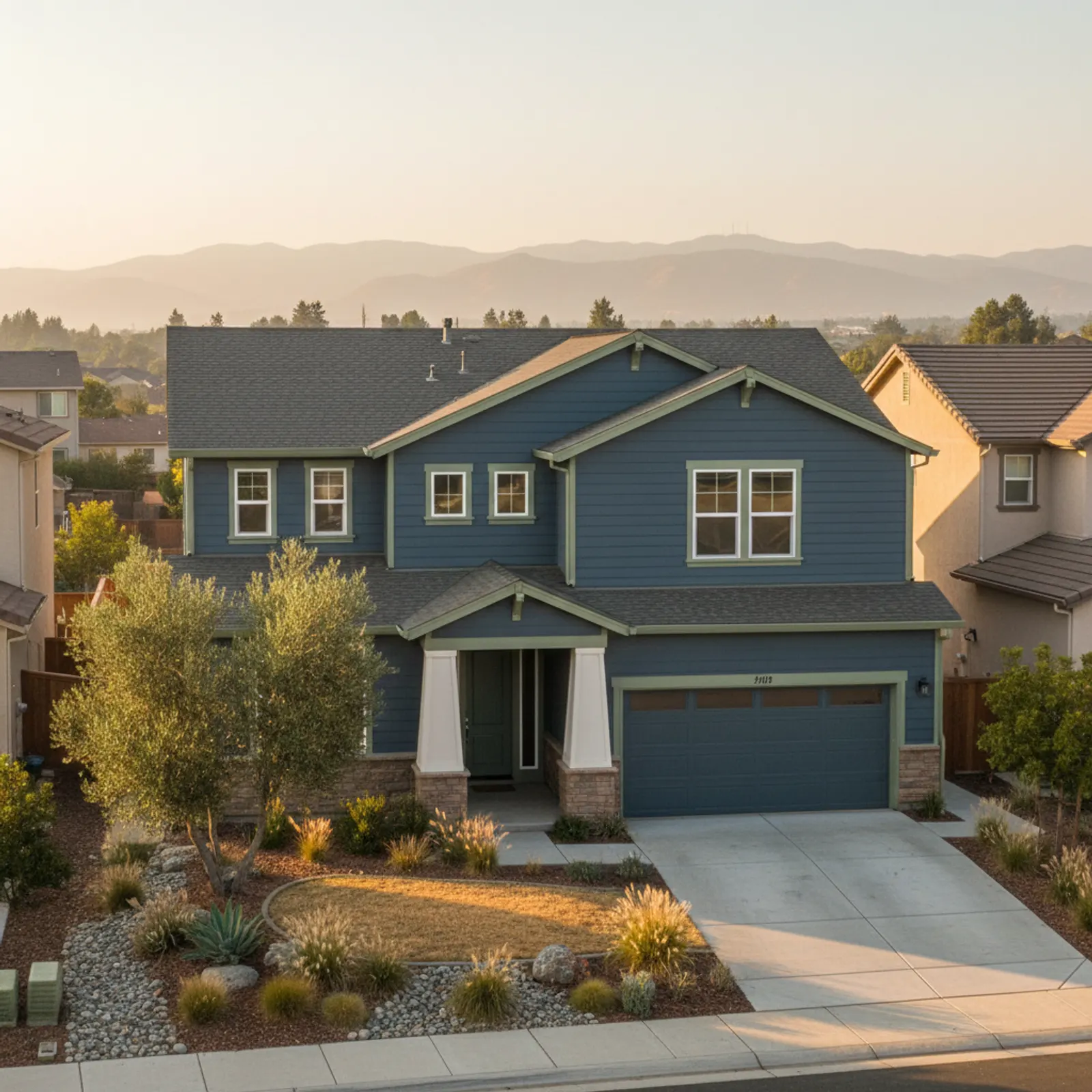
Siding in Roseville
Re-siding is the single most common exterior project in Roseville, and for a specific reason: the city's enormous run of master-planned construction — Highland Reserve, Fiddyment Farm, Diamond Creek, Westpark, Sierra Vista — was clad in builder-grade hardboard, T1-11, and economy vinyl that simply was not specified for two-plus decades of Sacramento Valley sun. Whole streets reach end-of-siding-life within a few years of each other.
When Roseville homeowners ask us about "siding," they're usually weighing a like-for-like patch against a full system replacement. We almost always recommend the system: new cladding is only as good as the weather-resistive barrier, flashing, and trim behind it, and a Roseville re-side is the one chance to correct decades of cut-rate detailing.
What a Roseville siding project actually involves
On a typical Roseville two-story production home we strip the failed cladding, inspect and replace any moisture- or pest-damaged sheathing, install a continuous correctly-lapped weather-resistive barrier, flash every window and penetration, then install fiber cement or engineered-wood siding with a refined trim package. The visible boards are maybe a third of the value — the rest is the assembly that makes them last.
Turning tract uniformity into a custom look
Because so many Roseville homes share three or four builder elevations, a re-side is also the most effective way to make a home read as distinct. Mixing lap with board-and-batten gables, tightening reveals, and choosing a considered color program does more for curb appeal in West Roseville than almost any other improvement at the price.
Why valley sun dictates the siding spec in Roseville
Roseville sits squarely in a valley-heat zone, and that single factor drives nearly every material decision we make here. Summer afternoons in Highland Reserve or Fiddyment Farm routinely punish south- and west-facing walls with relentless, high-angle sun, and that is exactly what kills the builder-grade hardboard and economy vinyl these neighborhoods were originally clad in. Vinyl warps and oil-cans on hot elevations; thin painted hardboard chalks, fades, and swells at the bottom courses long before its supposed lifespan. For local re-sides we lean toward fiber cement, which holds a baked or factory-applied finish through repeated 100-plus-degree stretches without distorting. Color choice matters too: deep, heat-absorbing tones on a fully sun-exposed Westpark facade behave very differently than the same color on a shaded Old Roseville lot. Moisture and snow are essentially non-issues here, so the engineering priority shifts from drainage toward thermal stability, UV-stable coatings, and expansion detailing. Getting that spec right is what separates a Roseville exterior that still looks sharp in fifteen years from one that fades on schedule with the rest of the street.
HOA approval and access on master-planned Roseville lots
A practical reality of re-siding in communities like Diamond Creek, Sierra Vista, or Westpark is that most of these master-planned tracts sit under an active HOA with an architectural review committee. Before a single board comes off, color, profile, and sometimes the cladding material itself usually need written approval, and a swing from the original builder palette to a modern farmhouse scheme can require submitting samples and elevation notes. We plan Roseville projects around that approval window so the sign-off lands before crews mobilize rather than mid-job. Access is the other tract-specific wrinkle: many of these homes sit on tight zero-lot-line or narrow side-yard parcels with fences, AC condensers, and neighbor setbacks just feet from the wall, which shapes how we stage scaffolding and move full-length fiber cement planks. Older Cirby and Vernon corridor lots tend to be roomier but bring their own quirks, like additions clad in a different generation of material. Mapping both the HOA path and the physical access up front keeps a Roseville re-side from stalling once it is underway.
Why this matters in Roseville
- Specified for Sacramento Valley conditions
- James Hardie fiber cement as the recommended system
- Correctly detailed weather-resistive barrier and flashing
- Installed by a crew with 20 years combined experience
Recommended systems for Roseville
- James Hardie fiber cement
- LP SmartSide
- factory ColorPlus finishes
- lap and board-and-batten profiles
Fiber Cement Siding for Roseville homes
The full fiber cement siding approach — materials, weather-resistive detailing, and the manufacturer standards we install to — is covered on the main service page, then specified for Roseville's conditions on this one.
Our Roseville process
- Step 1
Consultation
We listen to your goals and assess your home on site — exposure, substrate, and architecture.
- Step 2
Design & Proposal
A clear written proposal with the right system specified for your climate and a transparent scope.
- Step 3
Expert Installation
Trained crews install to manufacturer best practices with careful weather-management detailing.
- Step 4
Walkthrough & Support
A final walkthrough, full cleanup, and a clear written record of the scope completed — work we stand behind.
FAQ
Siding in Roseville — FAQ
Whole-house, in nearly all cases. Roseville's sun damage is rarely confined to one elevation, and partial work leaves mismatched finish age and an interrupted weather-barrier — the most common source of later failures.
Yes. In Roseville's competitive resale market a clean, modern re-side is one of the highest-return curb-appeal investments, on top of eliminating an inspection red flag.
Yes — we routinely work within West Roseville master-planned community guidelines and can prepare the color and material details most HOAs require for approval.
Most single-family Roseville homes are 1–2.5 weeks depending on size, stories, and any dry-rot found once the old cladding is off. We confirm the schedule after the on-site assessment.
Keep Exploring
More for Roseville homeowners
More in Roseville
Other exterior services in Roseville
Nearby Service Areas
Siding near Roseville
Helpful Exterior Guides