
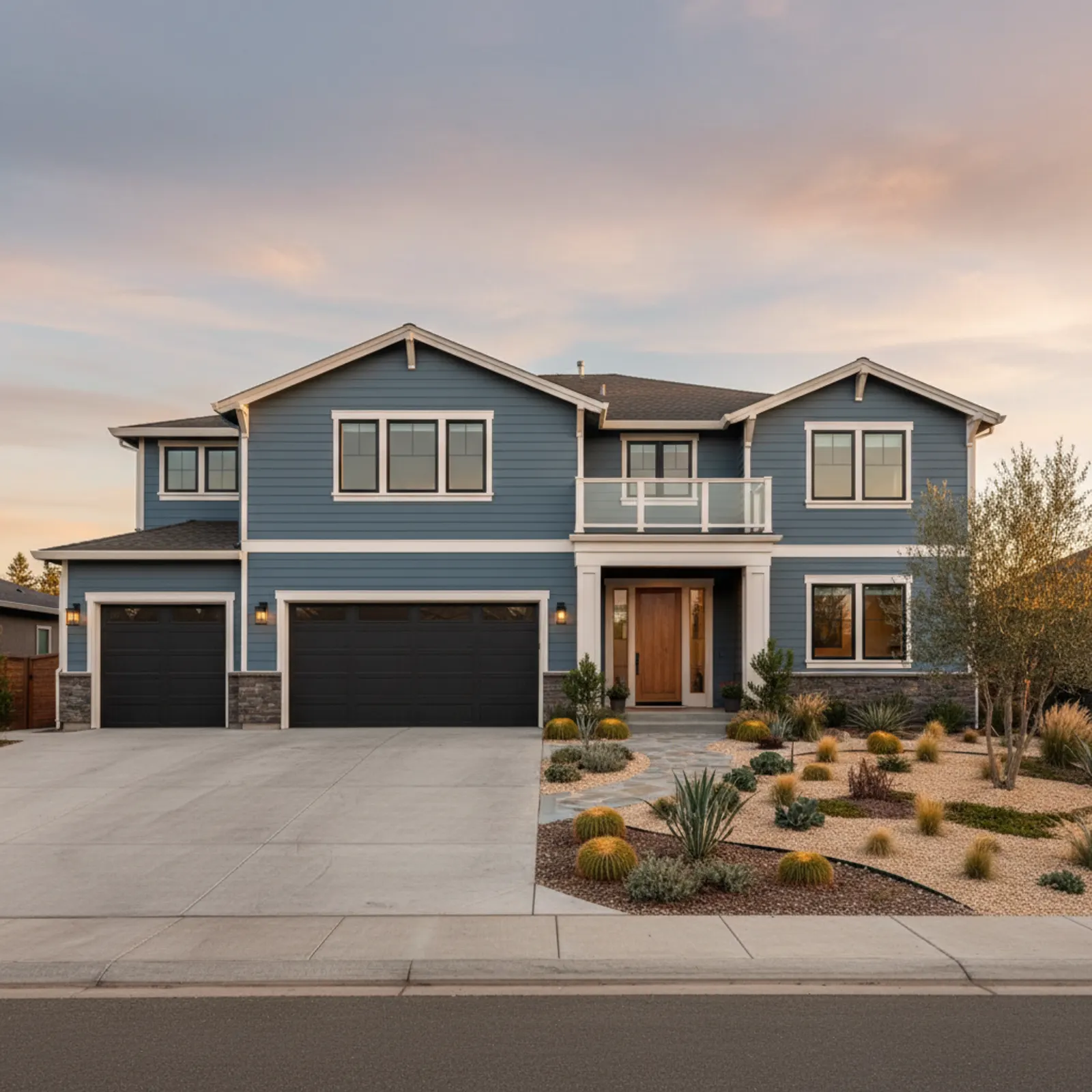
Exterior renovation in Roseville
Roseville is the largest city in Placer County and one of the most active exterior-remodel markets in the greater Sacramento region. Much of the city's housing stock was built in two big waves — older neighborhoods around Old Roseville and the Cirby/Vernon corridors, and the enormous expansion of master-planned communities like Highland Reserve, Fiddyment Farm, Diamond Creek, and the Westpark and Sierra Vista areas. That means a large number of homes are now twenty to thirty years past their original builder-grade siding and trim, with sun-faded finishes and dated profiles. Re-siding is one of the highest-return exterior investments available to a Roseville homeowner, both for protection and for curb appeal in a competitive resale market.
Why it matters here specifically
Roseville sits squarely on the Sacramento Valley floor, and the defining exterior challenge is sustained summer heat and ultraviolet load. South- and west-facing elevations take a punishing amount of sun, and the original builder-grade hardboard, T1-11, and lower-grade vinyl found on many Roseville homes simply was not specified to hold up to it. We see chalking, cupping, swollen butt joints, and faded paint as the typical failure pattern. The fix is not just new boards — it is a properly detailed system built for the specific way Roseville's climate works.
Considering an exterior project in Roseville?
Roseville housing and architecture
Roseville's neighborhoods are predominantly production and master-planned homes: two-story Mediterranean and traditional elevations from the late 1990s and 2000s, plus earlier single-story ranch and split-level homes in the older central neighborhoods. A growing share of homeowners are converting these toward a modern look — clean lap siding, board-and-batten gables and accent walls, simplified trim, and black or bronze window frames. Because so many of these homes share builder elevations, a thoughtful re-side and color program is one of the few ways to give a Roseville house a genuinely distinct, high-end exterior, and we design with that in mind rather than simply replacing like-for-like.
Built for Roseville's valley heat
The exterior priority in Roseville is heat and UV durability. We specify fiber cement with factory-applied, fade-resistant finishes because field-painted and lower-grade products lose color and integrity quickly on Roseville's sun-loaded elevations. Just as important is the detailing: correct gapping and fastening so cladding can move through large daily and seasonal temperature swings without cracking or buckling, and finish selection that accounts for which elevations face the worst afternoon sun. Moisture is a comparatively minor concern here, but we still install a continuous, correctly lapped weather-resistive barrier and flash every penetration — the assembly should never be the weak point.
Recommended materials for Roseville
For most Roseville homes we recommend James Hardie fiber cement with a factory ColorPlus-style finish: non-combustible, dimensionally stable in heat, and color-stable far longer than field paint. Engineered wood such as LP SmartSide is a reasonable alternative where a homeowner wants deep wood grain and the parcel is low fire-risk, which describes most of Roseville. Board-and-batten and mixed-profile compositions are extremely effective on the city's two-story production elevations, and a considered trim package is what separates a premium result from an ordinary re-side.
What an exterior project costs in Roseville
Roseville pricing is driven by the same factors as any quality re-side rather than by a per-square-foot sticker: home size and number of stories, trim and profile complexity, the condition of the substrate once the old cladding is removed, any dry rot or pest damage found, whether windows are integrated into the project, and the quality of the weather-management scope. Two-story production homes with significant trim detail naturally cost more than a single-story ranch. We provide a clear written estimate after an on-site assessment, with the scope behind the boards spelled out — because that hidden scope is exactly where a low bid is usually cutting corners.
West Roseville tracts versus the older core
Roseville is really two re-side markets in one city. The West Roseville master-planned communities — Fiddyment Farm, Westpark, Sierra Vista, Diamond Creek — are flat, wide-open, and short on mature canopy, so walls and trim take an unshaded UV beating and a thoughtful trim-and-color program is what lifts a repeating builder elevation out of the pack. The older central neighborhoods around Old Roseville and the Cirby and Vernon corridors are smaller single-story ranch and mid-century homes on more established, shadier lots, where the job is usually retiring tired original cladding while respecting simpler lines. We read which Roseville you are in before we spec, because the two call for genuinely different detailing.
Roseville Electric, permits, and HOA architectural review
Roseville is one of a small handful of Northern California cities served by its own municipal electric utility rather than PG&E. Roseville Electric Utility is city-owned and operated, which means any work near the service mast, meter, or overhead drop on a Roseville home coordinates through Roseville Electric — not the investor-owned utility much of the state runs on. Natural gas remains PG&E. On the permit side, the City of Roseville's Development Services Department handles siding permits, and a like-for-like re-side is typically a routine over-the-counter permit; substantive assembly changes trigger more review. The larger local wrinkle is HOA architectural review: Roseville's stock is dominated by master-planned communities — Highland Reserve, Fiddyment Farm, Diamond Creek, Westpark, and Sierra Vista among them — where every visible exterior change must be pre-approved by the community's architectural committee before a permit issues. Approved color palettes, allowed profiles, trim proportions, and window-frame color are all governed; a homeowner cannot simply choose. We pull the actual board profile, trim width, and ColorPlus chip into the submittal early so the committee reviews exactly what gets installed, and we clear design review before the old siding comes off the wall.
Roseville is HZ10 — getting Hardie's regional line right
Roseville sits in James Hardie's HZ10 climate zone — the West's hot, dry, low-freeze belt — and every material-spec decision on a valley project runs through that fact. HZ10 is the only correct regional line for a Roseville home; the alternative HZ5 line is engineered for hard freeze-humidity climates that do not exist here, and installing the wrong line is a documented warranty misapplication worth one line to verify on any estimate. Practically, HZ10 means the board itself is built for sustained UV, high summer heat, and long wet-dry swings — exactly the load a Roseville south- and west-facing wall takes. On top of the line question, Roseville's two-story production elevations from the master-planned era respond well to HardiePlank lap paired with HardiePanel-and-batten gable accents, and a factory ColorPlus finish selection outlasts field paint on the sun-loaded walls where builder-grade finishes fail first. We name HZ10 in writing on every Roseville estimate and match the install to Hardie's HZ10 best-practice guide so the manufacturer warranty is intact when the crew leaves.
Our process in Roseville
- Step 1
Consultation
We listen to your goals and assess your home on site — exposure, substrate, and architecture.
- Step 2
Design & Proposal
A clear written proposal with the right system specified for your climate and a transparent scope.
- Step 3
Expert Installation
Trained crews install to manufacturer best practices with careful weather-management detailing.
- Step 4
Walkthrough & Support
A final walkthrough, full cleanup, and a clear written record of the scope completed — work we stand behind.
Roseville homeowners get the strongest result when the exterior is treated as a heat-durable system and a design opportunity at the same time. That is how we approach every project in the city.
FAQ
Roseville — Common Questions
Fiber cement with a factory fade-resistant finish. Roseville's defining stressor is sustained summer UV and heat, and factory-finished fiber cement holds color and integrity far longer than field-painted or lower-grade products.
Yes — this is one of our most common Roseville projects. Re-siding in modern profiles with a refined trim and color program transforms a production elevation while also upgrading durability.
Most original builder-grade hardboard, T1-11, and economy vinyl was never specified for Roseville's UV load. Chalking, cupping, swollen joints, and faded paint on sun-facing elevations are the typical end-of-life pattern.
Roseville's western valley setting carries low wildfire exposure relative to the foothills, though grassland edges are non-zero. Non-combustible fiber cement is still a sound, low-regret choice.
When feasible, yes. Combining them ensures correct flashing integration, avoids duplicated trim work, and produces a better-looking and better-performing exterior in one project.
South- and west-facing walls take the heaviest afternoon sun and age fastest. We account for orientation when specifying finishes and detailing.
Yes — from the older central neighborhoods to West Roseville master-planned communities like Fiddyment Farm, Westpark, and Sierra Vista, and everything between.
A correctly installed fiber cement system commonly performs for 30 or more years in Roseville's climate; factory finishes substantially extend the interval before any cosmetic refresh is needed.