
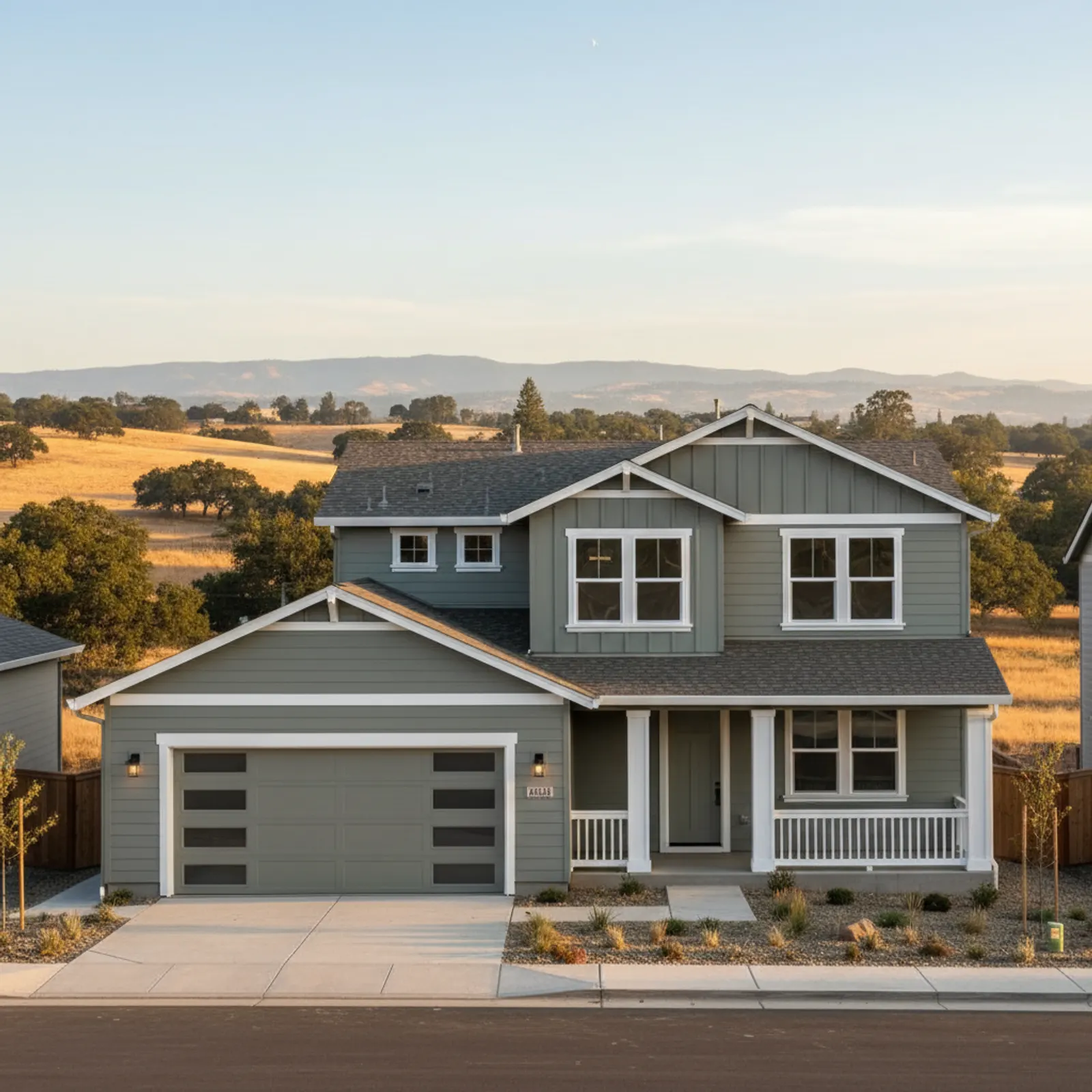
Exterior renovation in Rocklin
Rocklin occupies the transition zone between the Sacramento Valley floor and the Sierra foothills, and its exterior needs reflect that split personality. The city grew through the same late-1990s and 2000s production boom as neighboring Roseville — Whitney Ranch, Whitney Oaks, Stanford Ranch — alongside older ranch-style neighborhoods near historic downtown and the famous Rocklin granite quarries. A large share of these homes are now at the age where original siding and trim are failing, making Rocklin a strong and steady exterior-renovation market.
Heat in the west, embers on the edge
The defining decision on a Rocklin re-side is reading which Rocklin a home sits in. Western and central neighborhoods behave like the valley floor, where intense summer heat and UV fade finishes and stress south- and west-facing walls, and fade-resistant fiber cement is the answer. Push east toward Whitney Oaks and the subdivisions backing onto open grassland and oak, and a real moderate grassland-and-ember exposure enters the spec. We assess each address individually and step up to fully non-combustible, fire-detailed assemblies where the parcel warrants it — and tell you honestly when it does not.
Considering an exterior project in Rocklin?
Rocklin housing and architecture
Rocklin's stock is dominated by two-story production homes from the Stanford Ranch and Whitney Ranch eras, with pockets of single-story ranch homes in the older Sunset Whitney area and a band of larger custom and semi-custom homes on the eastern, foothill-adjacent edge near Whitney Oaks. The production homes respond very well to a modern re-side and trim program; the eastern custom homes call for a more architectural approach and, increasingly, fire-aware specification.
Built for Rocklin's heat and foothill edge
Western and central Rocklin behaves like the valley floor: intense summer heat and UV are the controlling factors, and the answer is fade-resistant fiber cement with heat-aware detailing, exactly as in Roseville. What changes in Rocklin is the eastern edge. As neighborhoods push toward open space and the foothill grassland-oak interface, grassland and ember exposure rises from negligible to a real moderate consideration. We assess each address individually and step up to fully non-combustible, fire-detailed assemblies where the parcel warrants it.
Fire-aware detailing on Rocklin's eastern edge
Rocklin is not Auburn, but it is also no longer pure valley once you reach the eastern subdivisions backing to open grassland and oak. For those homes we treat fire performance as part of the spec: Class A non-combustible cladding, and attention to eaves, vents, and the ground-to-wall transition where embers collect. For interior valley-side Rocklin homes this is a low-regret upgrade rather than a strict necessity, and we will tell you honestly which side of that line your home falls on.
Recommended materials for Rocklin
James Hardie fiber cement is our standard Rocklin recommendation: it handles valley heat and, being non-combustible, also covers the rising fire consideration on the eastern edge without a material change. Board-and-batten and mixed-profile designs are very effective on Rocklin's two-story production elevations. Engineered wood is acceptable on low-risk interior parcels but we generally favor fiber cement here precisely because so much of Rocklin trends toward at least moderate fire awareness.
What an exterior project costs in Rocklin
Cost drivers in Rocklin mirror the rest of western Placer: square footage and stories, trim and profile complexity, substrate and dry-rot condition once cladding is removed, window integration, and the weather- and fire-management scope. Foothill-edge homes that require additional fire detailing carry some added scope. As always we provide a written, scoped estimate after an on-site assessment rather than a generic per-foot number.
Granite quarry country and the older core
Rocklin's identity is rooted in its granite quarries, and the older single-story neighborhoods near historic downtown and the Sunset Whitney area carry more individual character than the production tracts that surround them. These homes take beautifully to a clean lap-and-batten re-side with updated trim, and the work is as much about respecting their established lines as modernizing them. We treat the older Rocklin core and the Stanford Ranch and Whitney Ranch production belt as distinct design problems, because the detailing that flatters a 1970s ranch is not the detailing that lifts a two-story 2000s elevation.
Rocklin is HZ10 — getting the Hardie board itself right
Homeowners searching for James Hardie in Rocklin usually want the material named, and the first thing worth confirming on any estimate is that it names the right regional line. Rocklin sits in Hardie's HZ10 zone — the West's hot, dry, low-freeze belt — same as the rest of the valley and its foothill transition. HZ10 is the only correct spec for a Rocklin home; the alternative HZ5 line is engineered for hard freeze-humidity climates that do not exist here, and installing the wrong line is a documented warranty misapplication. On top of the line question, Whitney Ranch, Stanford Ranch, and Whitney Oaks homes take particularly well to HardiePlank lap with HardiePanel-and-batten gable accents, and the two-story production elevations that dominate Rocklin's western and central subdivisions reward a considered ColorPlus palette that outlasts field paint on the west and south walls — the walls that fail first every time here. We name HZ10 in writing on every Rocklin estimate and match the install to Hardie's HZ10 best-practice guide so the manufacturer warranty is intact when the crew leaves.
Rocklin's fire-zone reality — what the 2025 remap did and did not do
California released its recommended 2025 Fire Hazard Severity Zone maps for Local Responsibility Areas early in 2025, and Placer County adopted the recommendations for its unincorporated LRA that year — but Rocklin is its own incorporated jurisdiction, and the county ordinance does not itself designate a parcel inside city limits. In practice a Rocklin homeowner cannot read the fire-zone question off the county map alone; the city's Community Development Department is the final authority for city-limit addresses, and where a permit is issued matters as much as where a lot sits on paper. Our Placer FHSZ reference covers the framework, and the WUI-listed products handbook documents the material side when a parcel is designated. On the eastern edge — Whitney Oaks, Springfield, the outer bands of Stanford Ranch — the terrain rationale for hardening is real regardless of the paper designation: open grassland, oak, and slope on the wind-exposed side. Non-combustible fiber cement and the accompanying eave-vent-and-grade details are a low-regret upgrade on those parcels even where the code is not strictly triggering it, and we tell homeowners honestly whether their specific address is hardening because of code, because of terrain, or both.
Our process in Rocklin
- Step 1
Consultation
We listen to your goals and assess your home on site — exposure, substrate, and architecture.
- Step 2
Design & Proposal
A clear written proposal with the right system specified for your climate and a transparent scope.
- Step 3
Expert Installation
Trained crews install to manufacturer best practices with careful weather-management detailing.
- Step 4
Walkthrough & Support
A final walkthrough, full cleanup, and a clear written record of the scope completed — work we stand behind.
Rocklin rewards an exterior strategy that respects its valley-to-foothill gradient. We specify per address, not by ZIP code average.
FAQ
Rocklin — Common Questions
It depends on where in Rocklin. Interior valley-side neighborhoods carry low exposure; eastern subdivisions backing to open grassland and oak warrant non-combustible cladding and fire-aware detailing. We assess each address.
Fiber cement with a fade-resistant factory finish. It handles valley heat and also covers the rising fire consideration on Rocklin's eastern edge without a material change.
Yes. These production-era homes are now at the age where original siding and trim fail, and they respond very well to a modern re-side and trim program.
Effectively yes for exterior purposes — western and central Rocklin shares the valley heat and UV profile, so the same heat-durable specification applies.
Absolutely. Single-story ranch homes take beautifully to a clean lap-and-batten re-side with updated trim and window detailing.
When feasible, yes — combining them ensures correct flashing integration and avoids duplicated trim work, improving both performance and appearance.
Yes, and those are exactly the Rocklin areas where we emphasize non-combustible cladding and fire-conscious detailing.
A properly installed fiber cement system commonly performs 30+ years in Rocklin's climate, with factory finishes extending the time before any cosmetic refresh.
Explore