Exterior Renovation for Carmel Valley's Inland Climate
Just a few miles inland from the fog line, Carmel Valley trades the Peninsula's salt air for warm, dry sun, oak-dotted hillsides, and the wildfire exposure that comes with living against the wildland. Sierra Siding builds exteriors here for a completely different stress profile than coastal Carmel: less moisture, more heat and UV, and a real obligation to harden the home against ember and fire. From the village core to the estates and ranches strung along Carmel Valley Road and up the side canyons, we spec each home to its actual sun and fire exposure rather than a generic valley template.
Why It Matters Here Specifically
In Carmel Valley the controlling exterior problem is wildfire, not weather, and that reframes a re-side as a hardening project rather than a cosmetic one. Much of the valley sits in or near the wildland-urban interface, with dry grass and brush running up to homes along the foothills and side canyons, and the region has seen serious fire activity in recent years. A re-side is the moment to put non-combustible fiber cement on the wall and tighten the ember-vulnerable details — eaves, soffits, vents, and ground-to-wall transitions — so wind-driven embers find no easy entry. In wildland-adjacent California that hardened, documentable exterior increasingly affects insurability and resale, not just looks, which is why we read each lot's real fire exposure before we spec it.
Considering an exterior project in Carmel Valley?
Ranches, Haciendas, and Wine-Country Estates
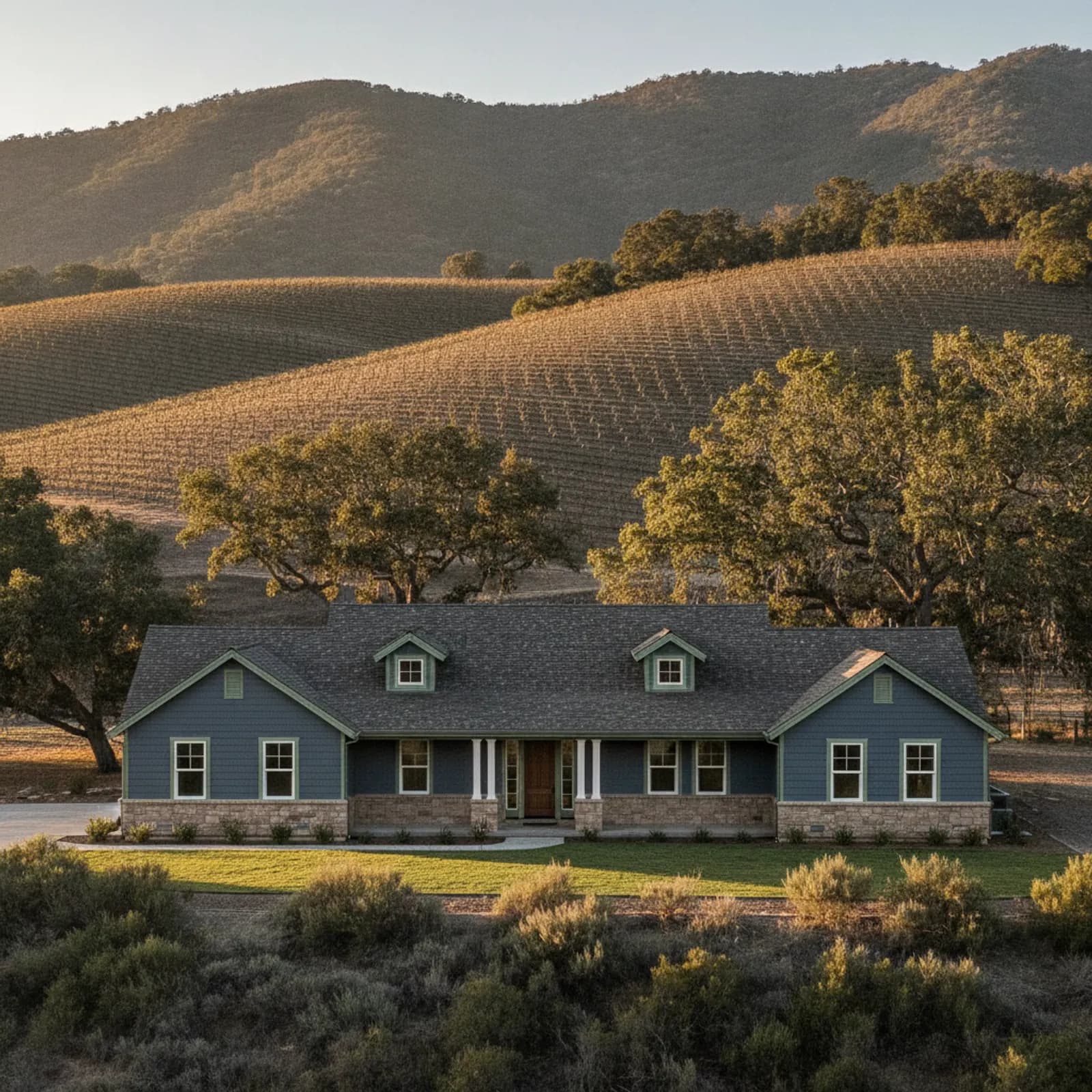
Carmel Valley's housing leans rural and individual: ranch homes on acreage, Spanish and Mediterranean hacienda styles that suit the warm dry climate, custom wine-country estates near the vineyards and tasting rooms, and rustic foothill cabins and lodges deeper in the canyons. There is little uniform tract here, so a re-side is rarely a like-for-like swap. We assess each home's massing, trim, and existing cladding, then rebuild the exterior to fit its character while quietly upgrading the assembly underneath. A hacienda keeps its heavy trim and warm finish; a ranch keeps its long horizontal lines; both gain a far more durable, fire-smart shell.
Heat, UV, and Wildland Exposure Drive the Spec
The controlling stressors in Carmel Valley are sun and fire, not salt or rain. Summer temperatures climb well above the coast, so cladding takes sustained heat and intense UV that fade finishes and stress wood. More importantly, much of the valley sits in or near the wildland-urban interface, with dry grass and brush running up to the structures along the foothills and canyons. That shapes the entire spec: non-combustible cladding, ember-resistant detailing, attention to eaves and vents, and finishes formulated to hold color through hard inland UV. We design the exterior to survive both the long dry summer and the fire season that follows it.
Hardening the Home Against Wildfire
Carmel Valley's foothill and canyon terrain carries genuine wildfire risk, and the Monterey County region has seen serious fire activity in recent years. For homes here we lead with non-combustible fiber cement, which carries a Class A fire rating and will not ignite or feed flame the way wood siding does. We extend the thinking past the wall surface: tight, ember-resistant detailing at eaves, soffits, trim, and penetrations so wind-driven embers find no easy entry point. The exterior becomes part of the home's defensible-space strategy, giving the structure a far better chance when fire pushes through the valley.
Non-Combustible Cladding Is the Right Spec Here
For Carmel Valley we recommend James Hardie and fiber cement as the primary system because they are non-combustible, hold up to heat and UV, and resist the warping and fading that plague exposed wood in a hot inland climate. Where a rustic, woodgrain look is essential to a cabin or lodge, LP SmartSide engineered wood offers that texture with better dimensional stability than solid cedar, though for the highest-exposure WUI lots we still steer toward the non-combustible option. In every case we finish with UV-stable coatings so the home keeps its appearance through the valley's bright, dry summers.
What Drives a Re-Side's Cost in Carmel Valley
Cost here is shaped by the valley's rural character. Many homes sit on acreage with long driveways and limited staging, custom and estate elevations are tall and detailed, and the fire-hardening work, ember-resistant detailing and non-combustible materials, adds value-driven labor over a plain re-side. The architectural variety means more custom trim and matching than a tract neighborhood would require. We scope each property on site, account for access and the fire spec the lot actually needs, and explain the budget so you understand what protection and finish quality you are buying.
From the Village to the Canyons
Carmel Valley spans very different conditions along its length. Homes near Carmel Valley Village and the lower valley floor see more moderate exposure, while properties climbing the foothills and side canyons toward the wildland face higher fire risk, steeper access, and more sun. We treat a valley-floor home and a ridge or canyon home as distinct problems, hardening the exterior most aggressively where the brush and terrain put the structure most at risk.
Acreage, Access, and Permitting
Much of Carmel Valley is rural Monterey County parcels rather than dense subdivision, which means longer drives, gated or shared access, and the need to protect landscaping and well or septic infrastructure during the work. We plan staging and material delivery for these conditions up front and coordinate the permitting that county work requires, so the project runs smoothly even on a remote canyon lot. Steep driveways and tight turnarounds also shape how we deliver and stage cladding, and we sort those logistics out before a single board arrives on the property.
Resale and Insurability
In wildland-adjacent California, a hardened, non-combustible exterior is increasingly tied to insurability and resale, not just appearance. A fire-smart fiber cement re-side gives a Carmel Valley home a meaningful, documentable upgrade that buyers and insurers recognize, while delivering the warm, well-detailed look the valley's market expects. It is one of the few improvements that pays back in protection, finish, and marketability at once. For estate buyers comparing properties along the valley, a maintained, fire-ready exterior is a tangible signal that the rest of the home has been cared for as well.
Monterey County, Cal-Am water, and CAL FIRE / Mid-Coast Fire
Working exteriors in Carmel Valley coordinates with a few local authorities. Carmel Valley is unincorporated Monterey County — there is no city government, so building permits come through the Monterey County Housing and Community Development / Building Services rather than a municipal department. Electric and gas are PG&E, and Carmel Valley is a documented PSPS-shutoff area because the ridges and side canyons raise the fire-risk threshold. Water on the valley floor is largely served by California-American Water (Cal-Am) under the state's Monterey Peninsula supply framework, though private wells still serve many rural parcels farther upvalley. Fire response is CAL FIRE / Monterey County Regional Fire (Mid-Coast) alongside adjacent local companies on structure calls; the Monterey County Sheriff and CAL FIRE coordinate PSPS and evacuation during red-flag events.
HZ10 and the Cachagua/foothill FHSZ reality
Carmel Valley is in James Hardie's HZ10 climate zone; installing HZ5 is a documented warranty misapplication. On the fire side, the valley-floor lots near the village sit in Moderate FHSZ territory under California's 2025 LRA Fire Hazard Severity Zone map, while the foothill and canyon parcels climbing toward Cachagua, Los Padres National Forest, and the Santa Lucia range carry High to Very High designations — an exposure profile confirmed by the 2016 Soberanes Fire and other Monterey County wildland events. On designated hillside parcels the 2025 California Wildland-Urban Interface Code governs the exterior wall. Chapter 7A moved into the standalone WUI Code on January 1, 2026.
Our process in Carmel Valley
- Step 1
Consultation
We listen to your goals and assess your home on site — exposure, substrate, and architecture.
- Step 2
Design & Proposal
A clear written proposal with the right system specified for your climate and a transparent scope.
- Step 3
Expert Installation
Trained crews install to manufacturer best practices with careful weather-management detailing.
- Step 4
Walkthrough & Support
A final walkthrough, full cleanup, and a clear written record of the scope completed — work we stand behind.
Carmel Valley homes live with sun and wildfire, not salt, so the right exterior is a hardened, non-combustible one finished to the valley's warm character. Sierra Siding builds that kind of fire-smart shell for ranches, haciendas, and estates across the valley. When you are ready, we will walk your lot, read its real fire and sun exposure, and show you how we would protect it.
FAQ
Carmel Valley — Common Questions
Carmel Valley is inland, warm, and dry with real wildfire exposure, while coastal Carmel battles salt and fog. That flips the priorities: the valley spec centers on heat, UV, and fire hardening rather than salt-air corrosion and moisture management.
Much of the valley sits in or near the wildland-urban interface, with dry grass and brush along the foothills and canyons, and the region has seen serious fire activity. Homes closer to the wildland carry higher risk and benefit most from a non-combustible, ember-resistant exterior.
We lead with James Hardie and fiber cement because they are non-combustible and carry a Class A fire rating, paired with tight ember-resistant detailing at eaves, vents, and trim. That makes the exterior part of the home's defensible-space strategy.
Yes. LP SmartSide engineered wood gives a woodgrain texture with better stability than solid cedar. For the highest-exposure wildland lots we still recommend non-combustible fiber cement, but moderate-exposure homes can use engineered wood for character.
In wildland-adjacent California, a non-combustible, hardened exterior is increasingly tied to insurability and resale. A fiber cement re-side gives you a documentable upgrade that insurers and buyers recognize, beyond just the improved appearance.
Many valley homes sit on acreage with long or gated driveways and limited staging, and the work has to protect landscaping plus well and septic infrastructure. We plan access and delivery for those conditions up front and handle county permitting.
We finish with UV-stable coatings built for hot, bright inland sun, so the exterior resists the fading and stress that hard summer UV causes. Fiber cement also will not warp or check the way exposed wood does in sustained heat.
Explore
Exterior Services
Helpful Exterior Guides