
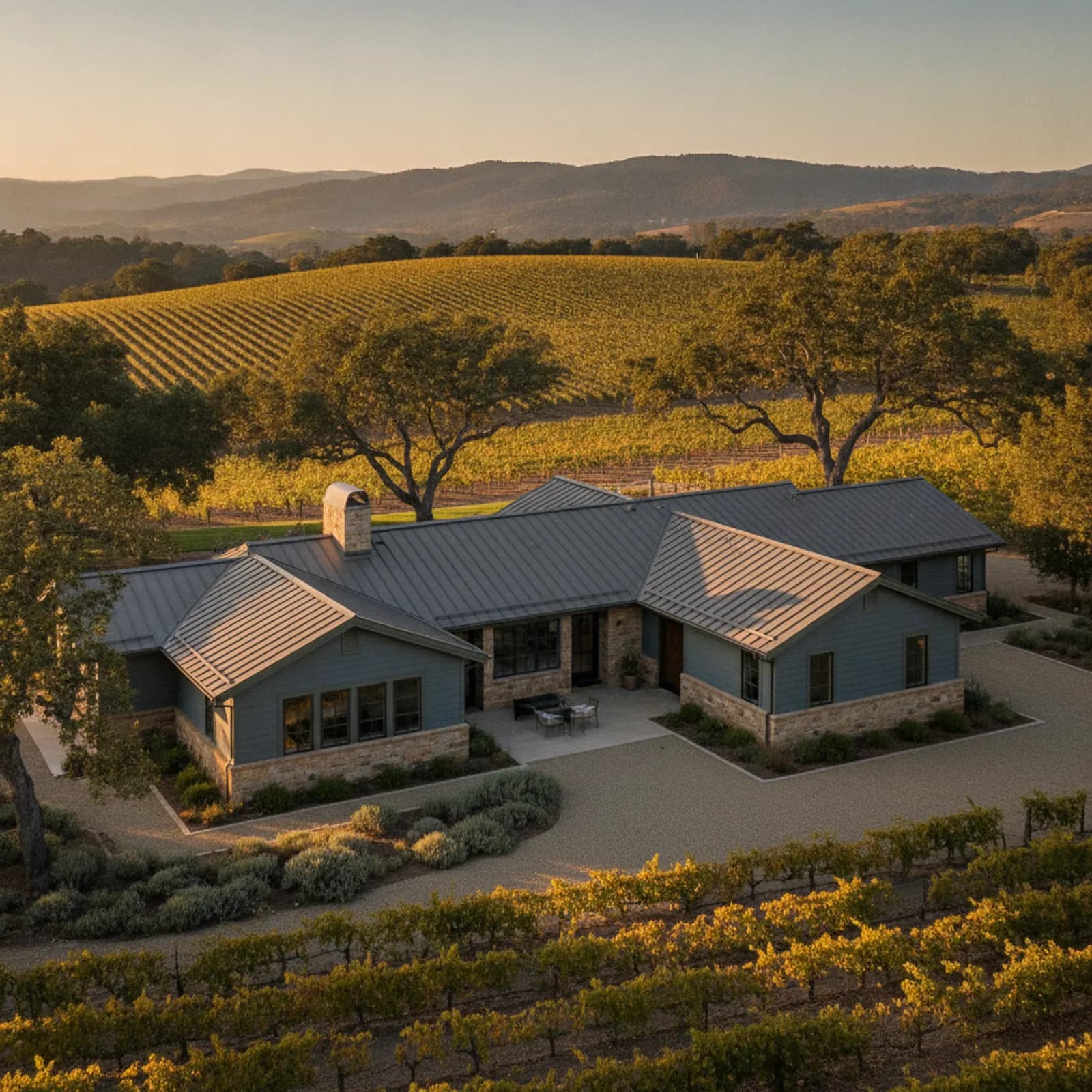
Fire-Resistant Siding in Carmel Valley
Direct answer: Carmel Valley carries genuine wildfire exposure. Much of its housing sits on oak- and chaparral-covered hillsides in wildland-urban interface terrain, in a warm, dry inland climate that cures vegetation to tinder by late summer. For homes on these slopes, fire-resistant siding and ember hardening are not a low-regret extra — they are the central reason to re-clad, and they should be specified to WUI-code standards where the parcel falls in a designated fire hazard zone.
Carmel Valley's real WUI exposure
Unlike the fog-buffered coast, the inland valley is hot and dry through the long fire season, and its estates and ranches sit directly against oak and chaparral fuel on the surrounding hills. That puts a large share of valley homes in genuine wildland-urban interface terrain, where wind-driven embers — not just a flame front — are the primary ignition threat. We treat fire exposure here as a controlling design input, the way the foggy coast treats salt, because for these parcels it genuinely is.
The WUI code and non-combustible cladding
The 2025 California Wildland-Urban Interface Code governs construction in designated wildfire hazard zones, and for valley homes that fall in those zones the exterior wall, eaves, vents, and openings all have requirements. We specify non-combustible cladding — Class A fiber cement such as James Hardie HZ10 or equivalent — and detail the assembly to 7A intent: ignition-resistant materials at the wall, sealed joints, and a wall plane that won't carry flame. Where a parcel sits in a mapped hazard zone we build to that standard rather than treating it as optional.
Ember hardening: the details that decide it
Most homes lost in California wildfires aren't taken by the main flame front — they're ignited by embers finding a vent, an unsealed eave, a combustible deck-to-wall junction, or a ground-to-wall transition packed with bark and leaf litter. So fire-resistant siding only works as part of ember hardening: ember-resistant vents, closed and detailed eaves and soffits, non-combustible base trim, and a clear ground-to-wall transition. On Carmel Valley's slopes we scope those details with the cladding rather than leaving them to chance, because any one of them can undo a non-combustible wall.
Defensible space alongside the hardened exterior
A hardened exterior and defensible space work together, and on the oak-shaded estate and ranch parcels of Carmel Valley both matter. We detail the first five feet around the home — non-combustible base trim, gravel or hardscape buffers, clearance from shrubs and bark mulch against the wall — as part of the exterior scope, because that zone is where embers settle and ignite siding. On ranch properties that zero-to-five-foot zone often abuts decks, fencing, and stored equipment, so we flag where a combustible attachment would undermine an otherwise hardened wall. Vegetation management out beyond that zone is a landscape professional's work; we make sure our cladding and ground-to-wall detailing integrates cleanly with whatever defensible-space plan the parcel needs.
Why this matters in Carmel Valley
- Specified for Monterey Peninsula conditions
- James Hardie as the recommended system
- Correctly detailed weather-resistive barrier and flashing
- Installed by a crew with 20 years combined experience
Recommended systems for Carmel Valley
- James Hardie
- fiber cement
- LP SmartSide
Fire-Resistant Siding for Carmel Valley homes
The full fire-resistant siding approach — materials, weather-resistive detailing, and the manufacturer standards we install to — is covered on the main service page, then specified for Carmel Valley's conditions on this one.
Our Carmel Valley process
- Step 1
Consultation
We listen to your goals and assess your home on site — exposure, substrate, and architecture.
- Step 2
Design & Proposal
A clear written proposal with the right system specified for your climate and a transparent scope.
- Step 3
Expert Installation
Trained crews install to manufacturer best practices with careful weather-management detailing.
- Step 4
Walkthrough & Support
A final walkthrough, full cleanup, and a clear written record of the scope completed — work we stand behind.
FAQ
Fire-Resistant Siding in Carmel Valley — FAQ
For homes on the oak-and-chaparral hillsides, yes — this is genuine wildland-urban interface terrain in a hot, dry climate, so non-combustible cladding and ember hardening are central, not optional. Valley-floor parcels well away from wildland fuel are lower exposure.
The WUI code is California's building code for construction in designated wildfire hazard zones, covering walls, eaves, vents, and openings. It applies to Carmel Valley parcels that fall in a mapped hazard zone, and we build to its intent on those homes.
It's necessary but not sufficient — most homes ignite from embers entering vents, eaves, or the ground-to-wall transition. Fire-resistant siding works only when those details are hardened with it, which is how we scope it.
Not really — the Class A fiber cement we'd recommend for the valley's sun and heat is already non-combustible, so the fire performance comes with it. The added work is in the ember-hardening details, not the board.
We detail the critical first five feet — non-combustible base trim, hardscape buffers, clearance from wall-contact vegetation — as part of the exterior. Vegetation work beyond that goes to a landscape professional, and we coordinate our detailing with it.
Keep Exploring
More for Carmel Valley homeowners
More in Carmel Valley
Other exterior services in Carmel Valley
Nearby Service Areas
Fire-Resistant Siding near Carmel Valley
Back to
Monterey County & Carmel Valley
Helpful Exterior Guides