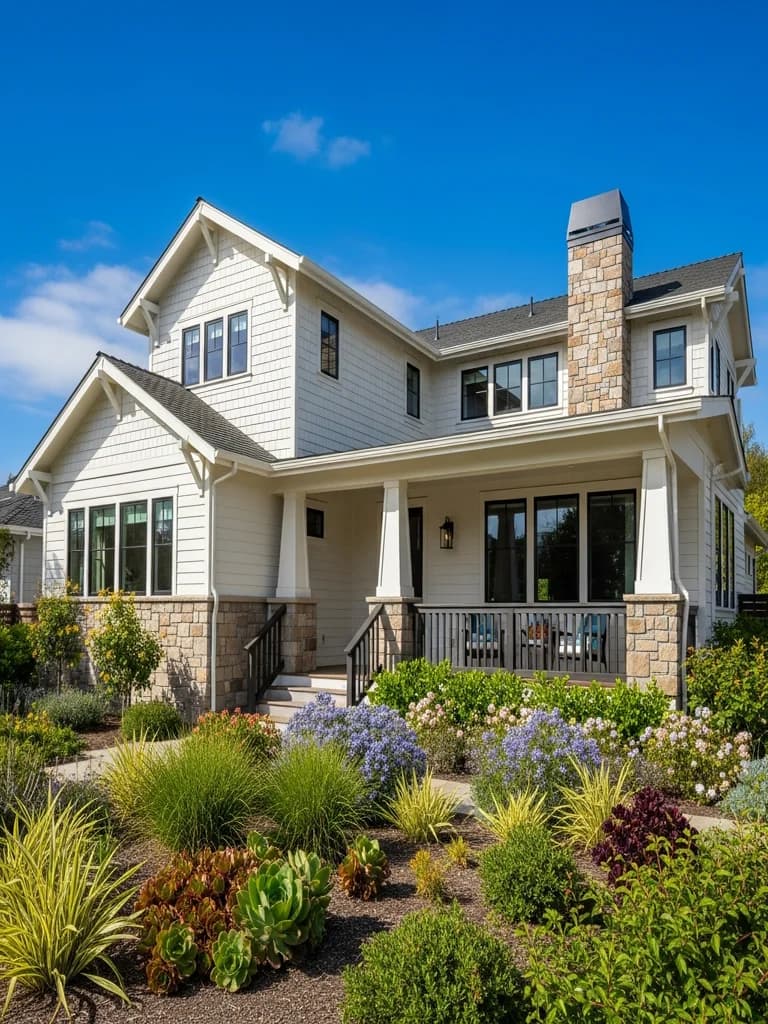
Siding in Carmel Valley
A Carmel Valley re-side is an estate-and-ranch project set in a warm, dry inland pocket that escapes the coastal fog the rest of the Peninsula lives under. Strung along Carmel Valley Road from the village inward, the housing here is high-end custom homes, working ranches, and wine-country estates on oak- and chaparral-covered hillsides. The controlling stressor is the inland combination of strong summer sun and genuine wildland-urban interface fire exposure on those hills — not salt air.
We scope a Carmel Valley re-side from the estate's architecture, its sun-loaded elevations, and its position on the fire-exposed slope first — never a stock re-clad carried over from the foggy coast.
Estate and ranch architecture along Carmel Valley Road
The homes inland of Carmel Valley Village range from sprawling single-story ranch houses to architect-designed estates and wine-country compounds, and the cladding job changes with each. Long ranch elevations, deep eaves, board-and-batten gables, and mixed stone-and-wood walls all want faithful re-creation rather than a uniform lap-board substitution. We document the existing profiles, reveals, and trim before tear-off so the re-side reads as the same considered home it was, scaled to the generous lots these properties sit on.
Sun and heat, not coastal fog, drive the spec
Carmel Valley sits in the sunbelt that the marine layer rarely reaches, so the envelope problem here is UV load and hot, dry thermal swings rather than salt and shade-damp. South- and west-facing walls take punishing summer sun that bakes field paint and works thermal movement hard at every joint. We specify finishes chosen for fade and heat stability, size sealant joints for the valley's wide day-night temperature swing, and detail expansion gapping so long ranch runs of cladding stay tight instead of oil-canning or splitting in the heat.
Siding as part of wildfire hardening on the hillsides
Much of Carmel Valley's housing sits on oak and chaparral slopes that carry real wildland-urban interface exposure, so for a meaningful share of these homes the re-side is also the moment to swap combustible wood, shingle, or T1-11 walls for non-combustible cladding. We treat the lower courses, the ground-to-wall transition, and the wall-to-eave junction as ignition-vulnerable details rather than afterthoughts. A re-side that ignores the slope it sits on misses the single biggest reason many valley owners are re-cladding in the first place.
Access, staging, and protecting the oaks on large parcels
Estate and ranch lots in Carmel Valley are large, often gated, and shaded by mature valley oaks that owners value as much as the house. That changes how a re-side runs: material drops and lift placement get planned around root zones and low canopy rather than the other way around, and long single-story elevations reward staging that lets a crew work an entire wall plane at once. On working ranch properties we sequence around outbuildings, livestock fencing, and the working life of the parcel. The lots give us room to work cleanly, but only if the staging respects the trees and the property's daily use.
Why this matters in Carmel Valley
- Specified for Monterey Peninsula conditions
- James Hardie as the recommended system
- Correctly detailed weather-resistive barrier and flashing
- Installed by a crew with 20 years combined experience
Recommended systems for Carmel Valley
- James Hardie
- fiber cement
- LP SmartSide
Fiber Cement Siding for Carmel Valley homes
The full fiber cement siding approach — materials, weather-resistive detailing, and the manufacturer standards we install to — is covered on the main service page, then specified for Carmel Valley's conditions on this one.
Our Carmel Valley process
- Step 1
Consultation
We listen to your goals and assess your home on site — exposure, substrate, and architecture.
- Step 2
Design & Proposal
A clear written proposal with the right system specified for your climate and a transparent scope.
- Step 3
Expert Installation
Trained crews install to manufacturer best practices with careful weather-management detailing.
- Step 4
Walkthrough & Support
A final walkthrough, full cleanup, and a clear written record of the scope completed — work we stand behind.
FAQ
Siding in Carmel Valley — FAQ
Carmel Valley is the warm, dry, sun-and-fire inland valley — UV load and wildland-interface exposure drive the spec, not the open-Pacific salt and pine-canopy shade-damp that govern coastal Carmel-by-the-Sea. The two read nothing alike.
Yes — south and west walls take heavy summer UV and wide thermal swings that bake paint and stress joints. We specify fade- and heat-stable finishes and size expansion gapping for the valley's hot, dry climate.
For most hillside and rural parcels, yes — the oak and chaparral slopes carry genuine WUI exposure, so re-cladding is the natural time to move to non-combustible siding and harden the ground-to-wall and eave details.
Yes — we document the original board profiles, reveals, and trim before tear-off and re-create them faithfully, whether that's board-and-batten, lap, shingle accents, or a mixed stone-and-wood elevation.
They give room to work whole wall planes cleanly, but staging has to protect mature valley oaks and work around gates, outbuildings, and ranch operations — we plan access and material drops around those constraints.
Keep Exploring
More for Carmel Valley homeowners
More in Carmel Valley
Other exterior services in Carmel Valley
Nearby Service Areas
Siding near Carmel Valley
Back to
Monterey County & Carmel Valley
Helpful Exterior Guides