
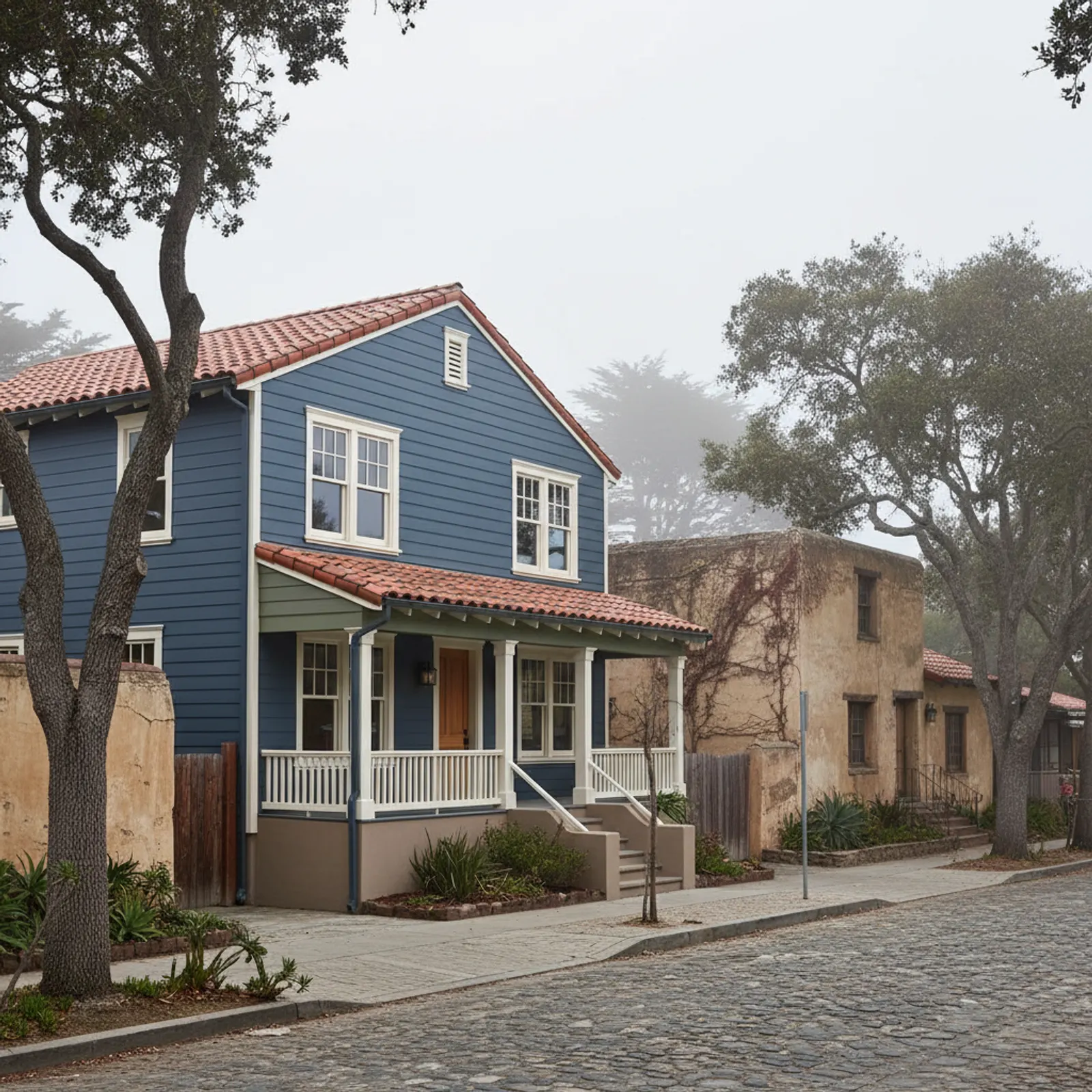
Siding in Monterey
A Monterey re-side is a fog-saturation and heritage problem, distinct from inland Salinas's valley work. The Monterey Peninsula sits in near-constant marine fog with salt off the bay, and the city carries one of California's most significant concentrations of historic adobes and Monterey Colonial architecture under real design scrutiny.
So a Monterey project is scoped around relentless drying demand and historic fidelity together. The cladding matters less than the drainage plane, corrosion-rated metal, and faithful reproduction of the peninsula's distinctive profiles and proportions.
Near-constant fog is the controlling factor
Monterey's persistent marine fog keeps walls damp far more hours than a sunny inland town; combined with bay salt, it punishes any assembly that cannot dry. We strip, replace corroded fastening and flashing with corrosion-rated components, correct moisture-damaged substrate, and re-clad over a rigorous, continuously drying plane.
Historic-peninsula fidelity, not generic re-clad
Monterey's adobes, downtown historic homes, and Monterey Colonial stock have exact proportions and trim that the work must respect — often within design-review expectations. We replicate profile and detail faithfully while engineering the concealed failure points out.
Bay-front exposure dictates the fasteners and flashing, not just the cladding
On Monterey's coastal hillside homes above the bay, the salt load is severe enough that the metal hidden inside the wall fails long before the visible siding does. That reality drives the spec from the fasteners outward. Standard galvanized nails and ordinary flashing corrode quickly here, so a sound re-side leans on stainless or heavily coated fasteners, corrosion-rated flashing and trim, and connectors chosen for marine service rather than whatever a big-box shelf offers. The choice of cladding itself matters less than whether every fixing and transition behind it can survive constant salt deposition. We also detail penetrations, window heads, and kick-out flashing with extra care, because a bay-facing elevation gets driven moisture from angles an inland wall never sees. Skipping any of this looks fine on handover day and then shows up two or three winters later as rust bleed, loosened siding, and rot starting at the fastener line. For the homes ringing the bay, building the corrosion resistance into the connections is the difference between a wall that lasts and one that quietly comes apart from the inside.
Tight downtown lots and pine-shaded slopes change how the job gets staged
Re-siding in Monterey is as much a logistics problem as a wall problem. Downtown-area homes sit on narrow streets with limited curb space, while the houses threaded through Monterey pine on the hillsides above the bay often have steep, shaded approaches and no flat ground for a material drop. That shapes the work plainly: scaffold and staging have to be planned around the lot before a single board comes off, debris gets hauled rather than left to bake on a driveway, and material is staged in smaller, sequenced loads instead of one bulk delivery. The dense pine canopy also keeps walls damp and slow to dry, so we sequence tear-off and dry-in to avoid leaving sheathing exposed through a foggy stretch. On the historic downtown blocks, access also means respecting neighbors and protecting mature landscaping that cannot simply be trampled. None of this appears in a generic siding quote, but on the peninsula it determines the timeline, the crew size, and whether the wall ever gets fully closed in before the marine layer rolls back through.
Why this matters in Monterey
- Specified for Monterey Peninsula conditions
- non-combustible fiber cement as the recommended system
- Correctly detailed weather-resistive barrier and flashing
- Installed by a crew with 20 years combined experience
Recommended systems for Monterey
- non-combustible fiber cement
- corrosion-resistant fastening
- rigorous drainage detailing
Fiber Cement Siding for Monterey homes
The full fiber cement siding approach — materials, weather-resistive detailing, and the manufacturer standards we install to — is covered on the main service page, then specified for Monterey's conditions on this one.
Our Monterey process
- Step 1
Consultation
We listen to your goals and assess your home on site — exposure, substrate, and architecture.
- Step 2
Design & Proposal
A clear written proposal with the right system specified for your climate and a transparent scope.
- Step 3
Expert Installation
Trained crews install to manufacturer best practices with careful weather-management detailing.
- Step 4
Walkthrough & Support
A final walkthrough, full cleanup, and a clear written record of the scope completed — work we stand behind.
FAQ
Siding in Monterey — FAQ
Monterey sits in near-constant peninsula fog with bay salt and carries protected historic architecture; Salinas is an inland agricultural-valley climate. Drying demand and heritage fidelity define Monterey.
Persistent marine fog keeps walls wet far more hours than inland sites, and bay salt corrodes fastening — trapped moisture in a non-drying assembly, not the board, is the usual cause.
Yes — faithful reproduction of the peninsula's profiles and proportions is central to the work, often within design-review expectations.
In the developed coastal city it's secondary to fog and salt. Non-combustible fiber cement is still a sound, low-regret default with no downside.
Yes — the peninsula's drying demand and salt exposure affect coastal hillside and downtown homes regardless of age.
Keep Exploring
More for Monterey homeowners
More in Monterey
Other exterior services in Monterey
Nearby Service Areas
Siding near Monterey
Helpful Exterior Guides