
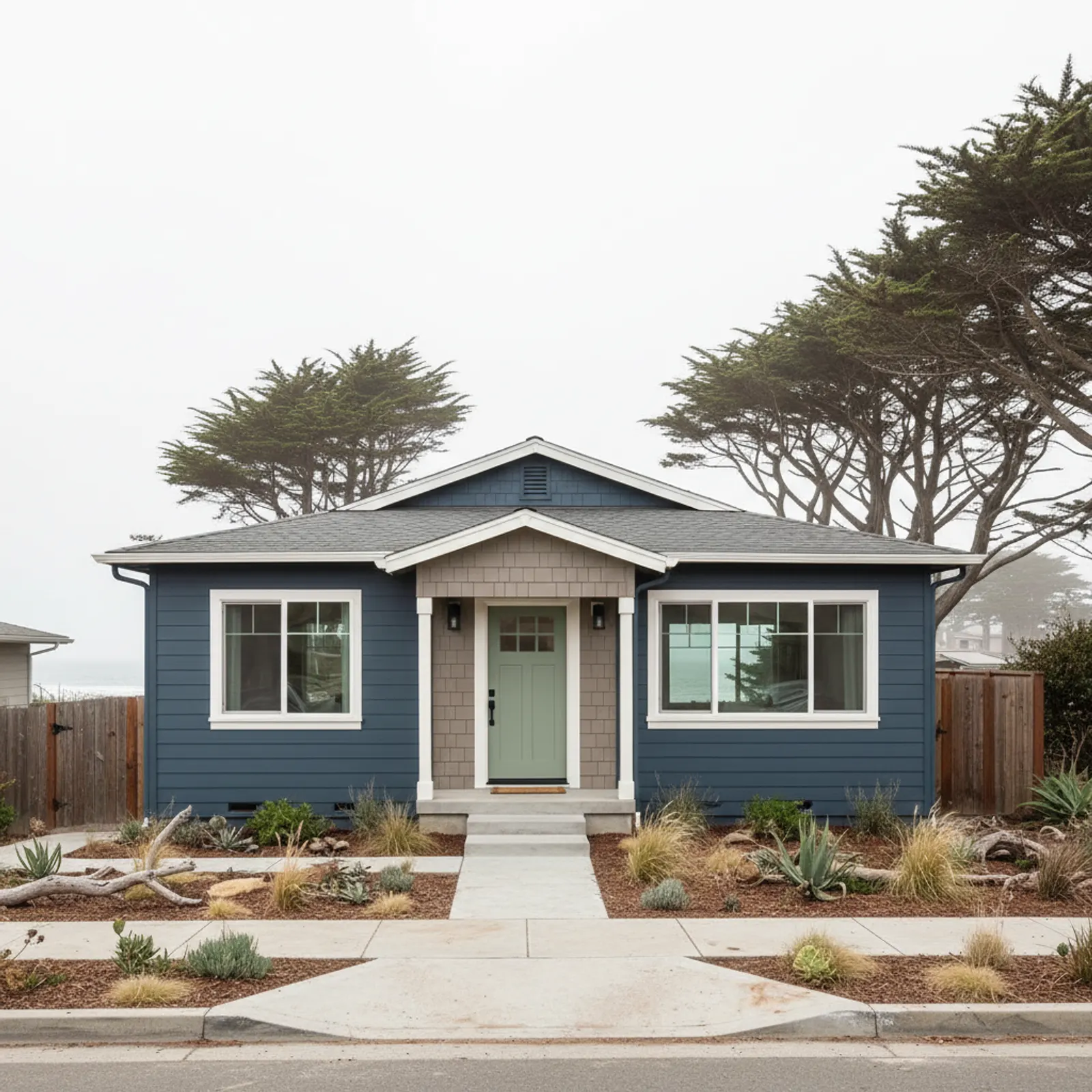
Siding in Seaside
A Seaside re-side is about aging Fort Ord-era tract stock on a salt-and-fog peninsula slope. Between Monterey and Marina, Seaside is a dense, practical, working peninsula city built largely of postwar coastal tracts (much of it Fort Ord-era) plus newer infill — and it rises from the bay flats into the hills, so marine moisture and salt exposure are graded by elevation rather than uniform.
So a Seaside project is scoped around durable, value-driven re-clads of a large aging stock, with exposure detailing tuned to how high and wind-open the parcel sits.
A large aging postwar stock, overdue
Much of Seaside's Fort Ord-era tract housing is well past its original cladding life. These are the core re-sides: strip, correct salt- and moisture-degraded substrate and fastening, and re-clad in durable non-combustible fiber cement with a refreshed palette that modernizes a dated street on a practical budget.
Exposure graded by elevation
Lower Seaside flats see steadier fog and less wind; the upper slopes and ridges take more wind-driven salt and damp. We tune flashing robustness and corrosion-aware detailing to where the home actually sits rather than applying one spec citywide.
Fastener and flashing choices for a salt-laden bay slope
On the windward side of Seaside, the marine layer drives salt deep into wall assemblies, and that reality dictates the hardware long before it dictates the cladding. Standard electro-galvanized nails and cheap face screws corrode fast here, bleeding rust streaks down a fresh wall within a couple of foggy winters. A siding job that lasts on these tract homes runs hot-dipped galvanized or stainless fasteners, corrosion-resistant flashing at every penetration, and clad or coated metal trim rather than bare steel. Kickout flashing at roof-to-wall junctions matters more in this damp air than it would inland, because water that lingers instead of drying becomes a substrate problem. We also pay attention to the back side of the cladding: a properly furred rain screen gap lets the assembly breathe and shed the moisture the fog forces in. The houses climbing toward the hills above the bay flats see less direct salt spray but more wind-driven rain, so the detailing shifts parcel by parcel rather than following one peninsula-wide recipe.
Re-clading former Fort Ord housing on a budget that pencils
Seaside reads differently from Carmel or Pacific Grove down the coast. It is a working, family-first city, and much of its housing came out of the Fort Ord era as practical tract construction, not heritage cottages. That changes how a re-side conversation goes. Owners here are usually weighing real value, not chasing a historic look, so the smart move is a durable mid-range cladding that shrugs off salt air for decades without the premium price a peninsula address can otherwise imply. Fiber cement and quality engineered products fit that brief well: they hold paint in the damp marine climate, resist the moisture that chews through older wood siding, and keep maintenance low for households that would rather not be repainting every few years. Many of these homes also share lot lines tightly in the denser postwar blocks, so staging, access, and protecting a neighbor's wall a few feet away become part of the plan. The goal is a wall that outlasts the fog cycle while respecting what a Seaside budget actually supports.
Why this matters in Seaside
- Specified for Monterey Peninsula conditions
- non-combustible fiber cement as the recommended system
- Correctly detailed weather-resistive barrier and flashing
- Installed by a crew with 20 years combined experience
Recommended systems for Seaside
- non-combustible fiber cement
- corrosion-resistant fastening
- drainage-plane detailing
Fiber Cement Siding for Seaside homes
The full fiber cement siding approach — materials, weather-resistive detailing, and the manufacturer standards we install to — is covered on the main service page, then specified for Seaside's conditions on this one.
Our Seaside process
- Step 1
Consultation
We listen to your goals and assess your home on site — exposure, substrate, and architecture.
- Step 2
Design & Proposal
A clear written proposal with the right system specified for your climate and a transparent scope.
- Step 3
Expert Installation
Trained crews install to manufacturer best practices with careful weather-management detailing.
- Step 4
Walkthrough & Support
A final walkthrough, full cleanup, and a clear written record of the scope completed — work we stand behind.
FAQ
Siding in Seaside — FAQ
Seaside is a dense, aging Fort Ord-era tract city with exposure graded by its bay-to-hills elevation — versus Marina's raw open-dune wind or Monterey's fog-sheltered historic streets. The work is large-scale practical re-cladding.
Decades of peninsula salt and marine damp on original Fort Ord-era cladding — it's past its life. Failure is age-and-exposure driven, fixed by a durable non-combustible re-clad.
Yes — upper slopes take more wind-driven salt and damp than the lower flats; we tune flashing and corrosion detailing to where your parcel actually sits.
Low — developed peninsula city; salt and marine moisture, not fire, are the controlling factors. Non-combustible fiber cement is still a sound, low-regret default.
Yes — the same exposure-graded, drying-capable approach, tuned to the home; newer infill often needs less than the aging tract stock.
Keep Exploring
More for Seaside homeowners
More in Seaside
Other exterior services in Seaside
Helpful Exterior Guides