
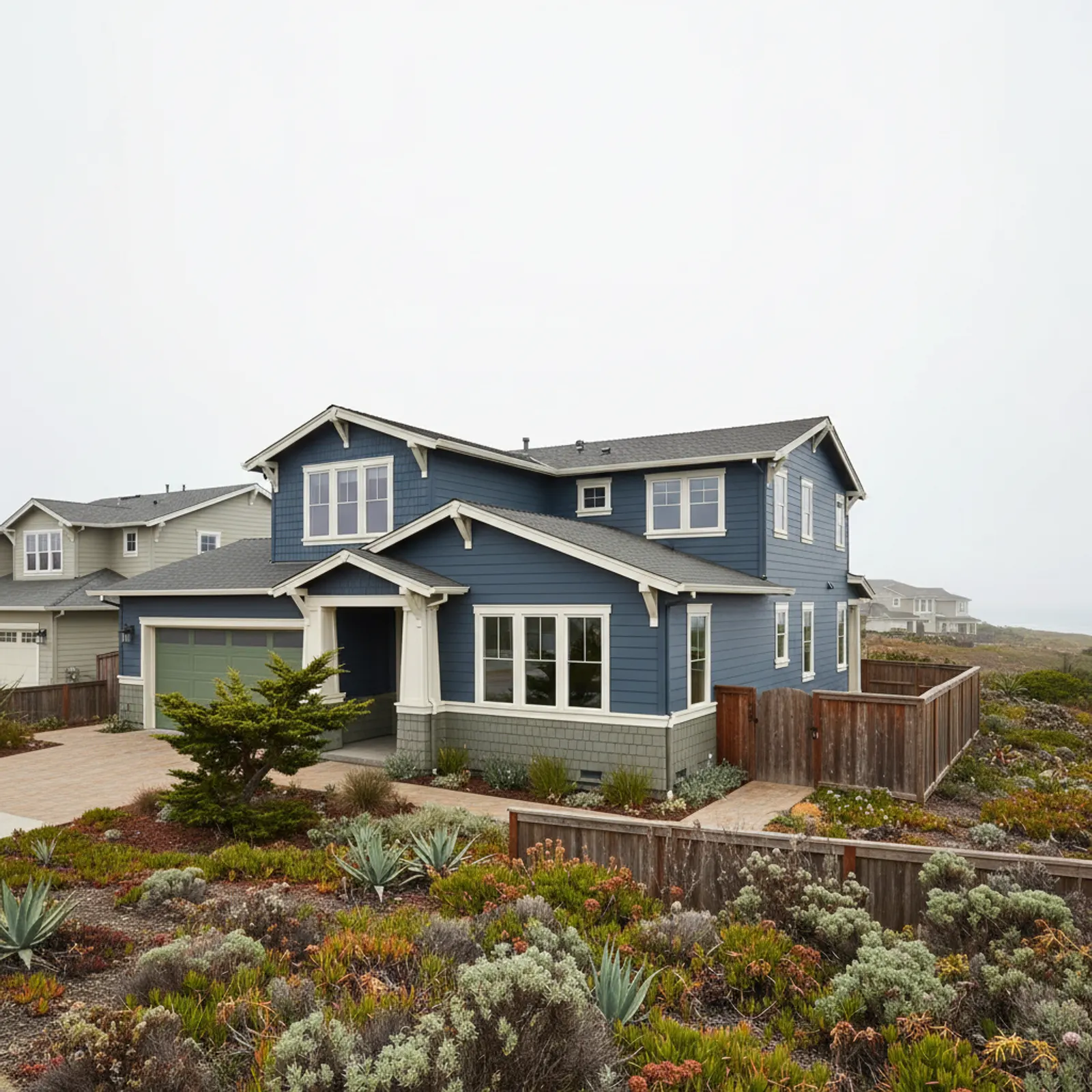
Siding in Marina
A Marina re-side is an exposed open-dune-coast problem. North of the sheltered historic peninsula, Marina sits directly on the windswept Monterey Bay dune coast — so beyond high marine moisture and salt, its homes take wind-driven salt and even fine sand abrasion off Marina State Beach far harder than tucked-in Monterey. It's a fast-growing, value-driven market of newer master-planned (the Dunes/CSUMB area) and postwar tract homes.
So a Marina project is scoped around wind-driven salt and abrasion plus drying capacity — practical, durable assemblies, not heritage detailing.
Open-dune wind is the distinctive factor
Unlike Monterey's fog-sheltered streets, Marina faces the raw bay: persistent onshore wind drives salt and fine sand into joints, fasteners, and finishes. We build a robustly flashed, drying-capable plane with corrosion-rated metal and abrasion-tolerant finishes facing the prevailing wind.
A practical master-planned and tract market
Marina's newer master-planned homes and aging postwar tracts want durable, low-maintenance re-clads with a clean refreshed palette — value-driven work that ends the wind-and-salt failure cycle, not period replication.
Fastener and flashing choices for the Fort Ord build-out
The new neighborhoods rising on the former Fort Ord lands near CSUMB and The Dunes give Marina a different siding profile than the older postwar tracts inland. These master-planned homes go up quickly with engineered sheathing and modern weather-resistive barriers, but the salt load off the bay is unforgiving on the small details. We specify stainless or hot-dip galvanized fasteners rather than standard coated screws, because plain zinc heads streak and weep rust within a season this close to the dunes. Kickout flashing at every roof-wall intersection, properly lapped Z-flashing over horizontal joints, and corrosion-rated trim coil all matter more here than they would a few miles inland in Salinas. On the postwar tracts, original galvanized nails are often already bleeding through paint, which is a reliable sign the wall needs more than a recoat. Scoping a Marina re-side means treating the metal and the laps as the first line of defense, not an afterthought, so the new cladding outlasts the salt that took down the old.
Drying capacity matters more than any single product here
Marine moisture in Marina is relentless: morning fog rolls in off Monterey Bay, onshore humidity stays high, and walls rarely get the long dry spell that lets trapped water escape. For siding that means a wall assembly has to be able to dry, not just resist water at the surface. We favor a ventilated rainscreen gap behind fiber-cement or engineered-wood cladding so any moisture that gets past the face has a drainage and drying path instead of sitting against the sheathing. Back-priming cut ends, sealing field cuts, and keeping the bottom course well off grade all help, because a board that wicks at an unsealed edge will swell and cup long before the painted face fails. This is the opposite of a low-humidity inland spec, where surface shedding is enough. On the dune side of the peninsula, a sealed-tight wall with no drying path is how you grow hidden rot. Building Marina siding to breathe is what keeps the assembly sound through years of fog and salt.
Why this matters in Marina
- Specified for Monterey Peninsula conditions
- non-combustible fiber cement as the recommended system
- Correctly detailed weather-resistive barrier and flashing
- Installed by a crew with 20 years combined experience
Recommended systems for Marina
- non-combustible fiber cement
- corrosion-resistant fastening
- factory finishes
Fiber Cement Siding for Marina homes
The full fiber cement siding approach — materials, weather-resistive detailing, and the manufacturer standards we install to — is covered on the main service page, then specified for Marina's conditions on this one.
Our Marina process
- Step 1
Consultation
We listen to your goals and assess your home on site — exposure, substrate, and architecture.
- Step 2
Design & Proposal
A clear written proposal with the right system specified for your climate and a transparent scope.
- Step 3
Expert Installation
Trained crews install to manufacturer best practices with careful weather-management detailing.
- Step 4
Walkthrough & Support
A final walkthrough, full cleanup, and a clear written record of the scope completed — work we stand behind.
FAQ
Siding in Marina — FAQ
Marina sits on the exposed open-dune bay coast with wind-driven salt and sand abrasion, versus Monterey's fog-sheltered historic streets. Marina work is practical wind-and-salt durability, not heritage detailing.
Persistent onshore wind drives salt and fine sand into joints and finishes; failure is wind-driven salt/abrasion past under-detailed flashing, not the cladding alone.
Low — Marina is a developed dune-coast town; wind-driven salt and marine moisture, not fire, are the controlling factors. Non-combustible fiber cement is still a sound, low-regret default.
Yes — though younger homes often need targeted corrosion-aware maintenance rather than a full re-side; we'll say honestly which yours needs.
A robustly flashed, drying-capable fiber cement assembly with corrosion-rated metal and abrasion-tolerant factory finishes on the windward elevations.
Keep Exploring
More for Marina homeowners
More in Marina
Other exterior services in Marina
Helpful Exterior Guides