
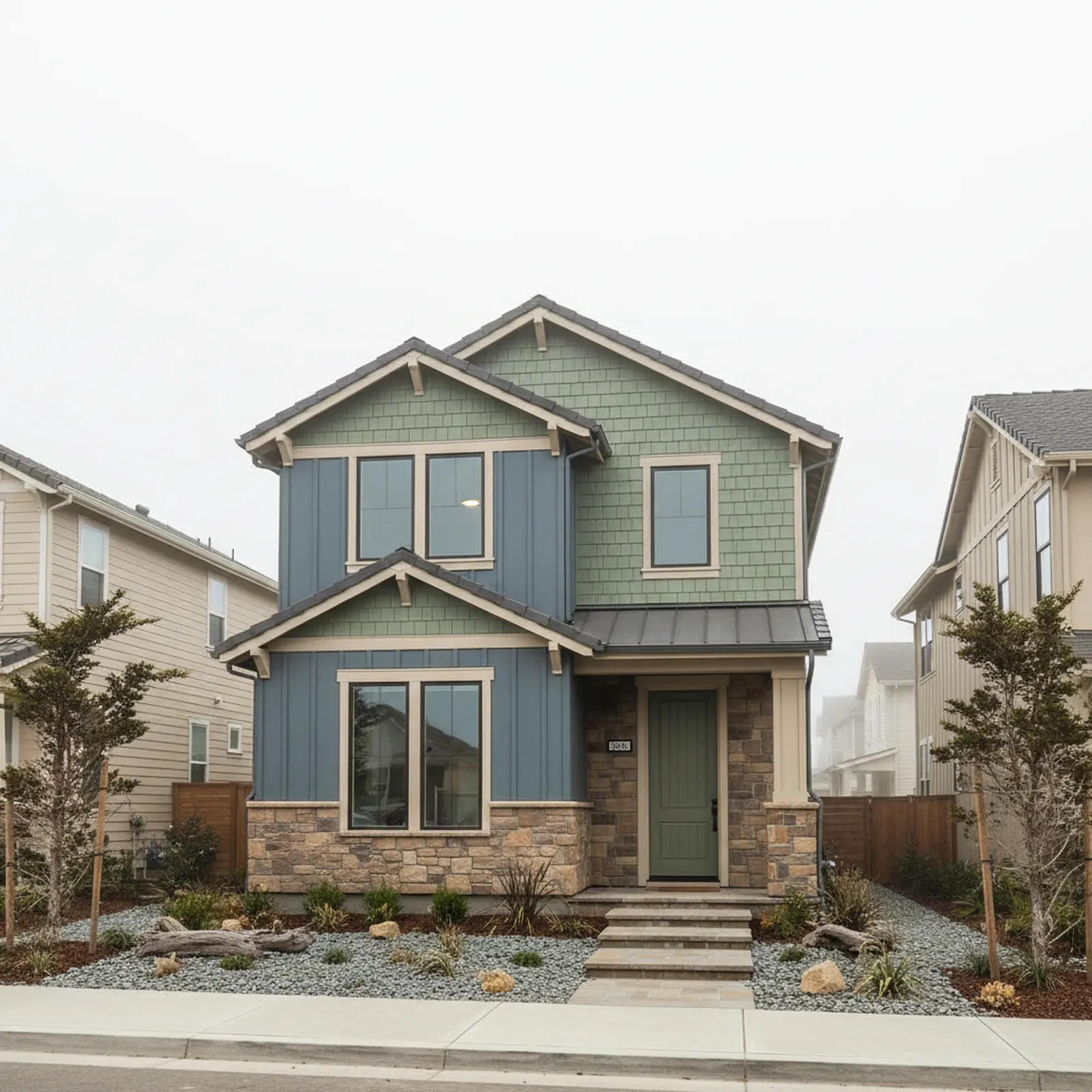
Fire-Resistant Siding in Marina
Direct answer: Marina is a developed open-dune-coast town with low wildfire exposure — wind-driven salt and marine moisture, not fire, are the controlling factors. Fire-resistant siding here is a low-regret choice, not a need, and we won't manufacture urgency for a Marina address.
The former Fort Ord backcountry to the east has had grass-fire incidents, but the developed Marina housing footprint sits well removed from any meaningful wildland interface. Most Marina homes share zero risk profile with foothill cities the same insurer might rate alongside them.
Marina's exposure reality
Marina's master-planned and tract neighborhoods carry low wildfire exposure — developed dune-coast terrain with no significant wildland interface. We tell Marina owners plainly that wind-driven salt and moisture are their real concerns.
Comes with the dune-sand abrasion fix
Marina's defining problem is wind-driven dune sand scouring the finish — abrasion, not just salt — which is why factory ColorPlus fiber cement is the answer. Its Class A rating is included at no cost; on developed dune-coast tracts with no wildland interface we don't dress it up as fire.
What fire-resistant cladding means on the former Fort Ord parcels
The bulk of Marina's recent growth sits on the redeveloped Fort Ord lands at the north end of the bay, where master-planned subdivisions went up fast and to a common builder spec. That housing stock changes how a fire-resistant siding job plays out here. These are not foothill homes scattered along a brushy ridgeline; they are tightly platted lots with paved street frontage, hydrant coverage, and short engine-access runs, so the controlling reason an owner chooses fiber-cement or mineral-based cladding is rarely a wildland threat. More often it is HOA architectural rules that lock in a specific lap profile and color across a whole tract, or a desire to upgrade builder-grade panels that have already started chalking in the salt wind. When we re-clad one of these homes we match the approved profile, confirm the substitution with the architectural committee before ordering, and treat the non-combustible board as a durability and consistency upgrade rather than a fire-urgency pitch the address does not support.
Why salt air decides the fastener and coating spec, not just the board
On a Marina re-clad the fire-rated board is the easy part. The harder problem is everything that holds it to the wall and seals it, because wind off the dunes carries salt straight onto the north and west elevations and never really lets up. Fiber-cement and mineral panels are non-combustible and shrug off marine moisture far better than wood, but standard fasteners and flashing do not. We move to hot-dip galvanized or stainless nails, stainless or coated trim screws, and corrosion-resistant flashing at every penetration, because a galvanized-coating failure here shows up as rust bleed and loosening within a few damp seasons rather than years. Factory-finished color coats also outlast field paint in this air, so we lean on pre-finished product where the HOA palette allows it and back-prime any cut edges before they go up. The result is a wall assembly that earns its fire rating on paper while actually surviving the salt load that defines this stretch of Monterey Bay coast, which is the failure mode a Marina owner will actually meet.
Why this matters in Marina
- Specified for Monterey Peninsula conditions
- non-combustible fiber cement as the recommended system
- Correctly detailed weather-resistive barrier and flashing
- Installed by a crew with 20 years combined experience
Recommended systems for Marina
- non-combustible fiber cement
- corrosion-resistant fastening
- factory finishes
Fire-Resistant Siding for Marina homes
The full fire-resistant siding approach — materials, weather-resistive detailing, and the manufacturer standards we install to — is covered on the main service page, then specified for Marina's conditions on this one.
Our Marina process
- Step 1
Consultation
We listen to your goals and assess your home on site — exposure, substrate, and architecture.
- Step 2
Design & Proposal
A clear written proposal with the right system specified for your climate and a transparent scope.
- Step 3
Expert Installation
Trained crews install to manufacturer best practices with careful weather-management detailing.
- Step 4
Walkthrough & Support
A final walkthrough, full cleanup, and a clear written record of the scope completed — work we stand behind.
FAQ
Fire-Resistant Siding in Marina — FAQ
Marina is low-exposure dune coast and salt/moisture-driven, so it's a low-regret upgrade rather than a necessity. We won't overstate fire risk here.
Low — developed dune-coast terrain with no significant wildland interface. Wind-driven salt and moisture are the controlling factors.
No — the fiber cement we recommend for Marina's wind-and-salt durability is already non-combustible, so Class A performance is included.
Wind-driven-water and salt management — robust flashing, corrosion-rated metal, a drying-capable plane — which is what actually fails here.
Keep Exploring
More for Marina homeowners
More in Marina
Other exterior services in Marina
Nearby Service Areas
Fire-Resistant Siding near Marina
Helpful Exterior Guides