
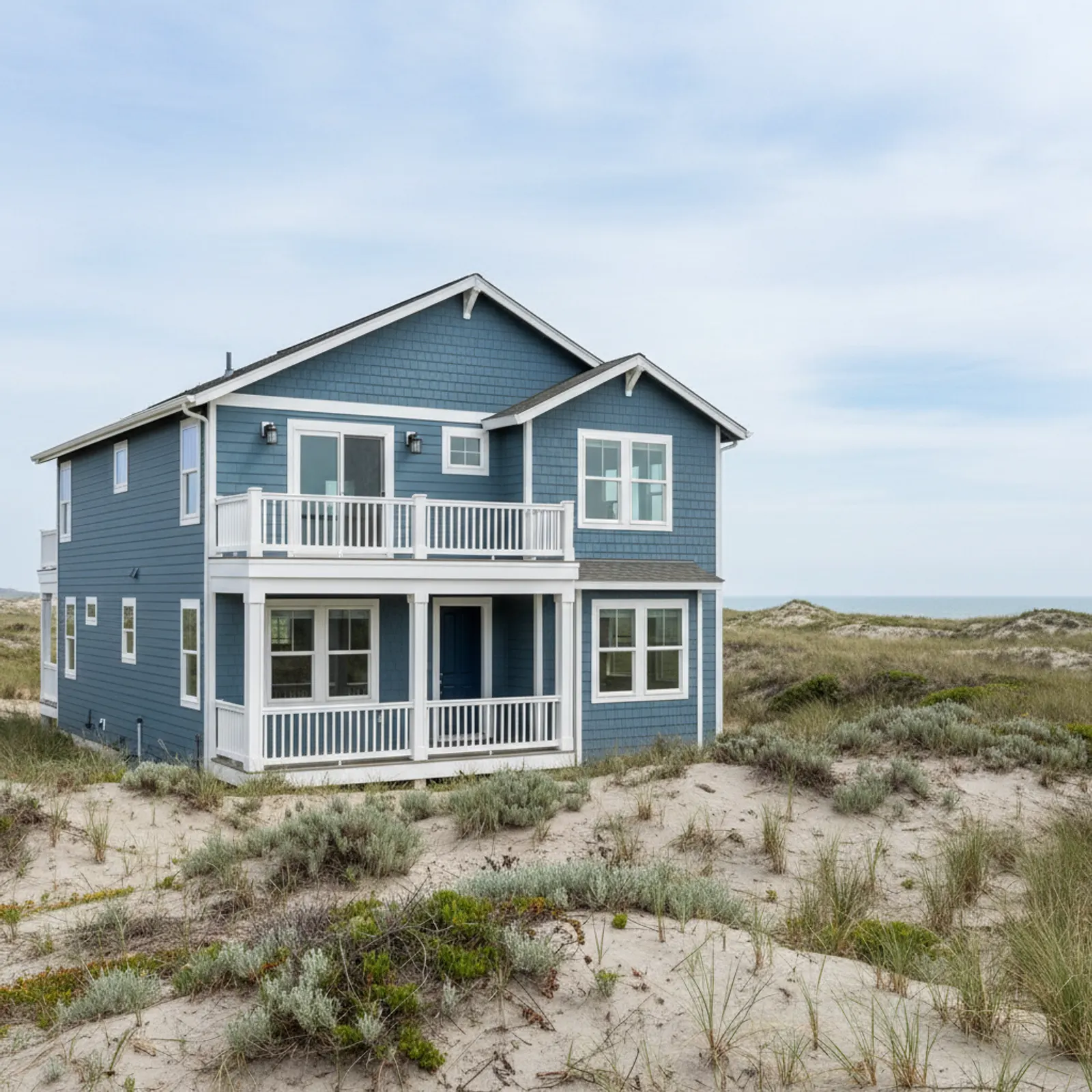
Exterior renovation in Marina
Marina sits on the dunes at the north end of Monterey Bay, one of the fastest-growing cities on the peninsula thanks to extensive new master-planned development on the former Fort Ord lands. Its exterior story blends a large, modern housing stock with the peninsula's harsh constant: direct ocean salt air, wind off the dunes, and persistent marine moisture.
Why even newer Marina homes still need re-cladding
Marina is unusually new for the peninsula, but an open dune coastline does not care how recent a tract is. Onshore wind comes straight off the bay with nothing to break it, driving salt and moisture hard into walls and abrading finishes with blowing sand — exactly the load that finds any corner a production builder cut. That is why we treat a Marina re-side as a corrosion-and-wind problem first: non-combustible fiber cement with corrosion-resistant fastening, wind-aware detailing, and a drying-capable drainage plane sized for this exposure. On the most exposed dune lots, that engineered assembly outlasts the original siding by a wide margin and ends the rust bleed and moisture failures these walls show early.
Considering an exterior project in Marina?
Marina housing and architecture
Marina's stock is unusually new for the peninsula — large 2000s–2020s master-planned communities (Sea Haven, the Dunes, university-area development) alongside older coastal tracts. The production homes modernize well with a clean profile and trim program; all of them sit on exposed, sandy, wind-blown coastal terrain.
Marina's dune-coast climate
Marina is cool, foggy, windy, and salt-laden essentially year-round — exposed dune coastline with strong onshore wind driving salt and moisture into walls. Heat is a non-issue; salt-driven corrosion, wind, and persistent damp govern every specification decision here.
Recommended materials for Marina
Non-combustible fiber cement with corrosion-resistant fastening over a rigorously detailed, drying-capable drainage plane, with wind-aware detailing, is the core recommendation — it withstands Marina's exposed dune-coast salt, wind, and moisture far better than lesser assemblies.
What an exterior project costs in Marina
Marina pricing follows the standard drivers — size and stories, trim complexity, substrate and rot condition, window integration, and a heavier corrosion-, wind-, and moisture-management scope than inland work. We provide a written, scoped estimate after an on-site assessment.
Former Fort Ord HOAs and the master-planned permit reality
A large share of Marina's housing sits on the former Fort Ord, redeveloped into managed communities like Sea Haven and the Dunes, and that ownership history shapes exterior work more than the building age does. Many of these neighborhoods carry active HOAs with architectural review boards, so a re-side, color change, or trim revision typically needs written approval on top of a city building permit. Approved color palettes, body-and-trim combinations, and even fascia and garage-door styling are often spelled out, which narrows material choices to products that can hit those tones in a marine-durable finish. Build first in an approved sample, then submit. Because the tracts were platted in coordinated phases, lots tend to be similar in massing, so a board will compare your proposal to the street's established look. Plan for a review cycle of a few weeks before any visible work begins, and confirm setback and corner-lot rules with Marina's planning counter. Getting the HOA packet and the city permit lined up in parallel keeps a coastal project from stalling once crews and materials are staged.
Wind, sand, and jobsite logistics on the Marina dunes
Working an exterior on Marina's dune lots is as much about the wind as the walls. Onshore gusts come straight off the bay with little to break them, so tall scaffold and material covers need real ballast, and spray or roll finishes have to be timed to calm morning windows before the afternoon blow picks up. Blowing sand is a constant: it gets into fastener heads, sands fresh caulk lines, and abrades primer before topcoat cures, which means staging materials under cover and cleaning substrates again right before fasten-up. The cool, foggy marine layer keeps surface temperatures and dew points close together, so paint and sealant cure slowly and morning condensation can delay a start. Sandy soils swallow scaffold feet, so base plates often need pads or planks for a stable footing. Newer streets off Imjin and 2nd Avenue usually allow decent truck access, but cul-de-sac tracts near the dunes can be tight for a delivery or boom. Sequencing the weather-sensitive steps for the calmer, drier part of the day keeps coastal detailing tight.
Our process in Marina
- Step 1
Consultation
We listen to your goals and assess your home on site — exposure, substrate, and architecture.
- Step 2
Design & Proposal
A clear written proposal with the right system specified for your climate and a transparent scope.
- Step 3
Expert Installation
Trained crews install to manufacturer best practices with careful weather-management detailing.
- Step 4
Walkthrough & Support
A final walkthrough, full cleanup, and a clear written record of the scope completed — work we stand behind.
Marina rewards an exterior engineered for exposed dune-coast salt, wind, and moisture across its modern housing stock.
FAQ
Marina — Common Questions
Non-combustible fiber cement with corrosion-resistant fastening and wind-aware detailing over a rigorously detailed drainage plane — built for the exposed dune-coast salt, wind, and moisture.
It is among the most exposed — open dune coastline with strong onshore wind that drives salt and moisture hard into walls.
Salt-driven corrosion and wind-driven moisture in poorly detailed assemblies. Corrosion-aware, wind-aware, drying-capable detailing fixes the cause.
Yes — even newer stock in this exposed environment benefits from corrosion- and wind-engineered re-cladding when original siding underperforms.
Low — it is an exposed coastal city. Non-combustible fiber cement remains a sound, low-regret choice.
Against constant salt, wind, and fog it degrades quickly compared to a properly fastened fiber cement assembly.
When feasible, yes — correct flashing integration matters even more in this high-wind, high-moisture coastal environment.
A correctly detailed, corrosion- and wind-aware fiber cement system commonly performs 30+ years even in Marina's exposed dune-coast environment.
Explore
Exterior Services
Helpful Exterior Guides