
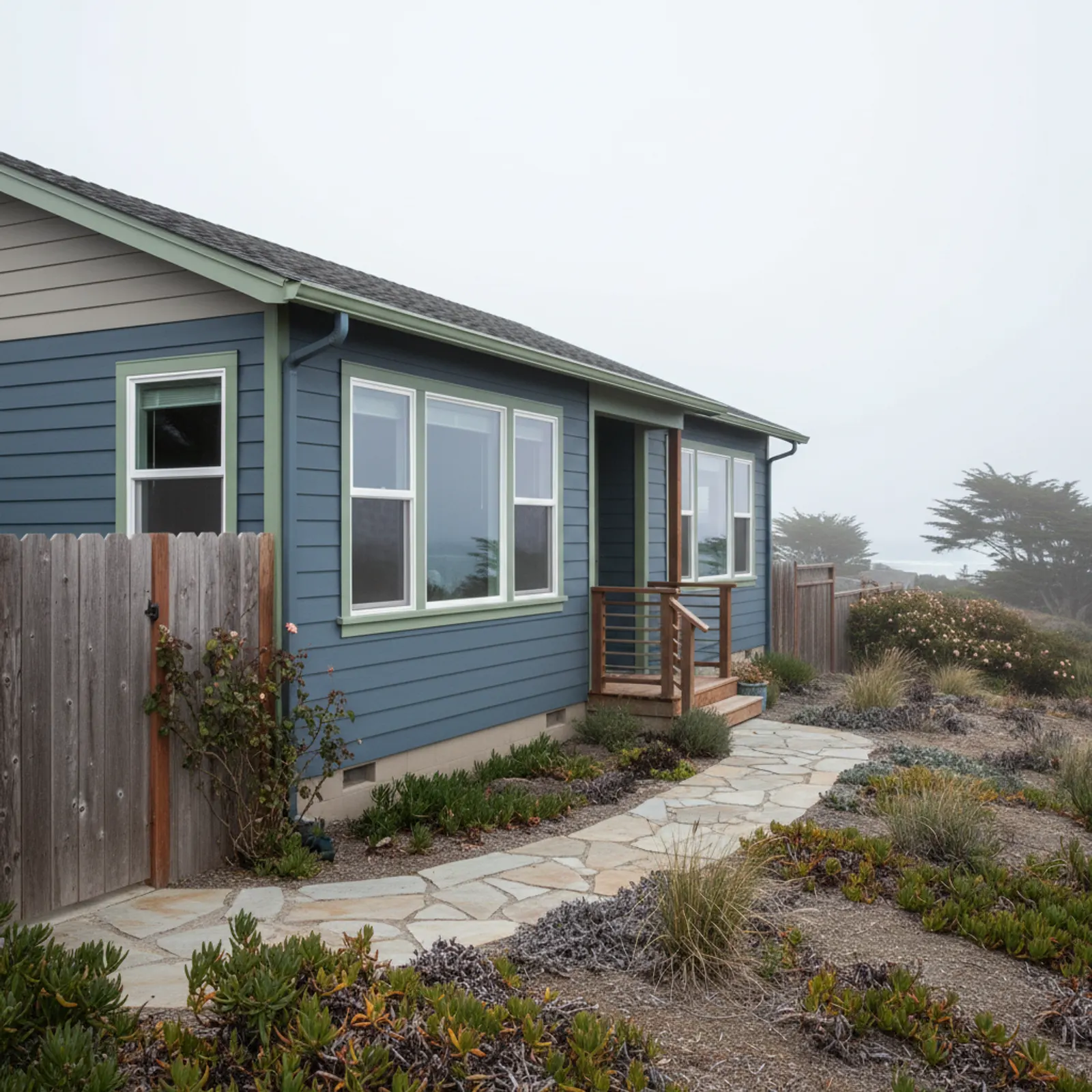
Exterior Contractor in Seaside
Seaside is a coastal Monterey Peninsula city with a mix of postwar tract homes, older town stock, and a continuing wave of newer infill. The salt-air exposure is significant (Monterey Bay direct), the housing market is more value-conscious than the premium peninsula cities, and the exterior priority is salt-air-tuned durability rather than premium character preservation.
A Seaside exterior contractor delivers a corrosion-aware, moisture-managed envelope as one project — fiber cement with appropriate fasteners and flashing, integrated window package, and a clean trim — without over-spec'ing for a premium-market scope the parcel doesn't need.
What an integrated Seaside exterior includes
On a typical Seaside production home an integrated scope strips failed cladding, corrects the WRB with drainage-plane detailing, installs corrosion-aware fasteners, integrates window replacement, and re-clads in fiber cement with factory ColorPlus finishes selected for salt-air durability.
Where the split-trade exterior fails in Seaside
Seaside's failure mode is moisture and salt finding the seams of separately-flashed trades. The result is rust streaks down the cladding and rotting bottom courses within a few years. An integrator scopes the salt-air-aware assembly as one system.
Materials and detailing we specify for Seaside
Fiber cement with corrosion-aware fasteners (stainless or hot-dipped galvanized), factory ColorPlus finishes selected for salt-air durability, a rigorous drainage plane, and value-conscious trim detailing.
Fort Ord-era housing stock and how it shapes an exterior scope in Seaside
A large share of Seaside's residential fabric traces back to Fort Ord-era construction and the postwar tract neighborhoods that filled in around it. That housing was built fast, to a modest budget, and decades of marine moisture have not been kind to the original envelopes. When an exterior contractor opens up cladding on these homes, the recurring finds are thin or aging building paper instead of a proper water-resistive barrier, single-pane or early aluminum windows that have corroded at the sills, and trim that was never detailed to shed salt-laden runoff. The right approach treats the wall as a system rather than swapping siding cosmetically: correcting the WRB and flashing laps, replacing the window package so the new openings tie cleanly into the drainage plane, and choosing fastener and trim details that suit a value-conscious parcel without gold-plating it. The goal is a durable, moisture-managed shell matched to what these former-base and tract homes actually need, not a premium-peninsula restoration budget they were never built to carry.
How salt air off Monterey Bay drives the corrosion spec
Seaside sits directly above Monterey Bay on the northern peninsula, and the prevailing onshore flow carries salt aerosol inland across the postwar neighborhoods every day. For an exterior contractor that single fact reorders the material list. Standard galvanized or budget fasteners that survive inland jobs will bleed rust streaks down a fresh wall within a season here, so connectors, nails, and flashing have to be specified for marine exposure rather than picked off the cheapest pallet. Cut edges of fiber cement get sealed, fastener heads stay set correctly so they do not telegraph corrosion, and any exposed metal trim or vent screen is chosen to tolerate chloride load. Window selection follows the same logic: hardware and finishes that hold up where Carmel and Pacific Grove face identical air, just at lower lot values in Seaside. The detailing that matters most is keeping water and salt moving off the assembly fast, which is why the drainage plane, kickout flashing, and head laps get more attention here than they would two ridgelines inland where the marine layer never reaches.
Why this matters in Seaside
- Specified for Monterey Peninsula conditions
- non-combustible fiber cement as the recommended system
- Correctly detailed weather-resistive barrier and flashing
- Installed by a crew with 20 years combined experience
Recommended systems for Seaside
- non-combustible fiber cement
- corrosion-resistant fastening
- drainage-plane detailing
Exterior Contractor for Seaside homes
The full exterior contractor approach — materials, weather-resistive detailing, and the manufacturer standards we install to — is covered on the main service page, then specified for Seaside's conditions on this one.
Our Seaside process
- Step 1
Consultation
We listen to your goals and assess your home on site — exposure, substrate, and architecture.
- Step 2
Design & Proposal
A clear written proposal with the right system specified for your climate and a transparent scope.
- Step 3
Expert Installation
Trained crews install to manufacturer best practices with careful weather-management detailing.
- Step 4
Walkthrough & Support
A final walkthrough, full cleanup, and a clear written record of the scope completed — work we stand behind.
FAQ
Exterior Contractor in Seaside — FAQ
Because direct Monterey Bay salt-air exposure rusts standard galvanized fasteners visibly within months. Salt-air-rated fasteners are the only ones that hold up.
Generally no — most parcels are coastal flats with minimal fire exposure. The dominant priorities are salt and moisture.
On homes with original or first-generation windows, yes — the salt-air exposure finds aged flashing fast.
Most Seaside single-family homes are three to six weeks of active work depending on size and scope.
Keep Exploring
More for Seaside homeowners
More in Seaside
Other exterior services in Seaside
Nearby Service Areas
Exterior Contractor near Seaside
Helpful Exterior Guides