
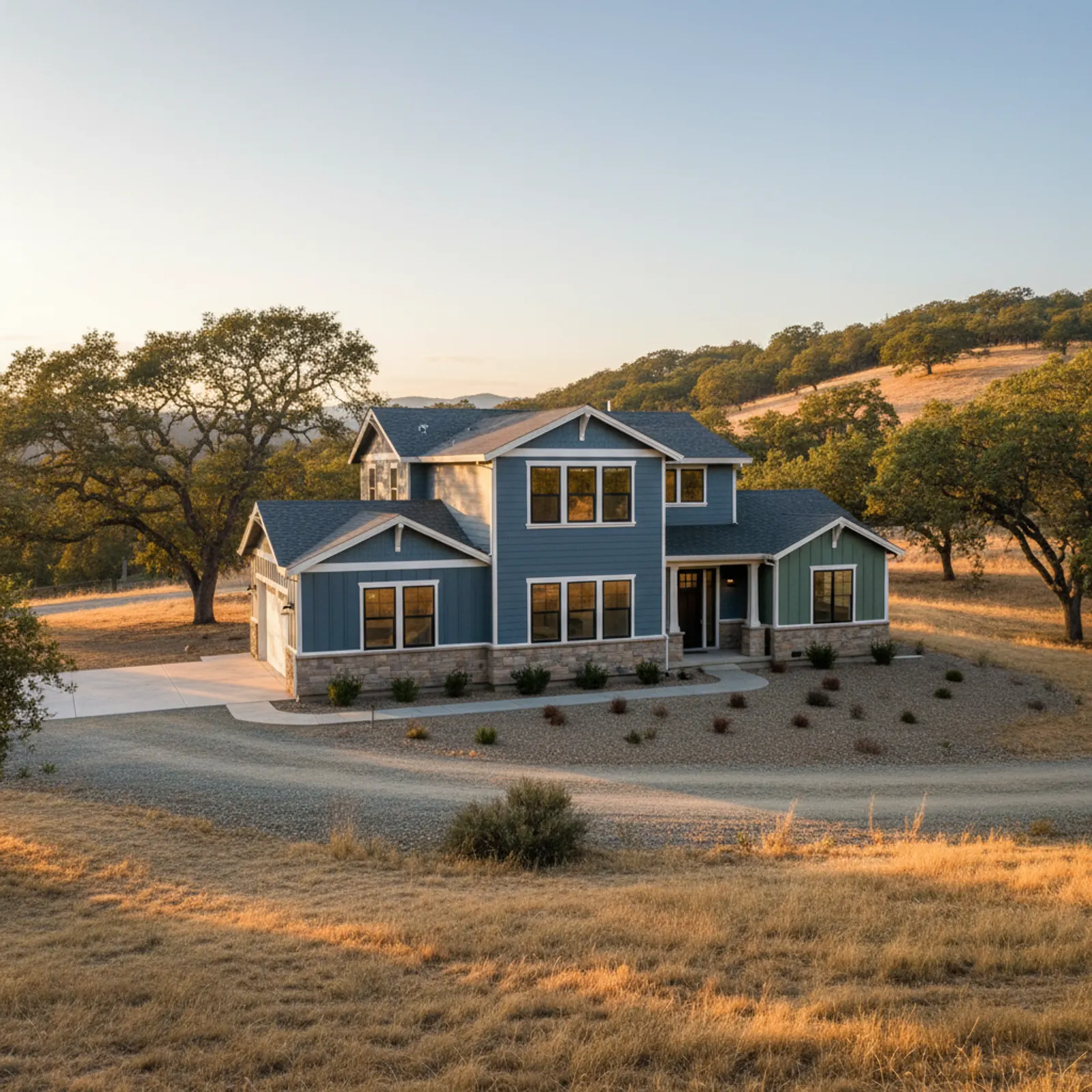
Fiber Cement Siding in Shingle Springs
Fiber cement is the core Shingle Springs recommendation because its Class A non-combustibility is decisive on dispersed oak-woodland high-fire acreage, and it is heat-stable for the elevated foothill summers — installed per parcel as one element of a hardened envelope.
Non-combustible for oak-woodland acreage
On Shingle Springs's scattered wooded parcels, combustible wood is the wrong call; fiber cement's Class A non-combustibility is decisive, paired with hardened eave, vent, and ground-transition detailing scoped to each lot.
Consistent across the property
Where acreage homes have outbuildings, fiber cement lets us carry the non-combustible approach consistently across the whole property, not just the dwelling.
Per-parcel, because the acreage varies
Shingle Springs is scattered acreage, so two fiber-cement projects a mile apart can need different detailing — slope, defensible space, and outbuildings all change what matters. We assess and document each lot individually rather than carry one oak-woodland template across the area.
What WUI ember exposure changes in the wall assembly
Out on the oak-woodland slopes off the Highway 50 corridor, Shingle Springs parcels carry the kind of ember exposure that pushes a fiber cement project past the cladding itself. Class A board only earns its keep when the rest of the wall assembly stops embers from getting behind it, so on these wooded lots we treat the bottom five feet of wall and the first horizontal foot of ground as their own problem. That means closing off weep gaps and starter-strip openings where windblown embers collect, keeping the lowest course up off bark mulch and grade, and pairing the panels with ember-resistant soffit and gable venting instead of standard mesh. The wildfire risk here is high while moisture stays low, so the assembly is built to resist ignition first and shed the occasional rain second. On a ranchette where the nearest hydrant is theoretical, the wall that does not catch is the one that matters, and the detailing around the boards is where that gets decided.
Working long driveways and dispersed structures on acreage
Equestrian properties and ranchettes spread across the western foothills rarely give a crew a tidy curbside staging spot. A fiber cement job in Shingle Springs usually starts with the driveway: long, sometimes unpaved approaches off Highway 50 frontage roads that decide where the delivery truck can drop a unit of board and where we can stage a cut station without kicking dust into a wooded canopy. The panels are heavy and brittle until fastened, so we plan material flow to the house rather than dragging boards across uneven grade between the main home and a detached shop or barn. Power and water are worth confirming before day one, since acreage parcels here can run off wells and limited service. We also walk the lot for the realities of oak-woodland sites, dripline shade that keeps north walls damp longer, root zones we should not compact, and slope that affects scaffold footing. Sequencing the cladding around those access facts keeps the install clean and the property intact while the hardened exterior goes up.
Why this matters in Shingle Springs
- Specified for Sierra Foothills conditions
- Class A non-combustible fiber cement as the recommended system
- Correctly detailed weather-resistive barrier and flashing
- Installed by a crew with 20 years combined experience
Recommended systems for Shingle Springs
- Class A non-combustible fiber cement
- fire-aware detailing
- robust flashing
Fiber Cement Siding for Shingle Springs homes
The full fiber cement siding approach — materials, weather-resistive detailing, and the manufacturer standards we install to — is covered on the main service page, then specified for Shingle Springs's conditions on this one.
Our Shingle Springs process
- Step 1
Consultation
We listen to your goals and assess your home on site — exposure, substrate, and architecture.
- Step 2
Design & Proposal
A clear written proposal with the right system specified for your climate and a transparent scope.
- Step 3
Expert Installation
Trained crews install to manufacturer best practices with careful weather-management detailing.
- Step 4
Walkthrough & Support
A final walkthrough, full cleanup, and a clear written record of the scope completed — work we stand behind.
FAQ
Fiber Cement Siding in Shingle Springs — FAQ
Yes — its Class A non-combustibility is decisive in this dispersed oak-woodland high-fire terrain, paired with hardened detailing, with no finish penalty versus wood.
Yes — carrying the non-combustible approach across attached outbuildings keeps the hardened envelope coherent on rural acreage.
Yes — dimensionally stable with a lasting baked finish for the foothill heat, scoped per dispersed-acreage parcel within the hardened envelope.
Fiber cement — across Shingle Springs's dispersed oak-woodland acreage engineered wood is combustible, and no durability claim offsets that fire risk per parcel.
Keep Exploring
More for Shingle Springs homeowners
More in Shingle Springs
Other exterior services in Shingle Springs
Nearby Service Areas
Fiber Cement Siding near Shingle Springs
Back to
El Dorado County & Shingle Springs
Helpful Exterior Guides