
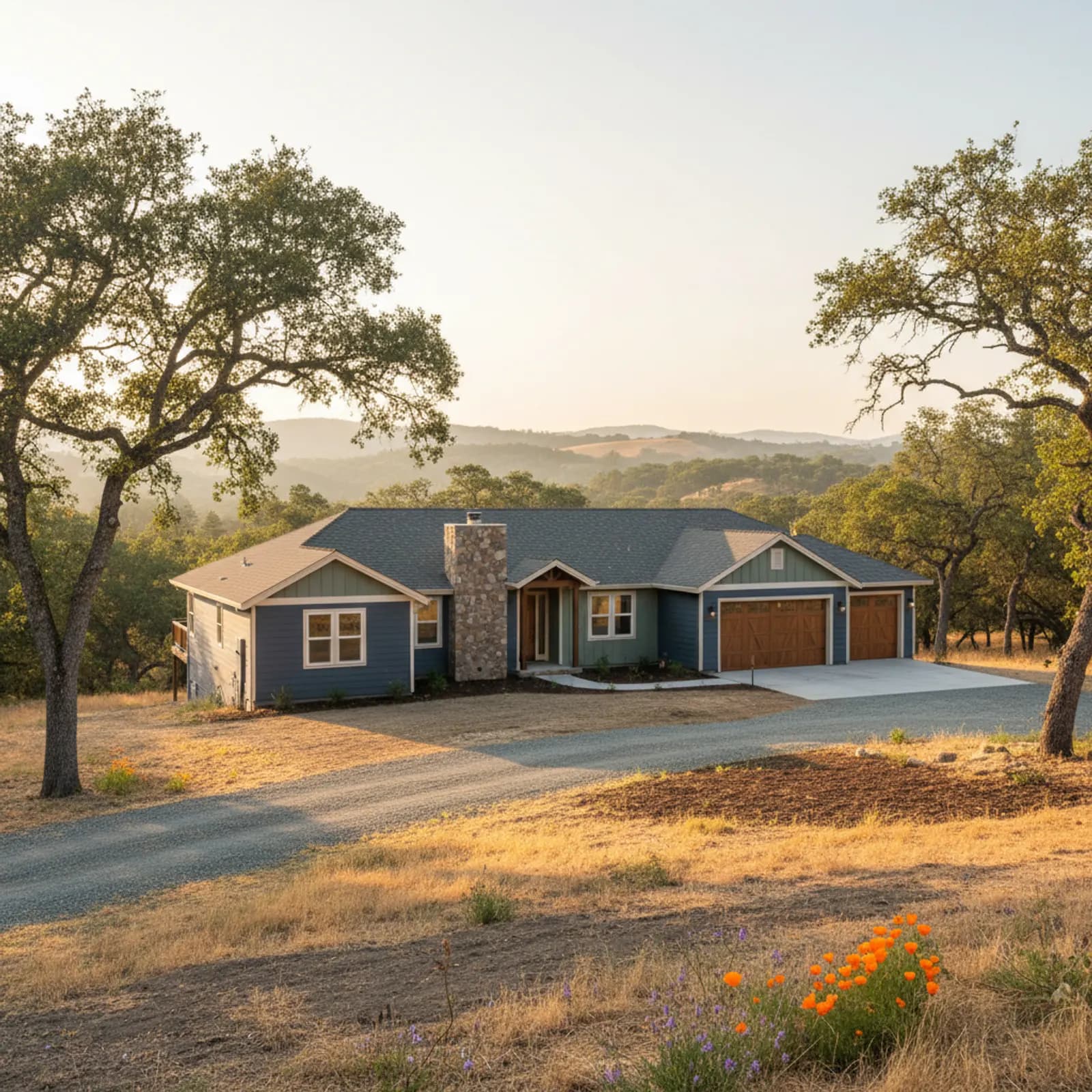
James Hardie Siding in Shingle Springs
Shingle Springs is dispersed rural acreage — long driveways, well water, and real distance between structures and from a hydrant. In high-fire oak woodland that changes the logic of a James Hardie re-side: a home here has to assume suppression help may be slow and water limited, so the exterior is a self-reliant hardening decision, not a backstop to fast response.
Designed for the home defending itself
On a remote Shingle Springs parcel the realistic plan is that the structure resists ignition on its own through the first critical period. That makes Class A non-combustible cladding and meticulous eave, vent, and ground-to-wall detailing more decisive here than on a parcel near a hydrant — the wall and its details may be doing the work unassisted. We scope to that reality, not to a suburban assumption.
Per-parcel, because no two acreage lots match
Slope, which direction the dominant vegetation sits, where the well and outbuildings are, how the driveway approaches — these differ on every Shingle Springs property and they change what actually matters. We walk and scope each parcel individually rather than apply an oak-woodland template, then install Hardie to its clearance and flashing spec so the hardening and the warranty both hold.
WUI ember exposure, and the Hardie spec it forces in the oak woodland
Shingle Springs sits inside a designated wildland-urban interface, so a James Hardie re-side here is governed as much by ember intrusion as by flame contact. Wind-driven embers off the surrounding oak woodland travel ahead of any front and lodge wherever the wall meets a horizontal ledge, a vent, or bare soil. That drives the spec toward HardiePlank or HardiePanel run tight to the sheathing, with closed-cell joints, ember-resistant vent screening, and fascia and soffit details that leave no gap for a spark to settle. We carry the non-combustible logic past the field of the wall into the band board, the deck-to-wall junction, and the first courses above grade, because those transitions are where a foothill home actually ignites. On an acreage lot ringed by seasonal grass and digger pine, the cladding is only as good as its weakest penetration, so the scope here is about sealing the whole envelope rather than simply cladding the flat walls in fiber cement and calling it hardened.
Long driveways, well pressure, and staging a re-side off Highway 50
Getting a James Hardie job onto a Shingle Springs property is its own piece of planning. Homes off Mother Lode Drive, North Shingle Road, and the lanes climbing back from Highway 50 sit at the end of long, often unpaved driveways with tight turnarounds and overhanging oaks, so we confirm a delivery and lift truck can actually reach the wall before bundles of fiber cement are ordered. The boards are heavy and dense, and staging them across an acreage lot means thinking about where material can sit without killing a season's worth of pasture or blocking the only way in. Well water and septic also shape the work: we plan dust control and saw stations so silica cutting does not foul a wellhead or leach field, and we keep cut zones downwind of the house. On El Dorado County parcels where the nearest hydrant is far off, we coordinate around your own water supply rather than assuming a municipal tap, the way a job in El Dorado Hills could.
Why this matters in Shingle Springs
- Specified for Sierra Foothills conditions
- Class A non-combustible fiber cement as the recommended system
- Correctly detailed weather-resistive barrier and flashing
- Installed by a crew with 20 years combined experience
Recommended systems for Shingle Springs
- Class A non-combustible fiber cement
- fire-aware detailing
- robust flashing
James Hardie Siding for Shingle Springs homes
The full james hardie siding approach — materials, weather-resistive detailing, and the manufacturer standards we install to — is covered on the main service page, then specified for Shingle Springs's conditions on this one.
Our Shingle Springs process
- Step 1
Consultation
We listen to your goals and assess your home on site — exposure, substrate, and architecture.
- Step 2
Design & Proposal
A clear written proposal with the right system specified for your climate and a transparent scope.
- Step 3
Expert Installation
Trained crews install to manufacturer best practices with careful weather-management detailing.
- Step 4
Walkthrough & Support
A final walkthrough, full cleanup, and a clear written record of the scope completed — work we stand behind.
FAQ
James Hardie Siding in Shingle Springs — FAQ
Yes. Long driveways, well water, and spacing mean a home here may need to resist ignition with little outside help for a while. We weight the cladding and detailing decisions toward self-reliance more than we would on a parcel near hydrants and fast access.
Because slope, vegetation direction, well and outbuilding placement, and driveway approach vary on every Shingle Springs lot and genuinely change what protects the home. A flat template would either over-spec or miss the actual exposure — neither is honest.
It is — these acreage homes are hard to re-access for maintenance, so factory ColorPlus that resists foothill UV and avoids a repaint cycle is a practical benefit beyond the fire case.
Keep Exploring
More for Shingle Springs homeowners
More in Shingle Springs
Other exterior services in Shingle Springs
Nearby Service Areas
James Hardie Siding near Shingle Springs
Back to
El Dorado County & Shingle Springs
Helpful Exterior Guides