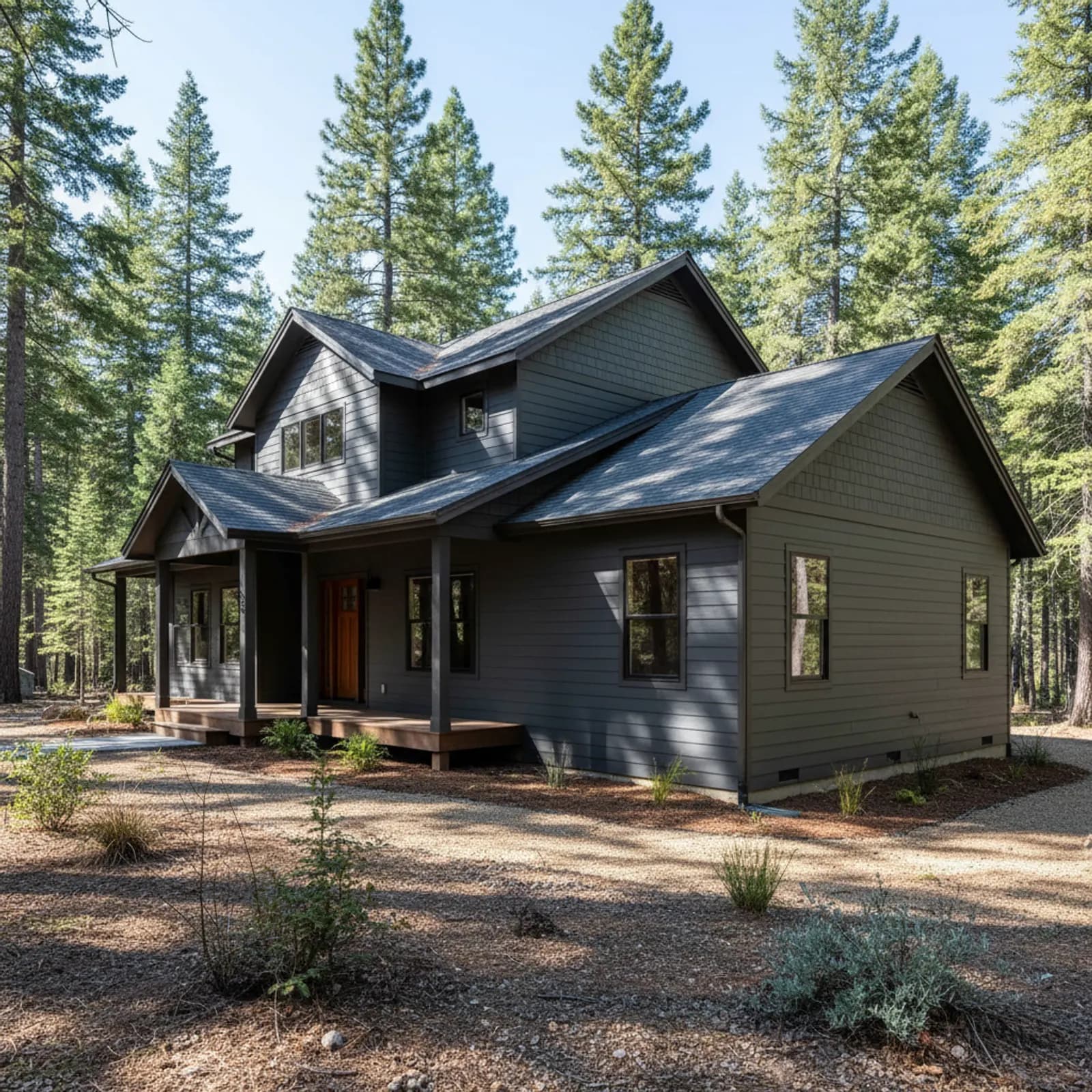
Exterior renovation in Pollock Pines
Pollock Pines sits at around 4,000 feet on the Highway 50 corridor toward Tahoe, deep in dense El Dorado County conifer forest. The Caldor Fire burned to this community in 2021, and that reality frames everything we do here. For a Pollock Pines homeowner an exterior project is unambiguously a wildfire-survival decision, made in a mountain environment that also brings real snow and prolonged freeze. We treat the wall assembly as protective infrastructure that must clear two bars at once: ember resistance and mountain-winter durability.
Fire and freeze on the same wall
The hard part here is that the two demands act on identical surfaces and can't be solved separately. The eaves, vents, and ground transitions we harden against embers are the same details that have to shed snowmelt and survive freeze-thaw without spalling, so a fire fix that ignores winter just fails a different way. We specify Class A non-combustible fiber cement and detail it freeze-aware — generous clearances, mountain-grade flashing, balanced ventilation — so the hardening holds up through a real Sierra winter instead of trading one hazard for another.
Considering an exterior project in Pollock Pines?
Pollock Pines housing and architecture
Pollock Pines's stock is forest cabins, mountain homes, and rural ridge and acreage properties scattered among tall pines and cedars, joined now by post-Caldor rebuilds going up across burned and threatened parcels. A great deal of the older stock wears combustible wood, shingle, and T1-11 cladding set directly in conifer fuel — the single highest-priority hardening target in the community. Rebuilds give us the chance to specify non-combustible assemblies from the studs out, while existing cabins need re-cladding to close the most dangerous exposure gap.
Pollock Pines's mountain-forest climate
Pollock Pines's controlling stressor is fire layered onto a true mountain climate. Summers are hot, dry, and high-UV inside dense forest carrying extreme fuel loading, which drives heavy ember risk. Winters bring significant snow and prolonged freeze-thaw at this elevation. The exterior therefore has to resist embers while also surviving snow load, meltwater intrusion, and repeated freeze cycles — a demanding combination that rules out anything but a non-combustible, freeze-aware system.
Aggressive wildfire hardening in Pollock Pines
Pollock Pines warrants the most aggressive hardening we do. That means Class A non-combustible fiber cement plus uncompromising detailing at eaves, soffits, vents, decks, and ground-to-wall transitions, recognizing that dense conifer forest drives extreme ember loading from every direction. Detailing is also freeze-aware for the elevation so the hardening doesn't trade fire performance for water and ice problems. We document the assemblies we install so the work complements defensible-space efforts and rebuilding programs across the community.
Recommended materials for Pollock Pines
Non-combustible fiber cement with mountain-grade, freeze-aware clearances and flashing is the only cladding we recommend for Pollock Pines's exposure. Combustible wood, shingle, and panel siding are not categories we entertain here given the forest fuel load. Fiber cement also tolerates freeze-thaw cycling far better than wood, so the choice is sound on both the fire and the winter axis — one material that answers both of the stressors this elevation imposes.
What an exterior project costs in Pollock Pines
Pollock Pines projects carry the heaviest fire-hardening scope we run, plus mountain-grade freeze-aware detailing throughout. Cost is shaped by difficult forested and ridge access on long mountain drives, winter-constrained scheduling that compresses the workable season, and a high likelihood of substrate and rot discovery once we open older cabin walls. We assess every property on site and provide a written, itemized estimate that reflects genuine mountain-and-fire construction rather than a flatland number.
Post-Caldor rebuilds and re-cladding
Since the 2021 fire, Pollock Pines work falls into two tracks: hardening existing combustible cabins, and building back parcels that burned. Rebuilds let us specify non-combustible cladding and detailing from the start, which is the cleanest path to a hardened envelope. For standing cabins, re-cladding wood or shingle in fiber cement is the highest-value single step a forest property can take. We tailor the approach to which track a given address is on.
Forested and ridge access realities
Many Pollock Pines homes sit on long private drives, ridge parcels, and forested lots where simply getting materials and crew to the wall is part of the job. Staging, protection of surrounding fuel-managed space, and crew logistics are planned explicitly here rather than assumed. We walk the access route during the site visit so the schedule reflects the real mountain property and the winter window it has to fit into.
Snow, freeze, and defensible space together
Hardening in Pollock Pines can't ignore winter. Snow load, meltwater, and freeze-thaw all act on the same walls we're hardening against embers, so flashing and clearances are detailed for both. We also document materials and assemblies so the cladding work lines up with defensible-space and broader community hardening efforts, rather than standing as an isolated upgrade on an otherwise unprepared lot.
Pollock Pines is unincorporated: county permits, EID, HZ conversation at elevation
Pollock Pines is not a city. It is an unincorporated community in El Dorado County at roughly 4,000 feet on Highway 50. Building permits go through El Dorado County's Community Development Agency in Placerville. Electric and gas are PG&E, and Pollock Pines is in one of the highest-PSPS corridors in California. Water is El Dorado Irrigation District (EID) and Grizzly Flats CSD on some parcels, with private wells on others. Fire response is Pioneer Fire Protection District alongside CAL FIRE's Amador-El Dorado Unit for the surrounding State Responsibility Area — much of which is Eldorado National Forest. At 4,000 feet Pollock Pines is at the edge of the elevation band where Hardie's HZ10-vs-HZ5 question can warrant attention — see our HZ10 vs HZ5 reference. Essentially all of Pollock Pines sits in Very High FHSZ or State Responsibility Area, and the 2025 California Wildland-Urban Interface Code governs the exterior wall on nearly every re-side. Chapter 7A moved into the standalone WUI Code on January 1, 2026.
Our process in Pollock Pines
- Step 1
Consultation
We listen to your goals and assess your home on site — exposure, substrate, and architecture.
- Step 2
Design & Proposal
A clear written proposal with the right system specified for your climate and a transparent scope.
- Step 3
Expert Installation
Trained crews install to manufacturer best practices with careful weather-management detailing.
- Step 4
Walkthrough & Support
A final walkthrough, full cleanup, and a clear written record of the scope completed — work we stand behind.
In Pollock Pines the exterior is survival infrastructure that must also endure deep mountain winters, and we build to exactly that standard. We scope every Pollock Pines project on site, specify non-combustible freeze-aware assemblies, and document the work so it strengthens your broader hardening efforts.
FAQ
Pollock Pines — Common Questions
Extreme — Pollock Pines sits deep in El Dorado County conifer forest and was burned to by the Caldor Fire. We apply the most aggressive hardening we do here.
Class A non-combustible fiber cement with uncompromising fire detailing and mountain-grade, freeze-aware clearances and flashing for the elevation.
Re-cladding combustible wood or shingle in non-combustible fiber cement is the single highest-value hardening step available for a conifer-forest property here.
Yes — significant winter snow and prolonged freeze-thaw at ~4,000 feet, so detailing is freeze-aware alongside the fire strategy.
No — given the extreme forest exposure we do not entertain it. Fiber cement also tolerates freeze-thaw, so it is sound on both counts.
Yes — difficult forested and ridge access plus winter-constrained scheduling are routine, explicitly planned parts of Pollock Pines scope.
Yes — we document the materials and assemblies used so the work complements broader hardening and rebuilding programs.
A correctly installed, mountain-detailed fiber cement system commonly performs 30+ years while materially reducing ignition risk in the conifer forest.
Explore
Exterior Services
Helpful Exterior Guides