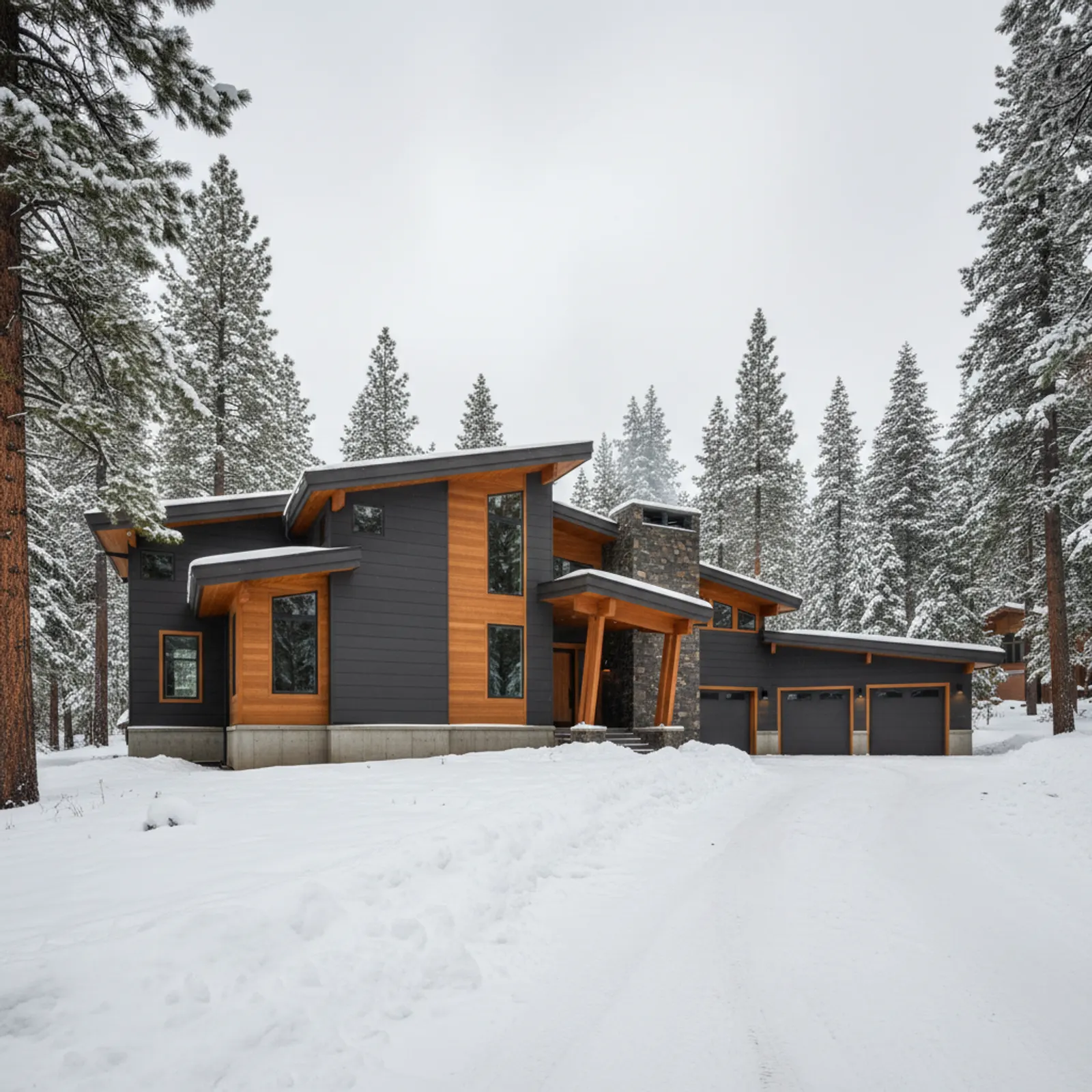
Exterior renovation in South Lake Tahoe
South Lake Tahoe sits at roughly 6,200 feet on the lake's south shore, and its exteriors face one of the most punishing combinations in California: extreme, sustained snow load, prolonged freeze-thaw, intense high-altitude UV, lake-driven moisture, and high wildfire exposure across the basin. A South Lake Tahoe re-side is a mountain-engineering problem first and an aesthetic project second, and that ordering shapes every decision from cladding choice to flashing geometry to the season we can actually run the work.
Why the basin is its own category
Most of our service area worries about one or two stressors; the Tahoe basin stacks four or five at once and lets none of them off the hook. The same wall that has to shed a heavy spring meltwater season also has to survive thermal cycling, resist altitude sun that fades and embrittles ordinary finishes, and hold up to wind-driven ember exposure in fire season. We treat South Lake Tahoe assemblies as alpine systems, not as valley details lifted up the hill.
Considering an exterior project in South Lake Tahoe?
South Lake Tahoe housing and architecture
The stock ranges from older Tahoe cabins and A-frames near the older neighborhoods off the highway corridors, to near-shore and lakefront homes on the south and west sides, to a growing tier of modern alpine custom builds, with a large overlay of vacation and short-term-rental properties throughout. Many of the older cabins still wear combustible board, shingle, or T1-11 siding poorly matched to current snow-management and freeze-thaw practice. Steep A-frame geometry and deep eaves complicate trim and transitions, so we plan profiles and flashing around how each roof and wall actually sheds snow.
South Lake Tahoe's alpine climate
The controlling stressor here is winter: heavy, sustained snowpack and repeated freeze-thaw that mechanically loads cladding, fasteners, and every transition, followed by a meltwater season that probes for any gap. Summers add strong UV at altitude and lake-influenced humidity. There is effectively no hot-valley concern. That forces a spec where the exterior must shed and survive snow and meltwater, tolerate freeze-thaw without cracking or spalling, hold finish under altitude sun, and resist ember exposure, all in one continuous assembly.
Fire and snow, designed together
The Tahoe basin carries high wildfire exposure, so in South Lake Tahoe the snow strategy and the fire strategy must coexist rather than compete. We specify non-combustible fiber cement cladding, fire-aware eave, soffit, and vent detailing, generous ground and roof-edge clearances, snow-aware flashing that still resists ember entry, and a continuous drainage plane behind it all. Neither hazard is permitted to undermine the other, and we will not overstate the risk on any individual parcel.
Recommended materials for South Lake Tahoe
Non-combustible fiber cement with mountain-grade detailing is the recommendation: it satisfies the fire requirement, tolerates freeze-thaw far better than wood, and with high-UV factory finishes it resists strong altitude sun that fades job-site coatings quickly. Just as important, clearances, flashing, and ventilation matter as much as the board itself. At altitude the detailing is the product, because it decides whether snowmelt stays out of the wall through a long basin winter.
What an exterior project costs in South Lake Tahoe
South Lake Tahoe projects carry premium scope qualitatively, driven by mountain-grade flashing and clearance detailing, fire hardening, a short and winter-constrained build window, and frequent substrate and rot discovery once old cabin cladding comes off. Near-shore and lakefront parcels add staging and access considerations, and steep A-frame geometry adds labor at the transitions. We assess every parcel on site and provide a written, itemized estimate reflecting genuine mountain construction rather than a valley scope applied at altitude.
Near-shore versus uphill parcels
Where a home sits in the basin changes the build. Near-shore and lakefront homes on the south and west sides bring tighter staging, more moisture management at grade, and access logistics that we plan before mobilizing. Homes set back uphill in the forested neighborhoods carry heavier ember and canopy exposure and often steeper drives that affect material handling. We walk the parcel before quoting because the lot, not the city line, dictates the realistic scope and the safe season to work.
Short-term-rental and second-home realities
A large share of South Lake Tahoe housing is vacation or short-term-rental property, and those owners are often managing the job remotely between booking windows. We plan sequencing and weather contingencies around that, keep documentation clear for off-site decision-makers, and aim to close exterior work before the snow season forecloses access. Hardening also tends to matter to these owners for insurability, so we document the materials and assemblies we install, while recognizing insurers set their own criteria.
Working inside a short build season
The basin's snow window genuinely narrows when a re-side can run, so timing is part of the engineering, not an afterthought. We scope to get walls weather-tight ahead of sustained snowfall, stage materials with freeze-thaw in mind, and avoid leaving open assemblies exposed to an early storm. Discovery of hidden rot or failed flashing on an old cabin can move a schedule, which is one more reason we assess on site first and write the season expectations into the estimate.
Liberty Utilities, STPUD water, TRPA jurisdiction in the basin
Working exteriors in the City of South Lake Tahoe coordinates with a utility mix distinct from most of California. Electric is supplied by Liberty Utilities (Liberty Energy) — the investor-owned utility that serves the California side of the Tahoe basin — not PG&E. Natural gas is Southwest Gas, the Nevada-based utility that serves the Tahoe corridor. Water and sewer are supplied by South Tahoe Public Utility District (STPUD), a customer-owned public agency. Fire response is South Lake Tahoe Fire Rescue and CAL FIRE's Amador-El Dorado Unit for surrounding SRA. On the permit side, the City of South Lake Tahoe's Development Services Department handles building permits, and the Tahoe Regional Planning Agency (TRPA) governs the Lake Tahoe Basin — a real jurisdictional overlay affecting any scope that alters the building envelope, floor area, or coverage. We flag utility, permit, and TRPA items at the estimate stage.
HZ10 vs HZ5 at 6,200 feet — the mountain conversation
Our HZ10 vs HZ5 reference puts it plainly: HZ10 is the correct spec for essentially all of California, with the Tahoe Basin and high-Sierra elevations being the one nuanced exception. South Lake Tahoe sits at roughly 6,200 feet with sustained freeze-thaw cycling and prolonged snow load, and it is one of the few California addresses where the HZ10-vs-HZ5 question is a real conversation rather than a rubber stamp. We look at the parcel's elevation, aspect, and specific exposure alongside Hardie's climate-zone map and match the line and the install manual accordingly. On the fire side, essentially all of the basin sits in Very High FHSZ or State Responsibility Area, so the 2025 California Wildland-Urban Interface Code governs the exterior wall on nearly every re-side. The code frame changed on January 1, 2026, when Chapter 7A moved into the standalone WUI Code.
Our process in South Lake Tahoe
- Step 1
Consultation
We listen to your goals and assess your home on site — exposure, substrate, and architecture.
- Step 2
Design & Proposal
A clear written proposal with the right system specified for your climate and a transparent scope.
- Step 3
Expert Installation
Trained crews install to manufacturer best practices with careful weather-management detailing.
- Step 4
Walkthrough & Support
A final walkthrough, full cleanup, and a clear written record of the scope completed — work we stand behind.
South Lake Tahoe punishes shortcuts harder than almost anywhere we work, stacking snow, freeze-thaw, altitude sun, and fire onto one wall. We build the exterior to survive the mountain and the fire season together, and we scope every South Lake Tahoe project on site so the plan and the season are honest before any board goes up.
FAQ
South Lake Tahoe — Common Questions
Non-combustible fiber cement with mountain-grade clearances, snow-aware flashing, and freeze-thaw-tolerant detailing — it outperforms wood on durability and also satisfies the wildfire requirement.
Yes. The Tahoe basin carries high wildfire exposure, so the fire and snow strategies must be designed together in one assembly.
At altitude, clearances, flashing, and ventilation decide whether snow and meltwater stay out of the wall. The best board over poor mountain detailing still fails.
Yes — we plan for the access, staging, and moisture considerations specific to near-shore and lakefront parcels.
It is combustible in a high-fire basin and less freeze-thaw-tolerant than fiber cement. We strongly favor non-combustible mountain-detailed assemblies.
Yes — winter constrains the season and access, and we plan timing around that realistically rather than promising valley-style scheduling.
Through detailing: generous ground and roof-edge clearances, snow-aware flashing, balanced ventilation, and a continuous drainage plane behind the cladding.
Yes — durable, low-maintenance non-combustible assemblies are well suited to rental and vacation properties in the basin.
Explore
Exterior Services
Helpful Exterior Guides