Fire-Resistant Siding in South Lake Tahoe
This is a primary service in South Lake Tahoe. The basin is forest-embedded high-altitude WUI terrain with narrow access — fire-resistant siding here is a central exterior decision, designed alongside an extreme-snow strategy and under TRPA defensible-space requirements rather than in isolation.
Fire hardening that coexists with snow and lake exposure
We specify Class A non-combustible cladding and harden eaves, soffits, vents, decks, and ground transitions against embers — while the same envelope carries snow-aware clearances, freeze-tolerant flashing, and reinforced lake-facing detailing. No hazard is allowed to undermine another.
TRPA and the insurer both want the same record
South Lake Tahoe layers TRPA shorezone/defensible-space review on top of WUI insurability, so the assembly documentation does double duty here. We produce a record that serves both the agency and the carrier, and is usable by an absentee owner who isn't on site for inspections — while being clear the insurer still sets its own bar.
What Class A cladding means for Tahoe cabins and A-frames
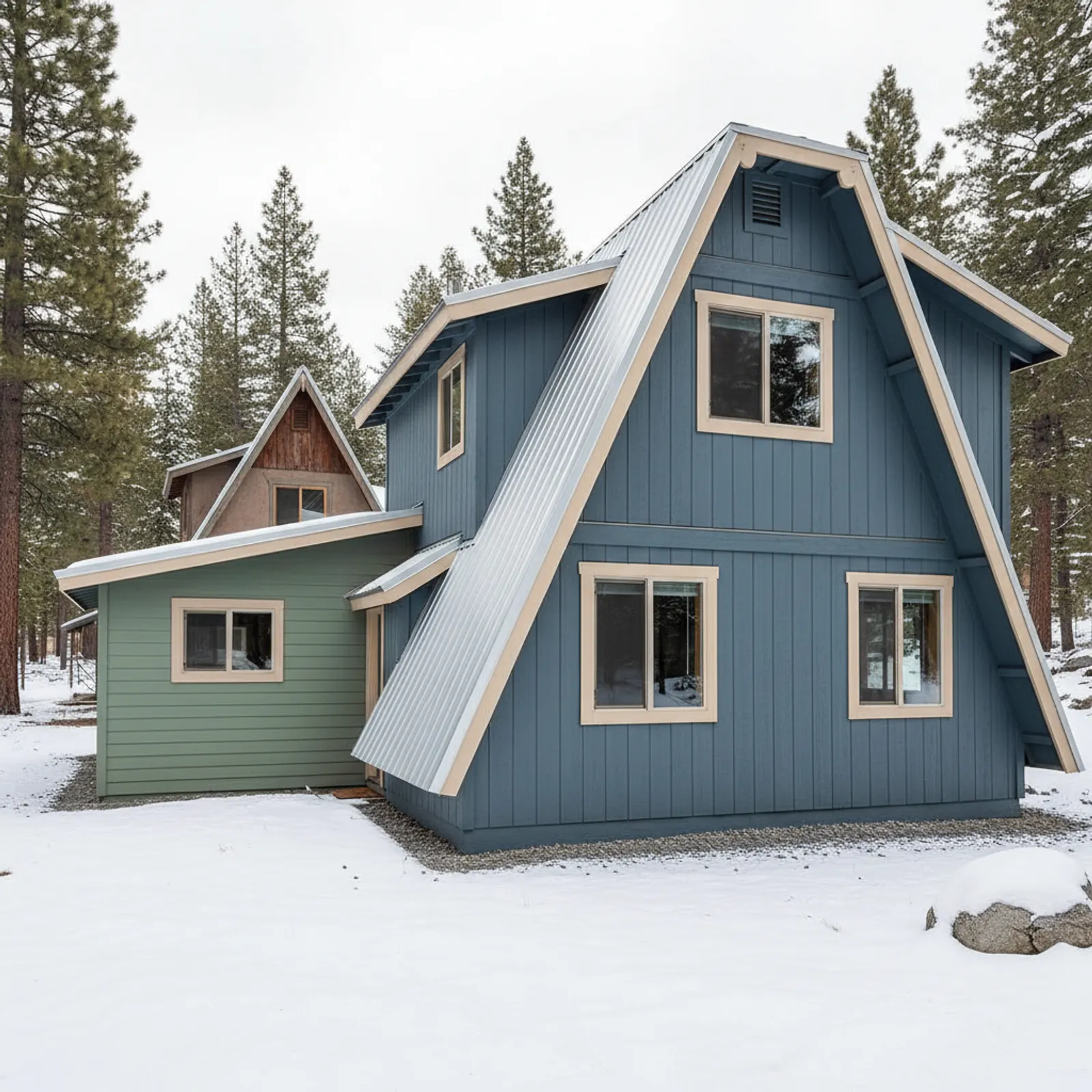
South Lake Tahoe's older cabins and steep-pitched A-frames were built for snow shedding, not for ember resistance, and that mismatch drives most fire-resistant siding work on the south shore. Many of these homes still wear cedar shakes or tongue-and-groove wood that has dried and checked under decades of high-altitude UV, turning the wall itself into kindling on a forested lot. Re-cladding an A-frame is geometry-heavy: the cladding runs almost to the ground on the sloped faces, so the lower courses sit close to needle litter and require noncombustible material plus a clean ground transition. We specify Class A fiber-cement or comparable noncombustible panels and rework the rake and eave details that historic cabins never hardened. Lakefront and near-shore homes add a second demand, since the same wall facing the water takes wind-driven moisture, so the fire-rated assembly also needs freeze-tolerant flashing. The result keeps the cabin's familiar look while removing the combustible skin that makes basin homes vulnerable.
Ember-tight detailing for rental cabins on tight basin lots
A large share of South Lake Tahoe properties are vacation homes and short-term rentals that sit empty through the dry, high-fire months, so the fire-resistant siding has to protect a building no one is watching when embers arrive on the south shore. That shifts the detailing priorities. We treat the wall as one continuous ember barrier, closing the small gaps that actually ignite homes: the junction where cladding meets the deck ledger, the vent penetrations, and the bottom course where siding nears forest duff on these tree-shaded basin lots. Class A cladding does little if a glowing ember lodges behind loose corner trim, so transitions and terminations get as much attention as the field panels. Access is its own constraint, since many cabins back up to narrow, snow-staged lanes with little staging room, which shapes how we sequence delivery and scaffolding. Coordinating the noncombustible re-side with the property's defensible-space zone gives an absent owner a wall that resists ignition without anyone present to intervene.
Why this matters in South Lake Tahoe
- Specified for Lake Tahoe / Sierra Alpine conditions
- non-combustible fiber cement as the recommended system
- Correctly detailed weather-resistive barrier and flashing
- Installed by a crew with 20 years combined experience
Recommended systems for South Lake Tahoe
- non-combustible fiber cement
- mountain-grade clearances and flashing
- freeze-thaw-durable detailing
- high-UV factory finishes
Fire-Resistant Siding for South Lake Tahoe homes
The full fire-resistant siding approach — materials, weather-resistive detailing, and the manufacturer standards we install to — is covered on the main service page, then specified for South Lake Tahoe's conditions on this one.
Our South Lake Tahoe process
- Step 1
Consultation
We listen to your goals and assess your home on site — exposure, substrate, and architecture.
- Step 2
Design & Proposal
A clear written proposal with the right system specified for your climate and a transparent scope.
- Step 3
Expert Installation
Trained crews install to manufacturer best practices with careful weather-management detailing.
- Step 4
Walkthrough & Support
A final walkthrough, full cleanup, and a clear written record of the scope completed — work we stand behind.
FAQ
Fire-Resistant Siding in South Lake Tahoe — FAQ
High — the basin is forest-embedded high-altitude WUI terrain with constrained access. Non-combustible, hardened exteriors are the baseline, designed with the snow strategy.
No — we design both into one envelope: hardened eaves/vents/ground transitions plus snow-aware clearances and freeze-tolerant flashing, with lake-facing detailing too.
They can — basin defensible-space requirements are part of the planning; we document the work to support those and insurance conversations.
No — eave, soffit, vent, deck, and ground-transition detailing complete the protection; we treat them as one assembly with the snow and lake strategies.
Keep Exploring
More for South Lake Tahoe homeowners
More in South Lake Tahoe
Other exterior services in South Lake Tahoe
Nearby Service Areas
Fire-Resistant Siding near South Lake Tahoe
Back to
El Dorado County & South Lake Tahoe
Helpful Exterior Guides