
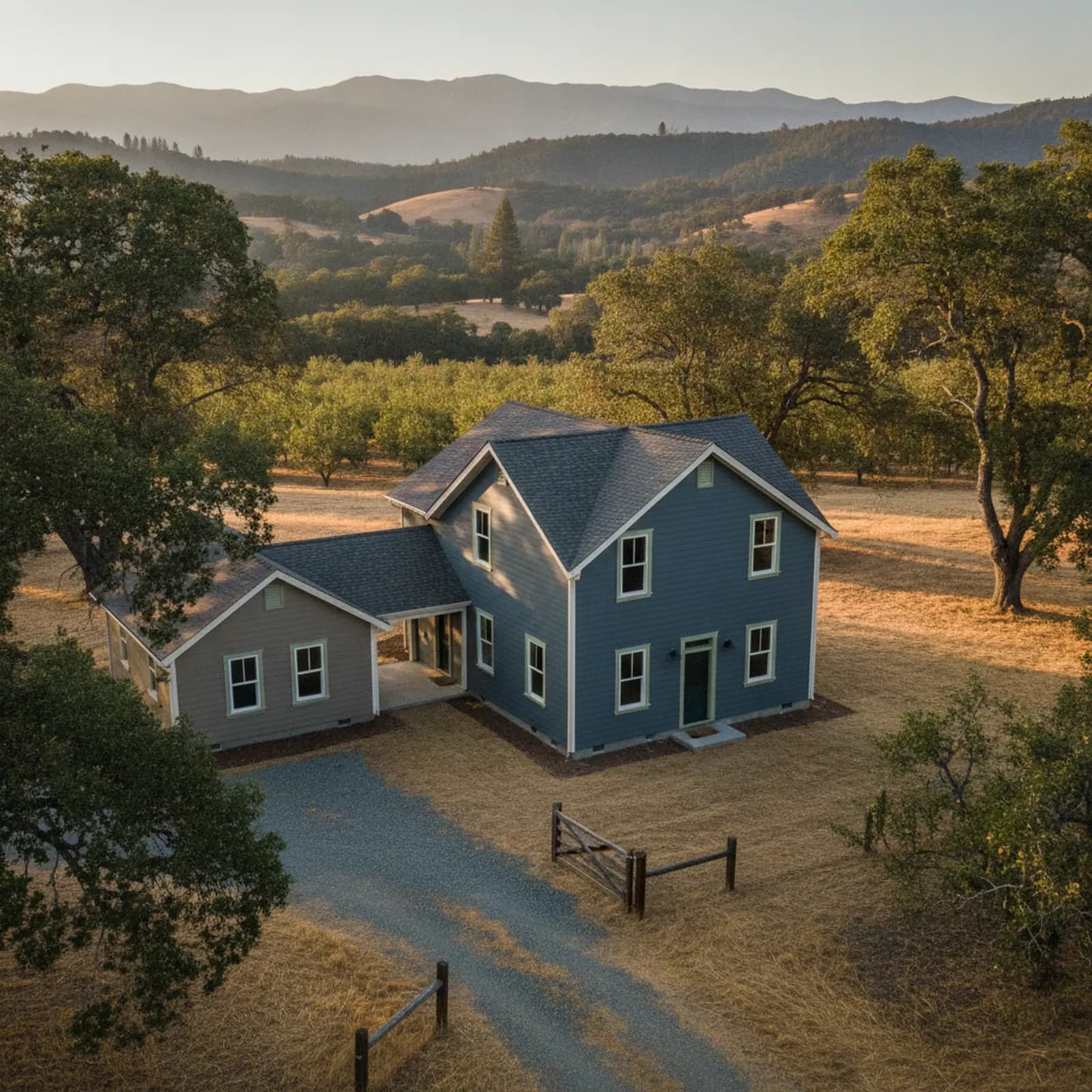
Exterior renovation in Camino
Camino sits on the Apple Hill ridge east of Placerville, climbing toward Pollock Pines along the Highway 50 corridor — the orchard country where El Dorado County's apple ranches, pine forest, and rural homes mingle on the same ridgeline. It is higher, cooler, and far more wooded than the western foothills, with farmhouses on orchard acreage interleaved with custom forest homes and older ridge cabins. That mix of mixed-conifer forest and open orchard puts Camino squarely in wildland-urban-interface terrain. Our Camino work begins with non-combustible cladding and hardened detailing built for a forested ridge, while accounting for the orchard-and-pine character that gives the area its identity.
Forest fire first, ridge winter second
Camino is cool and wet enough to grow apples, but that doesn't soften the fire problem — the surrounding mixed conifer still cures into deep, continuous fuel every summer, and that forest, more than the orchards, is the controlling stressor. So the fire strategy leads: Class A non-combustible fiber cement with hardened eaves, soffits, vents, and ground transitions where embers concentrate on a wooded ridge. Because the elevation toward Pollock Pines brings real winter rain and occasional snow, we detail the drainage plane and flashing to shed water cleanly too, so the same wall handles both the fire season and the wet months.
Considering an exterior project in Camino?
Camino housing and architecture
Camino's stock is defined by Apple Hill itself — orchard farmhouses on working ranch acreage, custom homes set among the pines, and older ridge cabins from earlier eras, many on wells and propane. A large share still wear combustible wood lap, board-and-batten, or T1-11 set against mixed conifer and orchard windbreaks, which makes them strong hardening candidates. The agritourism-active orchard properties often pair a residence with outbuildings and barns, so re-cladding here can involve more than the main house. We treat the forested and orchard-edge homes as whole-envelope fire projects while keeping farmhouse character intact where it defines the property.
Camino's ridge climate
Camino sits at a higher, cooler elevation than the western foothills — cool enough and wet enough to grow apples — but its summers are still dry, high-UV, and long enough to cure the surrounding mixed-conifer forest into deep, continuous fuel. That forest, more than open grass, is the controlling fire stressor on the ridge. Winters bring real precipitation and occasional snow as the elevation climbs toward Pollock Pines, so the assembly must shed water and handle freeze-and-wet edges cleanly. The combination — a serious forest fire season laid over genuine winter wet — is why we treat both fire detailing and the drainage plane as core to a Camino spec.
Hardening a forested orchard ridge
Camino is deep wildland-urban-interface terrain, its wildfire exposure high — mixed-conifer ridge country where embers travel and homes sit against forest and orchard fuel alike. We specify Class A non-combustible fiber cement and make the ignition-prone points the heart of the job: eaves, soffits, vents, and ground-to-wall transitions, where ember entry concentrates on a wooded ridge. Many Camino homes still wear combustible wood or T1-11 against the pines, so re-cladding in a non-combustible wall is among the most consequential hardening steps available here. On orchard properties we consider outbuildings and barns in the broader plan, and document materials to support defensible-space and insurability conversations.
Recommended materials for Camino
Non-combustible fiber cement — James Hardie systems included — is the clear recommendation for Camino given the forested ridge exposure. We use durable, farmhouse-appropriate profiles on orchard homes and straightforward profiles on the forest and cabin stock, with factory finishes that resist ridge UV. We advise against combustible cladding on the ridge as a matter of basic exposure, and there is no durability penalty: fiber cement also handles Camino's strong summer UV, dry fire season, and genuine winter wet-and-freeze cycles. Across fire, sun, and water on an Apple Hill parcel, the non-combustible choice is the sound one.
What an exterior project costs in Camino
Camino projects carry full fire-detailing scope plus ridge realities: forested rural drives, sloped Apple Hill parcels, and orchard sites where outbuildings, barns, or active agritourism layout shape staging. Older farmhouses and cabins regularly reveal substrate, sheathing, and dry-rot once decades-old wood comes off, particularly at the wet ground edges. Protecting existing defensible-space clearing and working around orchard operations both factor into the plan. We assess all of it on site and provide a written, itemized estimate; on the ridge the hardening scope is the core value of the work rather than an optional line, and your written estimate governs the job.
Apple Hill orchard properties
Many Camino parcels are working Apple Hill orchard ranches, often pairing a farmhouse with barns, fruit stands, and outbuildings that draw heavy visitor traffic in the fall season. Re-cladding on these properties can extend well beyond the main house, and we plan staging around orchard operations and agritourism timing so the work does not disrupt the harvest or the peak visiting weeks. Keeping farmhouse character intact while hardening the whole envelope is the balance these signature properties call for, since the home and outbuildings together define the ranch's appearance. We scope that mix carefully so the hardening and the look both come out right.
Forested ridge and cabin homes
Away from the orchards, Camino holds custom forest homes and older ridge cabins set deep among the pines, a great many still wearing combustible wood lap or T1-11 against the trees. These are high-leverage hardening candidates on the ridge, and the work nearly always means treating the whole envelope — cladding, eaves, soffits, vents, and ground transitions — as one connected system rather than swapping the siding alone. On wooded parcels the ember threat concentrates at the edges and undersides, so detailing those points is where the real protection is won. We scope these forest homes around that reality from the first site walk.
Ridge access and seasonal timing
Sloped Apple Hill lots, forested drives, and the higher-elevation winters toward Pollock Pines shape how we stage a Camino job and when we set the drainage-plane and flashing work. We plan the schedule into the dry season so the water-shedding details can be dried-in properly, and we protect existing defensible-space clearing throughout. We walk that timing on site so the plan fits your ridge parcel and its access rather than a generic calendar.
Camino is unincorporated: county permits, EID + wells, HZ10 + Very-High FHSZ
Camino is not a city. It is an unincorporated Apple Hill community in El Dorado County at roughly 3,200 feet on Highway 50. Building permits go through El Dorado County's Community Development Agency in Placerville. Electric and gas are PG&E, high-PSPS territory. Water is supplied by the El Dorado Irrigation District (EID) on some parcels and private wells on many others. Fire response is Camino-Pollock Pines Fire Protection District (now consolidated as Pioneer Fire Protection District) alongside CAL FIRE for surrounding Eldorado National Forest SRA. Camino is in James Hardie's HZ10 zone; installing HZ5 is a documented warranty misapplication. Essentially all of Camino sits in Very High FHSZ or State Responsibility Area, and the 2025 California Wildland-Urban Interface Code governs the exterior wall on nearly every re-side. Chapter 7A moved into the standalone WUI Code on January 1, 2026.
Our process in Camino
- Step 1
Consultation
We listen to your goals and assess your home on site — exposure, substrate, and architecture.
- Step 2
Design & Proposal
A clear written proposal with the right system specified for your climate and a transparent scope.
- Step 3
Expert Installation
Trained crews install to manufacturer best practices with careful weather-management detailing.
- Step 4
Walkthrough & Support
A final walkthrough, full cleanup, and a clear written record of the scope completed — work we stand behind.
On the Apple Hill ridge the goal is an exterior genuinely hardened against forest fire while honoring the orchard-and-pine character that defines Camino. We design for both, and we scope every Camino project on site so the spec matches your home, your orchard or forest setting, and your real exposure.
FAQ
Camino — Common Questions
High. Camino is forested Apple Hill ridge country in genuine WUI terrain, with homes against mixed-conifer and orchard fuel, so non-combustible cladding and hardened detailing are our baseline.
Re-cladding combustible wood or T1-11 in non-combustible fiber cement is among the most consequential hardening steps a Camino ridge property can take.
Yes. We plan staging around orchard operations and agritourism timing, and we can include barns and outbuildings in the broader hardening plan when needed.
Yes, occasional snow and real winter precipitation as the elevation climbs toward Pollock Pines, so we include sound drainage-plane and flashing detailing alongside the fire strategy.
We advise against it on the ridge given the forest exposure. Fiber cement also handles the UV and freeze-and-wet cycles, so it is the sound choice on every count.
Yes. James Hardie fiber cement answers the forested fire exposure, the ridge UV, and the genuine winter wet at once, which is why it is our core recommendation.
Yes. We document the materials and assemblies used so the exterior work complements defensible-space programs and supports insurability conversations.
A correctly installed fiber cement system commonly performs 30+ years on the ridge while materially reducing ignition risk across that lifespan.
Explore
Exterior Services
Helpful Exterior Guides