
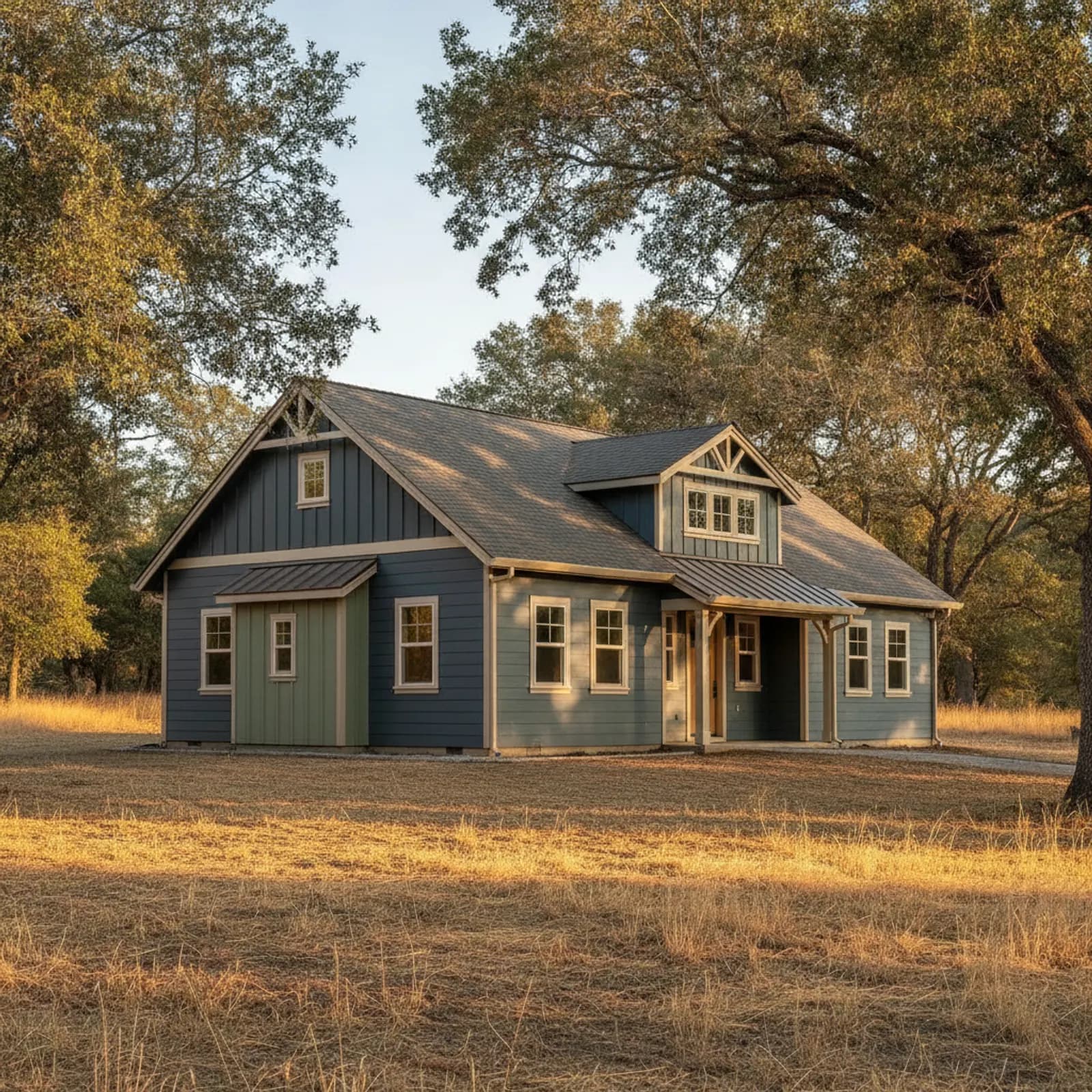
Fire-Resistant Siding in Camino
Camino is genuine wildland-urban interface terrain — mixed-conifer forest running up against orchard and residential parcels on a ridge with limited access — and fire-resistant cladding here is a baseline specification rather than an upgrade decision. The honest framing is that it is one component of an envelope, and the envelope is one layer of a whole-property strategy.
What separates serious hardening work from a cladding sale is where the attention goes: the wall face matters least of the details on a forested ridge home, and we would rather be direct about that than sell the easy part.
The wall is the easy part
Non-combustible cladding removes the largest continuous combustible surface on the building, which is worth doing. But wind-carried embers do not generally attack a wall face — they accumulate in the places where a structure has openings and horizontal ledges. Open eaves and exposed rafter tails collect embers under the roof edge. Unscreened or coarse-screened vents draw them straight into the attic and crawl space. Ground transitions where cladding meets soil, bark mulch, or leaf litter give fire a foothold at the base. Decks trap debris underneath. On a Camino property those five details do more for the outcome than the cladding does, and a package that hardens the wall while leaving them alone has spent money on the visible half.
Forest fuel arrangement around the structure
The ridge's appeal is conifer close to the house, and that is also the exposure. The zone within the first few feet of the structure is where most home ignitions are decided, and clearing combustible material out of it — leaf and needle litter against the foundation, firewood stacked on the wall, ornamental shrubs under windows, debris in gutters — is consistently the cheapest available risk reduction on properties like these. It is not work we are selling, and we will still point it out, because a hardened envelope surrounded by fuel at its base is not the project anyone should be paying for.
Wet winters do not get a pass
A common failure mode on hardened assemblies is that fire detailing and moisture detailing get treated as separate projects and end up fighting each other. Fire hardening wants a tight envelope with restricted openings; moisture management on a wet ridge wants an assembly that can drain and dry. Reconciling them is the actual engineering: ember-resistant venting that still provides the airflow the roof assembly needs, a drainage plane that works behind a hardened wall, and clearances at grade that satisfy both the fire and the water requirement. Camino gets enough winter wet that skipping this produces a hardened wall quietly rotting from behind.
What we will not tell you
We will not tell you that a hardened exterior makes a home fireproof, that it guarantees survival, or that it means the house will still be standing. Structures with excellent hardening have been lost and structures with poor hardening have survived, because outcomes in a severe wildfire depend on fire behaviour, weather, fuel, topography, and suppression resources far more than on any single building decision. What hardening does is improve the odds and remove the failure modes that are within an owner's control. That is a real and worthwhile thing, and it is not the same as a promise. Anyone selling you the promise has told you something about themselves.
Why this matters in Camino
- Specified for Sierra Foothills conditions
- fiber cement as the recommended system
- Correctly detailed weather-resistive barrier and flashing
- Installed by a crew with 20 years combined experience
Recommended systems for Camino
- fiber cement
- James Hardie
- LP SmartSide
Fire-Resistant Siding for Camino homes
The full fire-resistant siding approach — materials, weather-resistive detailing, and the manufacturer standards we install to — is covered on the main service page, then specified for Camino's conditions on this one.
Our Camino process
- Step 1
Consultation
We listen to your goals and assess your home on site — exposure, substrate, and architecture.
- Step 2
Design & Proposal
A clear written proposal with the right system specified for your climate and a transparent scope.
- Step 3
Expert Installation
Trained crews install to manufacturer best practices with careful weather-management detailing.
- Step 4
Walkthrough & Support
A final walkthrough, full cleanup, and a clear written record of the scope completed — work we stand behind.
FAQ
Fire-Resistant Siding in Camino — FAQ
On most Camino properties: the eaves, the vents, the ground transition at the base of the wall, and the first few feet of vegetation around the structure. Those are where wind-carried embers actually find a way in. We will sequence a project that way and say so even when it means a smaller job for us.
Yes, and reconciling them is the real engineering on a Camino home. Fire detailing wants a tight envelope with restricted openings; moisture management on a wet ridge wants an assembly that can drain and dry. Done carelessly you get a hardened wall quietly rotting from behind — ember-resistant venting still has to provide the airflow the roof assembly needs.
No, and we will not say otherwise. Well-hardened homes have been lost and poorly hardened ones have survived, because outcomes depend on fire behaviour, weather, fuel, terrain, and suppression far more than on any one building decision. Hardening improves the odds and removes the failure modes you control. That is worth doing; it is not a promise.
Whether wildland-interface requirements apply to a given project is El Dorado County's determination, based on the fire hazard severity zone and the scope of work. Establish it with them before scoping. We specify to the actual exposure on forested ridge parcels whether or not a permit compels it.
Keep Exploring
More for Camino homeowners
More in Camino
Other exterior services in Camino
Nearby Service Areas
Fire-Resistant Siding near Camino
Helpful Exterior Guides