
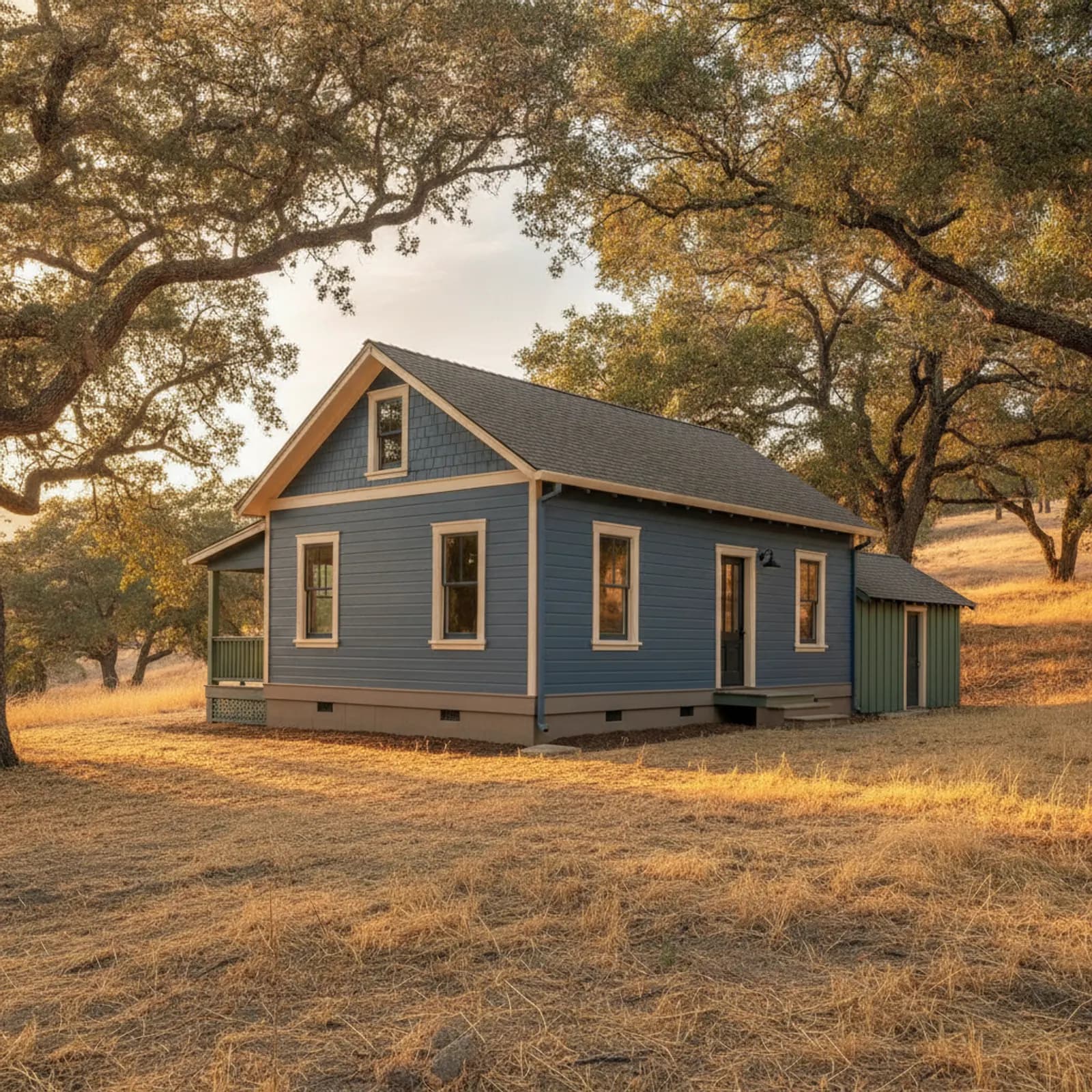
Exterior renovation in Coloma
Coloma sits on the South Fork of the American River along Highway 49, the small canyon town where James Marshall's 1848 gold discovery set off the Gold Rush. Today it is a tight cluster of historic structures, river-canyon cabins, and rural homes scattered up the steep grades that wall the river, much of it surrounded by oak woodland and seasonal grass. For a Coloma homeowner an exterior project sits at the intersection of two distinct demands: respecting a genuinely historic streetscape near the state park, and hardening a canyon home against wildfire that runs uphill through dry foothill fuel. We build to both at once.
Upslope fire decides where the hardening goes
Canyon topography is the whole story here: fire moves uphill faster and hotter through continuous oak and grass, so a Coloma home on the grades takes its exposure on the downhill side that faces the fuel. That's where we concentrate the detailing — eaves, soffits, vents, decks, and ground-to-wall transitions on the uphill-facing wall — over Class A non-combustible fiber cement. Down on the river flat the second problem appears: riparian damp, shaded north walls, and close-to-grade transitions, so on those homes we add reliable water-shedding at the lower edges. One wall, detailed for whichever hazard the parcel actually faces.
Considering an exterior project in Coloma?
Coloma housing and architecture
Coloma's built fabric runs from genuine Gold Rush-era cottages and historic-character structures near the river flat, up to canyon cabins, acreage homes, and 1970s-90s foothill ranch houses perched on the surrounding grades. A large share still wears original wood lap, board-and-batten, or aging T1-11 weathered by decades of canyon sun and river damp. On the older river-flat cottages we match the existing reveal, trim, and shadow line so a re-side reads as faithful preservation in a town that trades on its history; on the canyon and ranch homes above, re-cladding is the moment to retire combustible siding for a hardened, stable wall.
Coloma's river-canyon climate
Coloma's controlling stressor is wildfire shaped by canyon terrain, with river moisture as the secondary force. The South Fork canyon funnels heat and dries the surrounding oak and grass into volatile summer fuel, and fire moving uphill through that fuel is the defining hazard for homes on the grades. Down on the river flat, humidity, riparian damp, and the rafting-season microclimate keep moisture in play at ground transitions and shaded north walls. Summers are hot and high-UV while winters bring rain rather than meaningful snow, so the wall has to resist embers, shed water reliably at its lower edges, and survive canyon sun.
Wildfire hardening for a river canyon
Coloma's wildfire exposure is high because canyon topography accelerates fire upslope through continuous oak-woodland and grass fuel, putting homes on the grades in the direct path. We specify Class A non-combustible fiber cement and harden the points where embers and upslope fire find a home — eaves, soffits, vents, decks, and ground-to-wall transitions on the downhill side that faces the fuel. On the historic river-flat cottages we deliver the same hardening while preserving the period look, and on the canyon and ranch homes we treat swapping combustible cladding for a non-combustible wall as the single highest-value step. We document the assemblies for insurance and defensible-space conversations.
Recommended materials for Coloma
Non-combustible fiber cement, including James Hardie systems, is our core recommendation for Coloma because it answers the canyon's three stressors together — the high upslope fire exposure, the strong summer UV, and the river-flat moisture. For the historic cottages we use it in profiles that match the original lap reveal so preservation and hardening are not in tension. For canyon cabins and ranch homes we use durable factory-finished profiles that resist fade and damp. Where a budget-sensitive owner on a lower-exposure parcel prefers engineered wood, LP SmartSide can fit, but on canyon grades the non-combustible choice is the sound long-term call.
What an exterior project costs in Coloma
Cost in Coloma is driven by two things above all: steep canyon access and the age of the housing. Homes on the grades above the river often sit on narrow, winding private drives where staging materials and crew is part of the job, while historic river-flat cottages add period-matching trim work and the care a preservation-sensitive streetscape requires. Pulling decades-old wood or T1-11 frequently reveals substrate, sheathing, or river-damp rot once the wall is opened. We assess each property on site — access, exposure, and what the old cladding hides — and provide a written, itemized estimate that governs the work.
The historic river-flat core
The flat ground near the South Fork and the Marshall Gold Discovery area holds Coloma's most history-sensitive structures, where a re-side has to read as faithful upkeep rather than a remodel. On these we match the original lap reveal, shadow line, and trim character so a hardened, non-combustible wall reinforces the older streetscape instead of modernizing it away. Getting those proportions right is the part of the job that matters most in a town whose identity is its history, and it is where careful profile selection earns its keep. We treat these visible cottages as the homes that set the tone for the whole core.
Canyon grades and upslope access
Above the river flat, Coloma's homes climb the canyon walls on steep, narrow drives where the downhill side faces a continuous run of oak and grass fuel. These are the highest-priority hardening candidates in town, and also the ones where access shapes the schedule — staging, crew logistics, and protecting fuel-managed space around the home are planned explicitly rather than assumed. We walk the access route and study the downhill exposure during the site visit so the spec concentrates hardening where upslope fire would actually arrive, and so the schedule reflects the real canyon property.
River damp and resale near the state park
Coloma's river flat carries genuine moisture — riparian humidity, shaded north walls, and ground transitions close to grade — so the spec sheds water reliably even as it hardens against fire. That dual durability also reads well at resale in a town defined by its setting on the American River and its proximity to the historic park; for an older home here, a clean, hardened, low-maintenance exterior is among the most visible value moves short of a full remodel. Buyers weighing a canyon or river-flat home tend to notice a wall that has already retired its tired wood siding.
Coloma is unincorporated: Marshall Gold Discovery historic context, HZ10 + Very-High FHSZ
Coloma is not a city. It is a small unincorporated community on the South Fork American River in El Dorado County — the site of James Marshall's 1848 gold discovery at Sutter's Mill and now Marshall Gold Discovery State Historic Park. Building permits go through El Dorado County's Community Development Agency in Placerville, and parcels adjacent to the state park may carry additional coordination with California State Parks on visible exterior work. Electric and gas are PG&E, high-PSPS territory. Water is supplied by the El Dorado Irrigation District (EID) or Georgetown Divide PUD depending on address, with private wells on some acreage. Fire response is Georgetown Fire Protection District alongside CAL FIRE. Coloma is in James Hardie's HZ10 zone; installing HZ5 is a documented warranty misapplication. Essentially all of Coloma sits in Very High FHSZ or State Responsibility Area, and the 2025 California Wildland-Urban Interface Code governs the exterior wall on nearly every re-side. Chapter 7A moved into the standalone WUI Code on January 1, 2026.
Our process in Coloma
- Step 1
Consultation
We listen to your goals and assess your home on site — exposure, substrate, and architecture.
- Step 2
Design & Proposal
A clear written proposal with the right system specified for your climate and a transparent scope.
- Step 3
Expert Installation
Trained crews install to manufacturer best practices with careful weather-management detailing.
- Step 4
Walkthrough & Support
A final walkthrough, full cleanup, and a clear written record of the scope completed — work we stand behind.
In Coloma the exterior has to honor a historic river-canyon town while standing up to wildfire that runs uphill through dry fuel, and we build to exactly that double standard. We scope every Coloma project on site — access, canyon exposure, and the home's age — so the spec fits both the streetscape and the hazard.
FAQ
Coloma — Common Questions
High. The South Fork American River canyon accelerates fire upslope through continuous oak-woodland and grass fuel, so homes on the grades sit in the direct path and non-combustible cladding is a sensible baseline.
Yes. We match the original lap reveal, shadow line, and trim character so a hardened, non-combustible re-side reads as faithful preservation rather than a modern remodel.
Usually yes. On a canyon grade facing oak and grass fuel, swapping combustible T1-11 for non-combustible fiber cement is the single highest-value hardening step available.
On the river flat, yes — riparian damp, shaded north walls, and close-to-grade transitions keep moisture in play, so we detail the lower edges of the wall to shed water reliably.
Yes. James Hardie fiber cement answers the canyon's high fire exposure, strong summer UV, and river-flat moisture at once, which is why it is our core recommendation.
Often, yes. Many Coloma homes sit on narrow, winding drives above the river, so staging and crew logistics are planned explicitly as part of the scope.
Frequently. In a town defined by its river setting and history, a clean, hardened, low-maintenance exterior is one of the most visible value moves short of a full remodel.
A correctly installed, canyon-detailed system commonly performs 30+ years while resisting UV fade and materially reducing ignition risk on the grades.
Explore
Exterior Services
Helpful Exterior Guides