
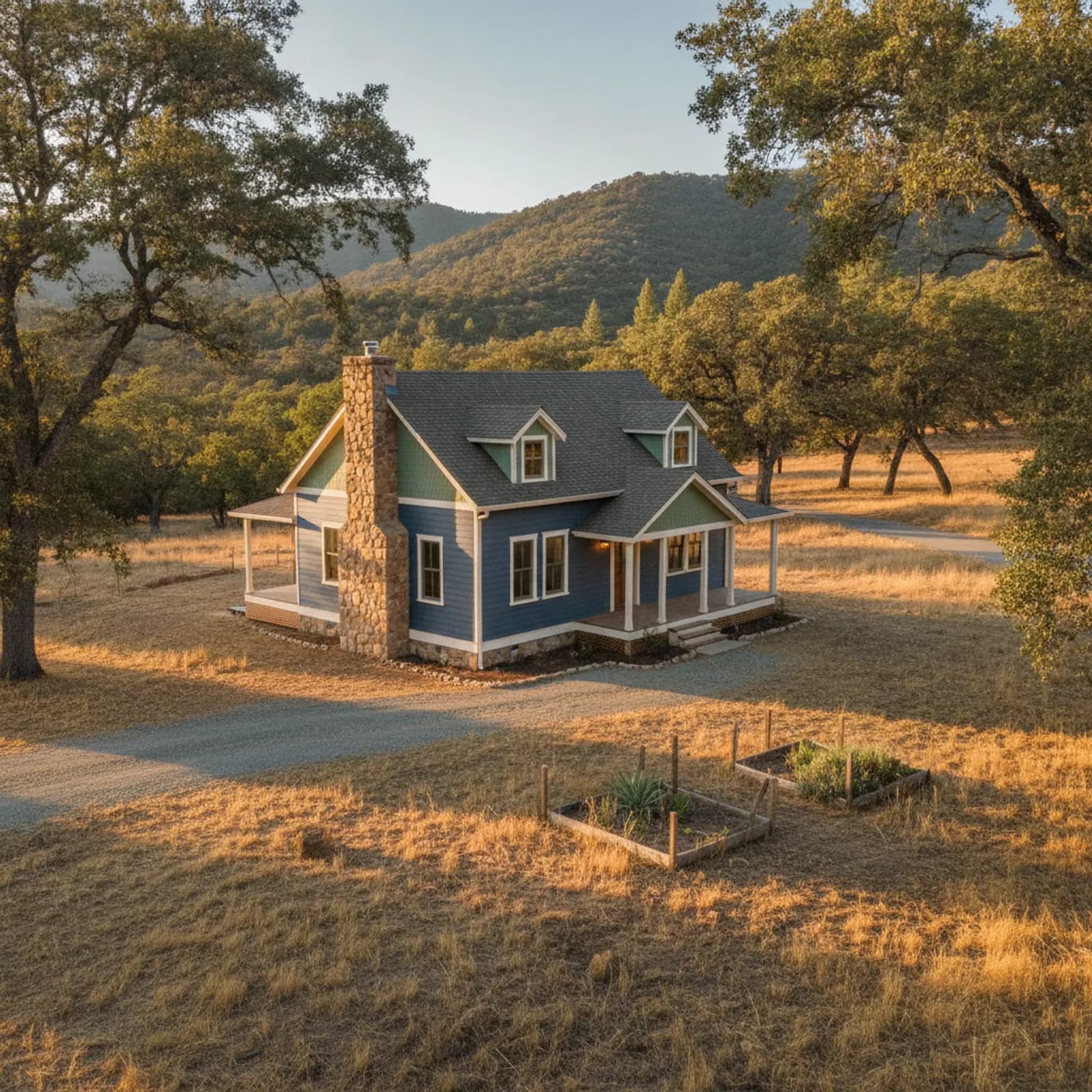
Exterior renovation in Diamond Springs
Diamond Springs is one of El Dorado County's older settlements, sitting immediately south of Placerville along Highway 49 where the foothill grade is gentler and the lots are more developed than the deeper-canyon towns. It carries a mix of genuine Gold Rush-era cottages, postwar foothill ranch homes, and small rural-residential parcels, much of it now decades past its original cladding. Because Diamond Springs is more built-up than the WUI ridges around it, the exterior conversation here leans toward durable, low-maintenance re-cladding that quietly raises a fire-aware floor without the extreme-exposure framing of a backcountry parcel. Our work pairs that everyday durability with sensible hardening for a town that has aged in place.
Durability leads, hardening rides along
Unlike the ridge towns where fire dictates everything, the honest controlling problem on most Diamond Springs homes is age — decades-old wood lap or 1970s T1-11 that has swelled, delaminated, and chalked through countless dry foothill summers. A non-combustible fiber cement re-side fixes that weathering, ends the constant repainting, and happens to retire combustible cladding at the same time, which is the most useful fire move available on a developed street. We frame the project that way honestly: durability first, with the hardening floor it raises as a real bonus rather than overstated drama.
Considering an exterior project in Diamond Springs?
Diamond Springs housing and architecture
The Diamond Springs housing stock skews older and modest — small Gold Rush-era cottages near the historic core, single-story 1960s-80s foothill ranch homes on the surrounding streets, and scattered rural-residential parcels reaching toward Placerville and El Dorado. A great deal of it still wears original wood lap, board-and-batten, or 1970s T1-11 that has weathered through decades of foothill sun. On the older cottages we match the existing reveal and trim so a re-side reads as faithful upkeep rather than a remodel; on the ranch and rural homes we treat re-cladding as the moment to retire tired combustible siding for a hardened, stable system.
Diamond Springs's foothill climate
Diamond Springs sits in the lower-to-mid foothill band where summers are hot, dry, and high-UV but the snow line stays well above town, so heat and sun-driven aging dominate the cladding's working life more than freeze cycles do. The same dry summers that bake the south-facing walls also cure the surrounding oak grass and brush into seasonal fuel, which keeps a fire-aware approach reasonable even on developed streets. Winters bring real rain rather than heavy snow, so the spec must shed water reliably at the lower edges and ground transitions. That heat-then-rain rhythm is what we design the wall assembly around here.
A fire-aware floor for a developed foothill town
Diamond Springs is more built-up than the canyon and ridge communities nearby, so its wildfire exposure is elevated rather than extreme — but it is real, sitting in the same Gold Country fuel belt as Placerville next door. We specify Class A non-combustible fiber cement and attend to the common ignition points — eaves, vents, and ground-to-wall transitions — so a re-side meaningfully raises the home's hardening floor. On the older cottages and tired-T1-11 ranch homes, swapping combustible cladding for a non-combustible wall is the single most useful step available, and we document the materials to support insurance and defensible-space conversations.
Recommended materials for Diamond Springs
Non-combustible fiber cement, including James Hardie systems, is our core recommendation for Diamond Springs because it answers all three local stressors at once — the elevated fire exposure, the punishing summer UV, and the winter rain. For period cottages we use it in profiles that match the existing reveal; for ranch and rural homes we use straightforward durable profiles with factory finishes that resist foothill fade. Where a budget-sensitive owner wants engineered wood, LP SmartSide can fit lower-exposure parcels, but on this town's older, sun-beaten stock the non-combustible choice is usually the simplest long-term call.
What an exterior project costs in Diamond Springs
Cost in Diamond Springs is shaped less by extreme access than by the age of the housing: pulling decades-old wood or T1-11 off a Gold Rush cottage or 1970s ranch frequently reveals substrate, sheathing, or dry-rot issues, especially where siding has sat close to grade. Period-matching trim on the older cottages adds detail work, while the more standard ranch homes scope more simply. Because lots here are generally developed and reachable, staging is usually less of a driver than on backcountry parcels. We assess each home on site and provide a written, itemized estimate that governs the work.
The older Highway 49 core
The streets nearest the historic Diamond Springs core hold genuine Gold Rush-era cottages, often small, close to the road, and visible from Highway 49 where it threads through town. On these we match the original lap reveal, shadow line, and trim character so a hardened re-side reinforces the older streetscape rather than modernizing it away. Getting those proportions right is what lets a non-combustible wall read as faithful upkeep on a town that wears its age openly, and it is the part of the job where careful profile selection matters most. We treat these visible cottages as the homes that set the tone for the whole older core.
Ranch and rural-residential parcels
Away from the core, Diamond Springs is mostly single-story foothill ranch homes and modest rural-residential parcels, a good share of them still wearing original wood or 1970s T1-11. These are the everyday re-side candidates here — straightforward homes where retiring tired combustible cladding for a stable, low-maintenance non-combustible wall delivers both a hardening gain and decades of freedom from repainting and patching. Because these lots are generally developed and easy to reach, the work usually scopes cleanly, with the main variable being whatever the old siding hides at the substrate once it comes off. We plan for that on site rather than assuming the wall is sound.
Market context beside Placerville
Diamond Springs trades closely with Placerville next door, so a clean, modern, low-maintenance exterior reads well to foothill buyers comparing the two towns side by side. For an older home here, re-cladding is often the most visible value move available short of a full remodel, and a hardened, fade-resistant wall is an easy story to tell at resale in this corner of El Dorado County. Buyers in this price band tend to weigh deferred maintenance carefully, so a home that has already retired its tired wood siding stands out against comparable listings that still carry that work ahead of them.
Diamond Springs is unincorporated: county permits, EID, HZ10 + Very-High FHSZ
Diamond Springs is not a city. It is an unincorporated Gold Rush-era community in El Dorado County immediately south of Placerville. Building permits go through the El Dorado County Community Development Agency in Placerville. Electric and gas are PG&E, and the area is in high-PSPS territory. Water is supplied by the El Dorado Irrigation District (EID). Fire response is Diamond Springs / El Dorado Fire Protection District — the district is named for this community — alongside CAL FIRE. Diamond Springs is in James Hardie's HZ10 zone; installing HZ5 is a documented warranty misapplication. Essentially all of Diamond Springs sits in Moderate to Very High FHSZ under California's 2025 LRA Fire Hazard Severity Zone map, and the 2025 California Wildland-Urban Interface Code governs the exterior wall on nearly every re-side. Chapter 7A moved into the standalone WUI Code on January 1, 2026.
Our process in Diamond Springs
- Step 1
Consultation
We listen to your goals and assess your home on site — exposure, substrate, and architecture.
- Step 2
Design & Proposal
A clear written proposal with the right system specified for your climate and a transparent scope.
- Step 3
Expert Installation
Trained crews install to manufacturer best practices with careful weather-management detailing.
- Step 4
Walkthrough & Support
A final walkthrough, full cleanup, and a clear written record of the scope completed — work we stand behind.
In Diamond Springs the goal is an honest, durable re-side that quietly hardens an older foothill home and ends the cycle of repainting weathered wood. We scope every Diamond Springs project on site so the spec fits your home's age, its exposure, and your budget.
FAQ
Diamond Springs — Common Questions
Elevated. Diamond Springs is more developed than the canyon towns nearby, but it sits in the same Gold Country fuel belt as Placerville, so non-combustible cladding is a sensible baseline.
Usually yes. Retiring tired T1-11 or wood for non-combustible fiber cement both hardens the home and ends the constant repainting that aging foothill siding demands.
Yes. We match the original lap reveal and trim character so a hardened re-side reads as faithful upkeep rather than a modern remodel.
Rarely. The snow line sits above town, so heat, UV, and winter rain drive the cladding's working life far more than freeze cycles do.
Yes. James Hardie fiber cement answers the elevated fire exposure, the strong summer UV, and the winter rain at once, which is why it is our core recommendation.
Often significantly. For an older Diamond Springs home, a clean, low-maintenance, fade-resistant exterior is one of the most visible value moves short of a full remodel.
We still harden the common ignition points — eaves, vents, and ground transitions — because the surrounding foothill fuels make a fire-aware floor worthwhile even on built-up streets.
A correctly installed system commonly performs 30+ years in this foothill climate while resisting the UV fade that ages combustible siding much faster.
Explore
Exterior Services
Helpful Exterior Guides