
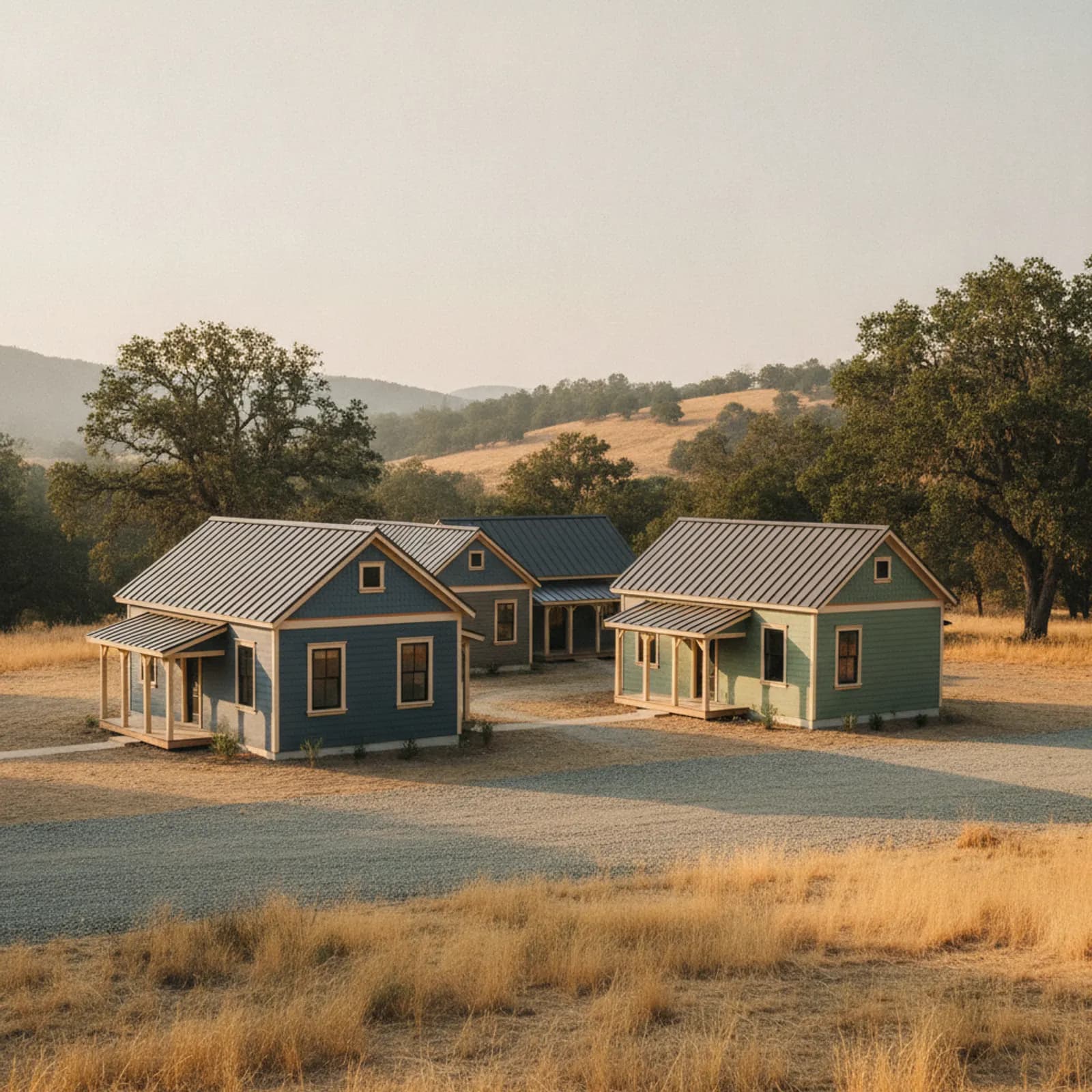
Fire-Resistant Siding in Diamond Springs
Diamond Springs is an established, more built-up foothill town just south of Placerville, but it still carries genuine, elevated wildfire exposure — concentrated on the grassy, oak-and-brush parcels toward the town's outskirts and along the Highway 49 corridor rather than spread evenly across every block. So fire-resistant siding here is a real and honest decision: serious on the exposed edges, sensible baseline on the protected in-town lots, and best assessed address by address.
Honest, elevated — not extreme — exposure
We are straight with Diamond Springs homeowners about where they sit. This is not a deep-forest community like Pollock Pines, but it is a foothill town with real fire terrain at its edges: dry grass, oak woodland, and brush that cure to fuel through the long hot summers. The exposure is elevated and uneven — heaviest on the acreage and outskirts parcels, lighter on the developed in-town grid. Our scope follows that reality. On the exposed parcels we specify Class A non-combustible cladding and harden the assembly; on the protected blocks we still favor non-combustible material as sensible insurance without overstating the threat. The honest assessment is the starting point, not a one-size foothill template.
Zone 0 and the first five feet at the foundation
Fire-resistant siding only does its job in Diamond Springs when the noncombustible cladding meets a clean ground transition. On the older in-town lots and the brushy acreage alike, we routinely find wood skirting, lattice, and bark mulch crowding the base of the wall, which turns even a Class A panel into a wick. Our scope treats the lowest band of siding as part of the ember-defense plan: we carry noncombustible material down to a defined break above grade, swap combustible vent screening for finer ember-rated mesh, and detail the wall-to-deck junction so a deck fire cannot climb behind the cladding. On the sloped, grassy parcels at the edges of town, where flame contact rides uphill, that base detailing matters more than on a flat downtown lot.
Embers, not flame fronts, on a built-up town
Because Diamond Springs is more developed than the remote ridge communities, the realistic threat to most homes is wind-driven embers landing on the house during a Gold Country event, not a wall of flame arriving across open forest. That changes what a hardened exterior has to do here. Non-combustible cladding is necessary but not sufficient: embers find the gaps. We close tight, gap-free joints, flash the siding-to-roofline transition, and treat soffit and eave returns so glowing debris cannot draw into the attic or wall cavity. On a denser town grid, a neighbor's structure can be the ignition source as much as the wildland, so we also weigh radiant exposure between close lots. The goal is a continuous sealed shell, because one unprotected vent or seam can undo an otherwise hardened wall.
Matching the cladding to mixed Diamond Springs stock
Diamond Springs housing spans postwar cottages, mid-century ranches, and newer acreage homes, and we choose the fire-resistant product to suit the building rather than forcing one look. For the older in-town stock we lean on fiber-cement and other Class A boards milled to read like traditional lap, so the hardened wall still belongs on its street. On the rural foothill homes at the edges, where the fire conversation is most urgent and the architecture is less constrained, we can specify heavier noncombustible systems and broader coverage. We also read how a home sits relative to its neighbors and the brush line — a tight in-town lot shares ember and radiant exposure with the house next door, while an outskirts parcel faces open vegetation. Reading the setting, not just the wall, keeps the choice honest.
Why this matters in Diamond Springs
- Specified for Sierra Foothills conditions
- fiber cement as the recommended system
- Correctly detailed weather-resistive barrier and flashing
- Installed by a crew with 20 years combined experience
Recommended systems for Diamond Springs
- fiber cement
- James Hardie
- LP SmartSide
Fire-Resistant Siding for Diamond Springs homes
The full fire-resistant siding approach — materials, weather-resistive detailing, and the manufacturer standards we install to — is covered on the main service page, then specified for Diamond Springs's conditions on this one.
Our Diamond Springs process
- Step 1
Consultation
We listen to your goals and assess your home on site — exposure, substrate, and architecture.
- Step 2
Design & Proposal
A clear written proposal with the right system specified for your climate and a transparent scope.
- Step 3
Expert Installation
Trained crews install to manufacturer best practices with careful weather-management detailing.
- Step 4
Walkthrough & Support
A final walkthrough, full cleanup, and a clear written record of the scope completed — work we stand behind.
FAQ
Fire-Resistant Siding in Diamond Springs — FAQ
Elevated and real, but not extreme — this is a built-up foothill town, with the heaviest exposure on the grassy, oak-and-brush parcels at the outskirts and along Highway 49. We assess each address honestly rather than overstate the risk.
It is sensible baseline insurance. Even away from the brushy edges, non-combustible cladding and ember-aware detailing cost little extra during a re-side and remove the wall as an ignition path.
Usually the first five feet at the foundation and the vents — embers collect against the base of the wall and draw into eaves. We carry noncombustible material to grade, use ember-rated mesh, and harden the ground-to-wall transition.
It can support insurability in elevated-fire foothill terrain; we document the materials and assemblies, though insurers set their own criteria.
Keep Exploring
More for Diamond Springs homeowners
More in Diamond Springs
Other exterior services in Diamond Springs
Nearby Service Areas
Fire-Resistant Siding near Diamond Springs
Back to
El Dorado County & Diamond Springs
Helpful Exterior Guides