
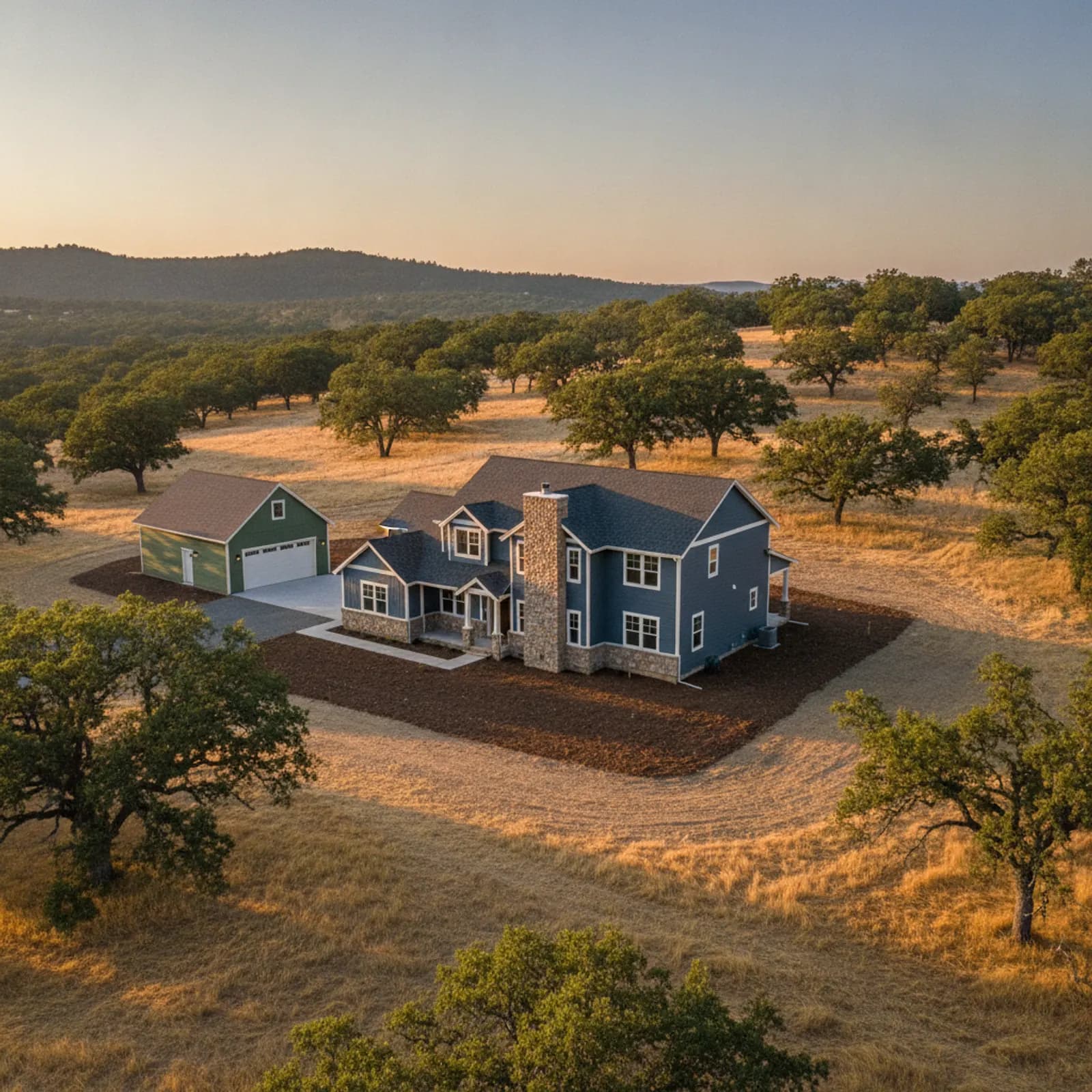
Exterior renovation in Pilot Hill
Pilot Hill is a rural community strung along Highway 49 in the open western El Dorado County foothills, between Auburn's edge and the American River canyons. It is country of large acreage parcels, working ranches, horse properties, and custom foothill homes set in rolling oak-studded grassland rather than dense forest. For a Pilot Hill owner an exterior project is shaped by exposure to fast-moving grass and oak-woodland fire across open ground, and by the practical demands of a low-density rural property where a home, outbuildings, and a barn may all share the same fuel. We build hardened, low-maintenance exteriors for exactly that setting.
Open ground, multiple structures, one fuel bed
Two things set Pilot Hill apart. First, open grassland means most walls face fuel on several sides at once, so the hardening isn't aimed at a single exposed elevation — we specify a non-combustible fiber cement wall and detail the eaves, vents, and ground transitions all the way around where wind-driven embers and grass flame can reach. Second, a home here usually shares its parcel with a barn and outbuildings in the same continuous grass, so we focus the cladding on the residence first while planning it to fit the owner's broader defensible-space work, since a hardened house ringed by combustible structures is only partly protected.
Considering an exterior project in Pilot Hill?
Pilot Hill housing and architecture
Pilot Hill's stock is overwhelmingly rural: single-story ranch and acreage homes, horse properties with barns and outbuildings, custom foothill houses from the 1980s through the 2000s, and a share of manufactured and modular rural homes on larger parcels. Much of it wears wood lap, board-and-batten, or T1-11 chosen for a country look and now decades into foothill weathering. Because the homes sit on open ground rather than in a townscape, re-cladding here is less about matching a streetscape and more about retiring combustible siding for a hardened, durable wall that stands up to grassland sun and the fire exposure that comes with open foothill acreage.
Pilot Hill's open-foothill climate
Pilot Hill's controlling stressor is grassland and oak-woodland wildfire across open terrain. The same hot, dry, high-UV summers that bake the exposed walls cure the surrounding annual grass and oak into continuous, fast-igniting fuel, and fire in this country moves quickly and broadly rather than crawling through timber. The snow line sits well above the community, so freeze cycles are a non-issue and heat, UV, and wind-driven ember exposure dominate the cladding's working life. Winters bring rain the wall must shed at its lower edges. The spec is built around resisting embers on open ground and surviving relentless foothill sun.
Hardening against open-ground grass and oak fire
Pilot Hill's wildfire exposure is high because open grass and oak-woodland fuel surrounds homes on most sides and carries fire fast across acreage. We specify Class A non-combustible fiber cement and harden the points where wind-driven embers find purchase — eaves, vents, soffits, and the ground-to-wall transitions that sit closest to grass fuel. On manufactured, T1-11, and wood-clad rural homes, replacing combustible siding with a non-combustible wall is the most useful single step a Pilot Hill property can take. Because parcels here carry barns and outbuildings in the same fuel, we plan the cladding work to fit alongside the broader defensible-space effort, and document the assemblies for insurance use.
Recommended materials for Pilot Hill
Non-combustible fiber cement, including James Hardie systems, is our core recommendation for Pilot Hill because it answers the two stressors that matter on open foothill acreage — fast grass-and-oak fire exposure and punishing summer UV — in one durable, factory-finished wall. The low-maintenance quality matters here: rural owners with long drives and multiple structures benefit from siding that stops demanding repainting. Where a lower-exposure parcel and a tighter budget point that way, LP SmartSide engineered wood can fit, but on open ground surrounded by grass fuel the non-combustible choice is the straightforward long-term call for the main residence.
What an exterior project costs in Pilot Hill
Cost in Pilot Hill is shaped by rural-property realities more than by terrain extremes. Long private drives and spread-out acreage affect staging and crew logistics, and many properties involve more than one structure when an owner hardens the home and considers outbuildings together. Pulling decades-old wood or T1-11 off a rural ranch home commonly reveals substrate or dry-rot issues once the wall is open. Manufactured and modular homes carry their own re-cladding considerations. We assess each property on site — access, the number and condition of structures, and what the old siding hides — and provide a written, itemized estimate that governs the work.
Ranch and horse properties
Much of Pilot Hill is working and hobby ranch land — horse properties with barns, paddocks, and outbuildings sharing a parcel with the residence. When we harden a home here we look at the whole property's fuel picture, because a hardened house ringed by combustible outbuildings in continuous grass is only partly protected. We focus the cladding work on the residence first while planning it to complement the owner's broader defensible-space and outbuilding decisions, so the hardening reads as a coherent property strategy rather than a single isolated upgrade on an exposed rural lot.
Open-ground access and acreage
Pilot Hill homes sit on large parcels reached by long private and shared drives off Highway 49, so simply getting materials and crew to the wall is a real part of the job on bigger acreage. We walk the access route during the site visit and plan staging around the home's position on the parcel, rather than assuming a tidy suburban setup. The open ground also means most walls face fuel on multiple sides, which we account for when deciding where hardening detail is concentrated across the home's exposure.
Low-maintenance value on rural property
On a rural Pilot Hill property, the maintenance burden of aging wood siding is heavier than in town — exposed walls, long sightlines, and multiple structures all mean more surface to keep painted and patched. Retiring tired combustible cladding for a fade-resistant, low-maintenance non-combustible wall ends that cycle on the main residence and pairs durability with a real hardening gain. For owners planning to hold acreage long-term, that combination is usually the most practical exterior investment available short of a full rebuild, and it reads well to the rural buyers this market attracts.
Pilot Hill is unincorporated: county permits, EID/GDPUD/wells, HZ10 + Very-High FHSZ
Pilot Hill is not a city. It is an unincorporated rural community in El Dorado County along Highway 49 between Auburn and Coloma. Building permits go through El Dorado County's Community Development Agency in Placerville. Electric and gas are PG&E, high-PSPS territory. Water is a mix — El Dorado Irrigation District (EID), Georgetown Divide PUD, and private wells all appear across the community. Fire response is Rescue Fire Protection District or Georgetown FPD depending on address, alongside CAL FIRE. Pilot Hill is in James Hardie's HZ10 zone; installing HZ5 is a documented warranty misapplication. Essentially all of Pilot Hill sits in Very High FHSZ or State Responsibility Area under California's 2025 LRA Fire Hazard Severity Zone map, and the 2025 California Wildland-Urban Interface Code governs the exterior wall on nearly every re-side. Chapter 7A moved into the standalone WUI Code on January 1, 2026.
Our process in Pilot Hill
- Step 1
Consultation
We listen to your goals and assess your home on site — exposure, substrate, and architecture.
- Step 2
Design & Proposal
A clear written proposal with the right system specified for your climate and a transparent scope.
- Step 3
Expert Installation
Trained crews install to manufacturer best practices with careful weather-management detailing.
- Step 4
Walkthrough & Support
A final walkthrough, full cleanup, and a clear written record of the scope completed — work we stand behind.
In Pilot Hill the exterior has to stand up to fast grass-and-oak fire across open foothill ground while ending the upkeep that aging rural siding demands, and we build to that standard. We scope every Pilot Hill project on site — access, the property's structures, and its fuel exposure — so the spec fits a real rural acreage home.
FAQ
Pilot Hill — Common Questions
High. Open grass and oak-woodland fuel surrounds most homes and carries fire fast across acreage, so non-combustible cladding is a sensible baseline for the main residence.
It carries differently but is very dangerous on open ground — grass fire moves fast and broadly, and wind-driven embers reach the walls, which is why we harden eaves, vents, and ground transitions.
Usually yes. On open foothill acreage surrounded by grass fuel, swapping combustible T1-11 or wood for non-combustible fiber cement is the most useful single hardening step.
We focus the cladding work on the residence first, but we plan it around the whole property's fuel picture so it complements your defensible-space and outbuilding decisions.
Rarely. The snow line sits above the community, so heat, UV, and wind-driven ember exposure drive the cladding's working life far more than freeze cycles.
Often, yes. Long private drives and spread-out acreage affect staging and crew logistics, so we walk the access route on site and plan around it.
Yes. James Hardie fiber cement answers the open-ground fire exposure and strong summer UV at once, and its low-maintenance finish suits a rural property with a lot of wall to keep up.
A correctly installed system commonly performs 30+ years in this open-foothill climate while resisting UV fade and reducing ignition risk on exposed acreage.
Explore
Exterior Services
Helpful Exterior Guides