Fiber Cement Siding in Grass Valley
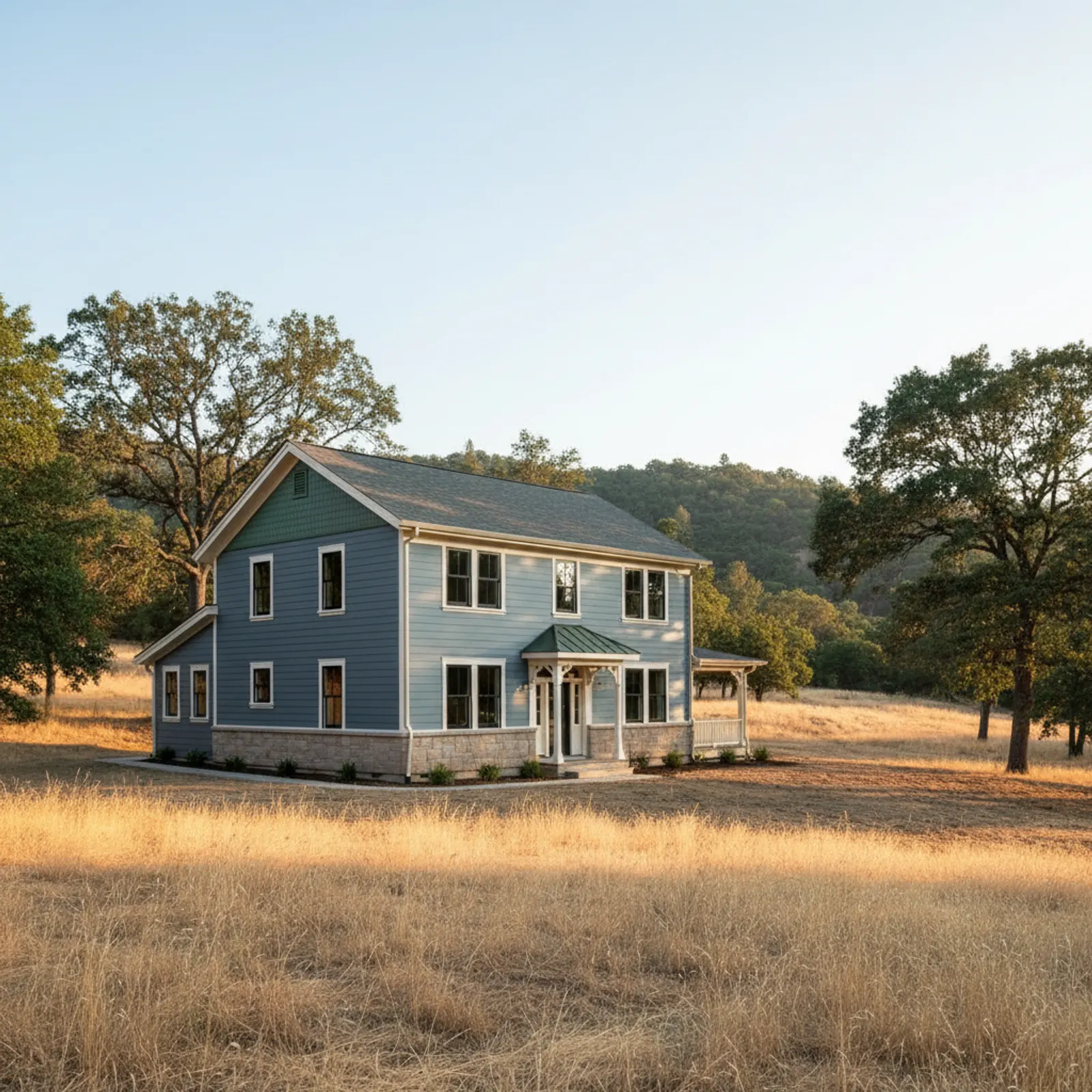
Fiber cement is the core Grass Valley recommendation because it is Class A non-combustible for the genuine high forested fire exposure and dimensionally stable through the elevated foothill summer — with factory finishes that resist Gold Country UV, and profiles faithful enough for the historic downtown stock.
The historic Grass Valley downtown carries Gold Rush-era architectural character that mass-market vinyl siding flattens immediately. Hardie's narrow-exposure beaded lap and shingle profiles can be specified to match original detailing on these homes while delivering the fire resistance the forested-edge parcels demand.
Non-combustible for forested Gold Country
On Grass Valley's forest-embedded subdivisions and rural acreage, combustible wood is the wrong call; fiber cement's Class A non-combustibility is the decisive property, paired with hardened eave, vent, and ground-transition detailing.
Period-faithful profiles for the historic core
On Grass Valley's Gold Rush-era homes we specify fiber cement in genuinely period-appropriate profiles with accurate reveals and replicated trim, so a re-side reads as a sympathetic upgrade — with non-combustibility as the technical backbone.
Ember-zone assembly detailing for acreage parcels
On Grass Valley's wide ring of rural-residential and acreage lots, the fiber cement board itself is only part of the fire equation. The real vulnerability on these forest-edge homes is the transitions and penetrations, so the assembly matters as much as the panel. We detail the work as a complete wall system: ember-resistant trim at eaves and rakes, soffit and gable treatments that pair the cement cladding with metal flashing, and tight terminations around vents, dryer outlets, and hose bibs where wind-driven embers collect. The first six inches above grade get special attention, because the standard mistake on these wooded parcels is running combustible substrate or wood trim down to bare dirt and pine duff. Where a deck, fence, or porch ties into the wall, that joint becomes the ignition path, so we plan the cement-to-noncombustible connection before tear-off rather than improvising at the wall. The result is cladding that actually behaves like the home-hardening project a Grass Valley re-side genuinely is, not just a Class A label on a single product.
Access, slope, and substrate on wooded foothill lots
Re-siding in Grass Valley rarely happens on a flat suburban pad. Homes here sit on pine-and-oak slopes near 2,400 feet, often down long private drives with limited turnaround, tree canopy crowding the walls, and grade that drops away on the downhill elevations. That terrain shapes the job before a single board goes up. Staging cement plank, which is heavy and brittle, requires planned material drops and protected cuts so silica dust stays controlled under the trees rather than scattered across the lot. On the older Gold Country and forest-embedded stock, tear-off frequently exposes substrate surprises: aged sheathing, prior repairs, or framing that has shifted on a settling foothill slope. We budget for substrate repair and a proper weather-resistive barrier rather than cladding over questionable wall structure. Even with the area's low moisture and snow, the uphill walls catch runoff and shade-held dampness, so flashing and clearance details on the downhill side carry the drainage. Sequencing access, slope work, and substrate correction up front keeps a Grass Valley fiber cement project from stalling halfway through tear-off.
Why this matters in Grass Valley
- Specified for Sierra Foothills / Gold Country conditions
- Class A non-combustible fiber cement as the recommended system
- Correctly detailed weather-resistive barrier and flashing
- Installed by a crew with 20 years combined experience
Recommended systems for Grass Valley
- Class A non-combustible fiber cement
- fire-aware detailing
- period-sensitive profiles
Fiber Cement Siding for Grass Valley homes
The full fiber cement siding approach — materials, weather-resistive detailing, and the manufacturer standards we install to — is covered on the main service page, then specified for Grass Valley's conditions on this one.
Our Grass Valley process
- Step 1
Consultation
We listen to your goals and assess your home on site — exposure, substrate, and architecture.
- Step 2
Design & Proposal
A clear written proposal with the right system specified for your climate and a transparent scope.
- Step 3
Expert Installation
Trained crews install to manufacturer best practices with careful weather-management detailing.
- Step 4
Walkthrough & Support
A final walkthrough, full cleanup, and a clear written record of the scope completed — work we stand behind.
FAQ
Fiber Cement Siding in Grass Valley — FAQ
Yes — its Class A non-combustibility is decisive in dense Gold Country conifer, paired with hardened detailing, with no finish-quality penalty versus wood.
Yes — in period-appropriate profiles with accurate reveals and replicated trim it suits the Gold Rush-era downtown stock.
Yes — it is dimensionally stable through the elevated foothill summer, and factory finishes resist Gold Country UV far better than field paint.
Fiber cement — engineered wood is combustible in forested Gold Country terrain; there's no durability gain to offset the fire risk here.
Keep Exploring
More for Grass Valley homeowners
More in Grass Valley
Other exterior services in Grass Valley
Nearby Service Areas
Fiber Cement Siding near Grass Valley
Helpful Exterior Guides