
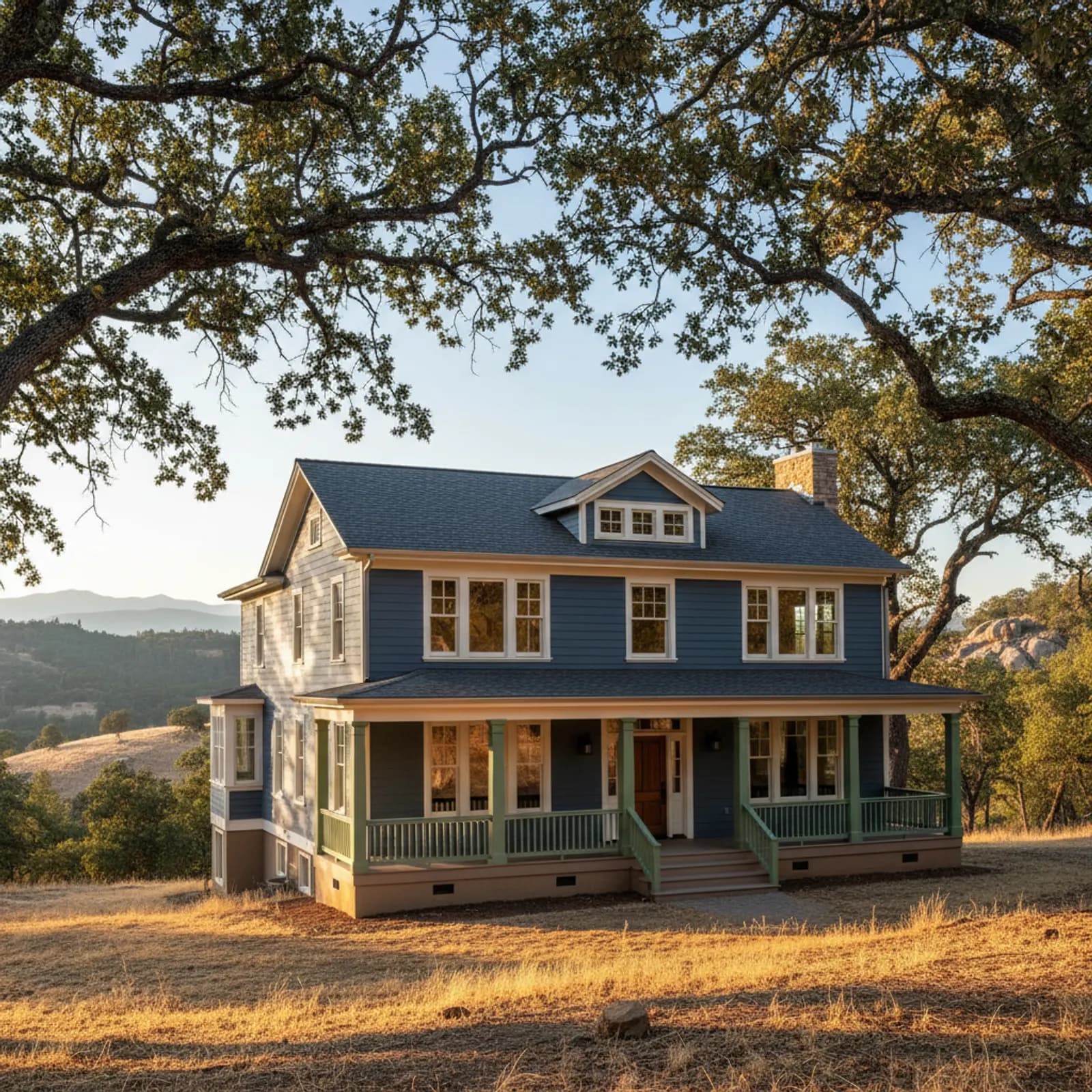
Siding in Grass Valley
A Grass Valley re-side is Gold Country forest-fire work, not alpine snow work like Truckee. At roughly 2,400 feet there is no extreme snow load — the controlling factors are genuine high wildfire exposure in dense conifer along the Highway 49 corridor, an elevated foothill summer, and a celebrated National Register-era Victorian downtown that demands period fidelity.
Grass Valley also wears its fire risk openly — this is rural, forest-embedded Gold Country with narrow access, not suburbia that hides its exposure. So a project is scoped around honest ember hardening and, on the historic stock, faithful period detailing.
Forest-embedded, openly high exposure
Grass Valley's subdivisions and rural acreage sit in dense conifer with constrained access. We strip combustible wood siding, re-clad in Class A non-combustible material, and harden eaves, soffits, vents, decks, and ground transitions — straightforward, honest fire work for terrain that genuinely warrants it.
A National Register-era historic downtown
Grass Valley's Gold Rush-era downtown and surrounding historic homes are architecturally significant; the work replicates period profiles and trim faithfully while still upgrading to non-combustible assemblies where the parcel's exposure warrants it.
What ember-zone code drives on a re-clad here
Because most of Grass Valley falls inside mapped wildfire-hazard terrain, a re-side is effectively a chance to bring the whole exterior envelope up to a wildland-urban-interface standard, not just swap one cladding for another. The wall covering itself is the obvious piece: we move homeowners off old combustible wood and plank siding toward non-combustible fiber cement or comparable ignition-resistant systems rated for these conditions. But siding does not stand alone. The same tear-off exposes the assemblies that actually let embers in during a foothill fire, so we treat eaves, soffits, trim transitions, and the gap where siding meets the foundation as part of the scope. That means tight, ember-resistant detailing at penetrations and a continuous, well-flashed bottom course rather than leaving a vulnerable edge. On a wooded lot off the Highway 49 corridor, the goal is an exterior that gives wind-driven embers nowhere to lodge, which is a meaningfully different spec than a re-side aimed only at curb appeal would call for in a lower-risk town.
Working around acreage access and the dry-season window
A re-side on a Grass Valley acreage parcel is as much a logistics problem as a carpentry one. Many homes here sit at the end of long gravel drives off the rural roads ringing town, with limited turnaround for a delivery truck and no flat staging pad for scaffold, a dumpster, and pallets of fiber cement. We plan material drops and tear-off staging before the first board comes down, because hauling old combustible siding back out a narrow private lane is slow and easy to underestimate. Timing matters too. At 2,400 feet the wet stretch is short, so we aim exterior work into the dry foothill season, which is also when defensible-space rules and any local burn or hot-work restrictions run strictest. That shapes how we handle saw cutting and debris on a forested lot. Spelling out access, parking, dust control, and disposal up front keeps a wooded Grass Valley job from stalling halfway through, which on an exposed parcel is exactly when you least want an opened-up wall sitting unfinished.
Why this matters in Grass Valley
- Specified for Sierra Foothills / Gold Country conditions
- Class A non-combustible fiber cement as the recommended system
- Correctly detailed weather-resistive barrier and flashing
- Installed by a crew with 20 years combined experience
Recommended systems for Grass Valley
- Class A non-combustible fiber cement
- fire-aware detailing
- period-sensitive profiles
Fiber Cement Siding for Grass Valley homes
The full fiber cement siding approach — materials, weather-resistive detailing, and the manufacturer standards we install to — is covered on the main service page, then specified for Grass Valley's conditions on this one.
Our Grass Valley process
- Step 1
Consultation
We listen to your goals and assess your home on site — exposure, substrate, and architecture.
- Step 2
Design & Proposal
A clear written proposal with the right system specified for your climate and a transparent scope.
- Step 3
Expert Installation
Trained crews install to manufacturer best practices with careful weather-management detailing.
- Step 4
Walkthrough & Support
A final walkthrough, full cleanup, and a clear written record of the scope completed — work we stand behind.
FAQ
Siding in Grass Valley — FAQ
Grass Valley is ~2,400-ft Gold Country with no extreme snow — the controlling factors are high forested fire, an elevated foothill summer, and historic-downtown fidelity, not alpine snow engineering.
Genuinely high — dense conifer along the Highway 49 corridor with constrained rural access. Non-combustible, hardened exteriors are the baseline here.
Yes — faithful period profiles and trim on the Gold Rush-era stock, with non-combustible upgrades where the parcel's exposure warrants it.
No — at ~2,400 ft snow is modest; the project is foothill fire and heat work, not alpine snow engineering.
In dense forested Gold Country terrain it's combustible and the wrong call on most parcels; we strongly favor non-combustible, hardened assemblies.
Keep Exploring
More for Grass Valley homeowners
More in Grass Valley
Other exterior services in Grass Valley
Helpful Exterior Guides