Siding in Penn Valley
A Penn Valley re-side splits between the gated Lake Wildwood community and surrounding rural acreage. West of Grass Valley, Penn Valley centers on Lake Wildwood — a planned gated lake-and-golf community with HOA architectural standards and a constrained single-gate access — plus oak-grassland rural acreage, all in genuine high Sierra-foothill fire terrain and elevated heat.
So a Penn Valley project is scoped to context: HOA-compliant hardened work inside Lake Wildwood, and per-parcel hardened acreage work outside it.
Lake Wildwood: HOA context and gated egress
Inside Lake Wildwood, exterior work meets HOA architectural standards while we deliver Class A non-combustible cladding and hardened detailing. The gated single-access layout is a real fire-planning factor we acknowledge and design around honestly.
Surrounding rural acreage
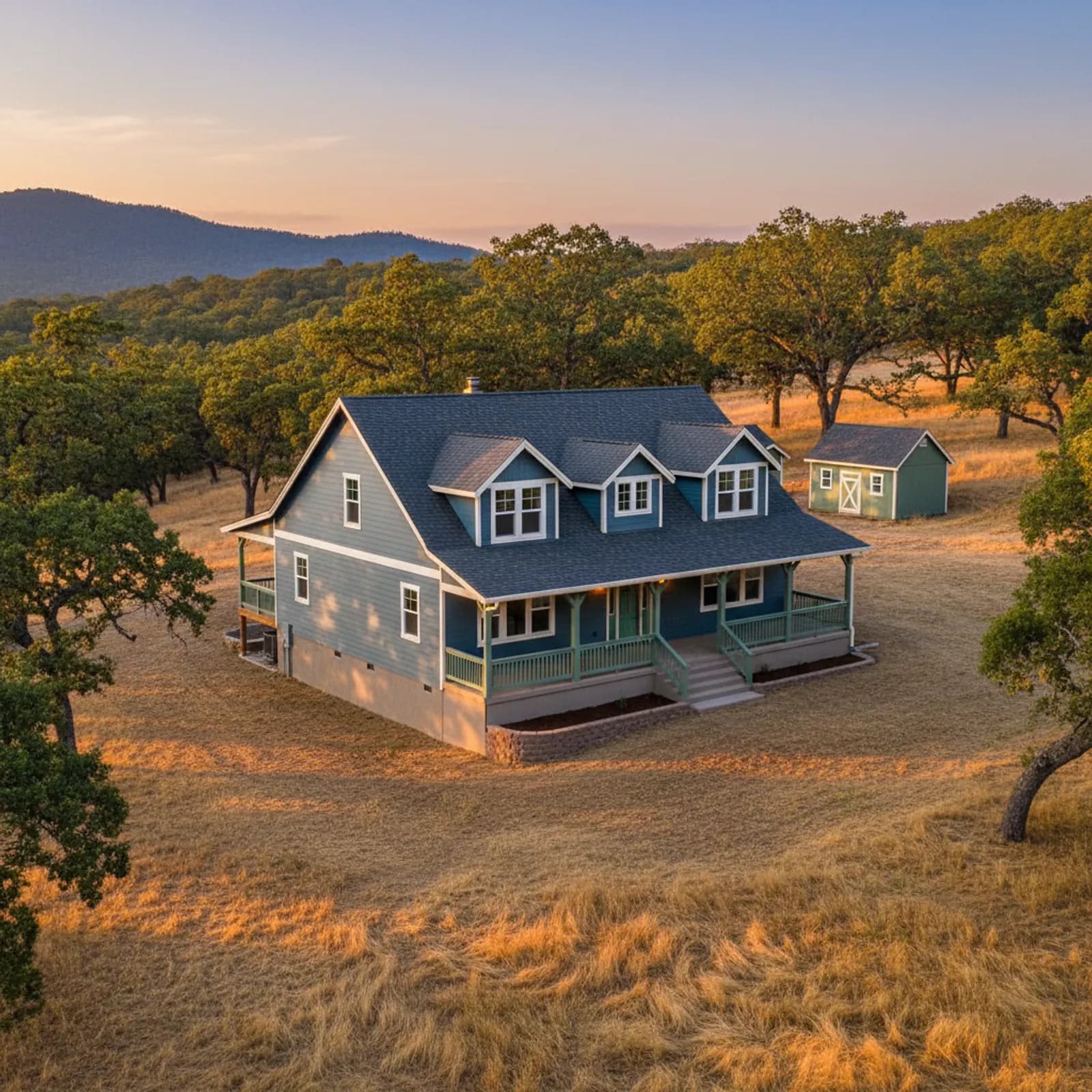
Outside the community, Penn Valley's oak-grassland acreage homes carry high exposure on individual parcels; we harden per lot — eaves, vents, decks, ground transitions — extended across outbuildings where relevant.
Chapter 7A ember detailing for Penn Valley walls
Because Penn Valley sits squarely in the wildland-urban interface, siding here is judged less on looks than on how the wall assembly survives an ember storm. Wind-driven embers from oak-grassland fuels do not usually arrive as a wall of flame; they sift into gaps and smolder. So our siding scope treats the cladding as one layer in a hardened envelope. We specify Class A non-combustible board, then close the small openings that actually start house fires: the gap behind the bottom course gets a metal starter and ember-resistant trim, weep screeds are detailed so they breathe without inviting glowing debris, and any vent penetrating the new wall is screened to fine mesh. Where siding meets a deck ledger or a low roof-to-wall junction, we flash and seal so embers cannot lodge in the seam. On ranchette parcels with mature ponderosa and live oak crowding the walls, that junction work matters more than the siding panel itself. The result is a wall that reads as ordinary lap or panel siding but is built to refuse ignition at every edge.
Foothill heat, UV load, and material choice on west-facing acreage
Penn Valley summers run hot and dry, and the long foothill sun cycle is hard on exterior walls in ways coastal towns never see. South and west elevations on open acreage take direct afternoon radiation for hours, which is why wood and older composite siding here tends to check, cup, and bleach years before a homeowner expects to repaint. For a Penn Valley re-side we lean on fiber-cement and other dimensionally stable, non-combustible boards precisely because they shrug off both the UV punishment and the fire exposure that define this terrain. Factory-finished or baked-on color systems hold up far better than field paint against the glare reflecting off dry grass and gravel drives. We also plan fastener spacing and expansion gaps for the wide day-to-night temperature swing common west of Grass Valley, so panels do not oil-can or pop in August heat. Color choice gets attention too: lighter, earth-keyed tones that suit oak-and-pine ranch settings also run cooler, easing the heat load the wall passes back into the house through long foothill afternoons.
Why this matters in Penn Valley
- Specified for Sierra Foothills conditions
- Class A non-combustible fiber cement as the recommended system
- Correctly detailed weather-resistive barrier and flashing
- Installed by a crew with 20 years combined experience
Recommended systems for Penn Valley
- Class A non-combustible fiber cement
- fire-aware detailing
- robust flashing
Fiber Cement Siding for Penn Valley homes
The full fiber cement siding approach — materials, weather-resistive detailing, and the manufacturer standards we install to — is covered on the main service page, then specified for Penn Valley's conditions on this one.
Our Penn Valley process
- Step 1
Consultation
We listen to your goals and assess your home on site — exposure, substrate, and architecture.
- Step 2
Design & Proposal
A clear written proposal with the right system specified for your climate and a transparent scope.
- Step 3
Expert Installation
Trained crews install to manufacturer best practices with careful weather-management detailing.
- Step 4
Walkthrough & Support
A final walkthrough, full cleanup, and a clear written record of the scope completed — work we stand behind.
FAQ
Siding in Penn Valley — FAQ
Penn Valley centers on the gated Lake Wildwood HOA community (architectural standards + single-gate egress) plus oak-grassland acreage — distinct from Grass Valley's Gold-Rush town or Shingle Springs's dispersed Hwy-50 acreage.
Yes — we deliver Class A non-combustible, hardened exteriors that also meet Lake Wildwood's architectural requirements.
High — oak-grassland foothill terrain; non-combustible hardened exteriors are the baseline, HOA-detailed inside Lake Wildwood and whole-parcel on the ranch acreage.
It's a real planning factor — constrained single-gate egress; we acknowledge it honestly and focus on the most resilient hardened exterior possible.
Yes, secondarily — heat- and UV-stable assemblies for the elevated foothill summers, within the hardened envelope.
Keep Exploring
More for Penn Valley homeowners
More in Penn Valley
Other exterior services in Penn Valley
Helpful Exterior Guides