Exterior Contractor in Penn Valley
Penn Valley is rural Nevada County — oak-grassland and scattered-conifer terrain, larger acreage parcels, a mix of older ranch homes and the Lake Wildwood community, and serious foothill fire exposure on most lots. The exterior conversation here is similar to Loomis or Shingle Springs: the cladding decision is inseparable from the vents, eaves, ground-to-wall, and accessory-structure decisions, and treating them as separate trade engagements leaves a defense story that's never coherent.
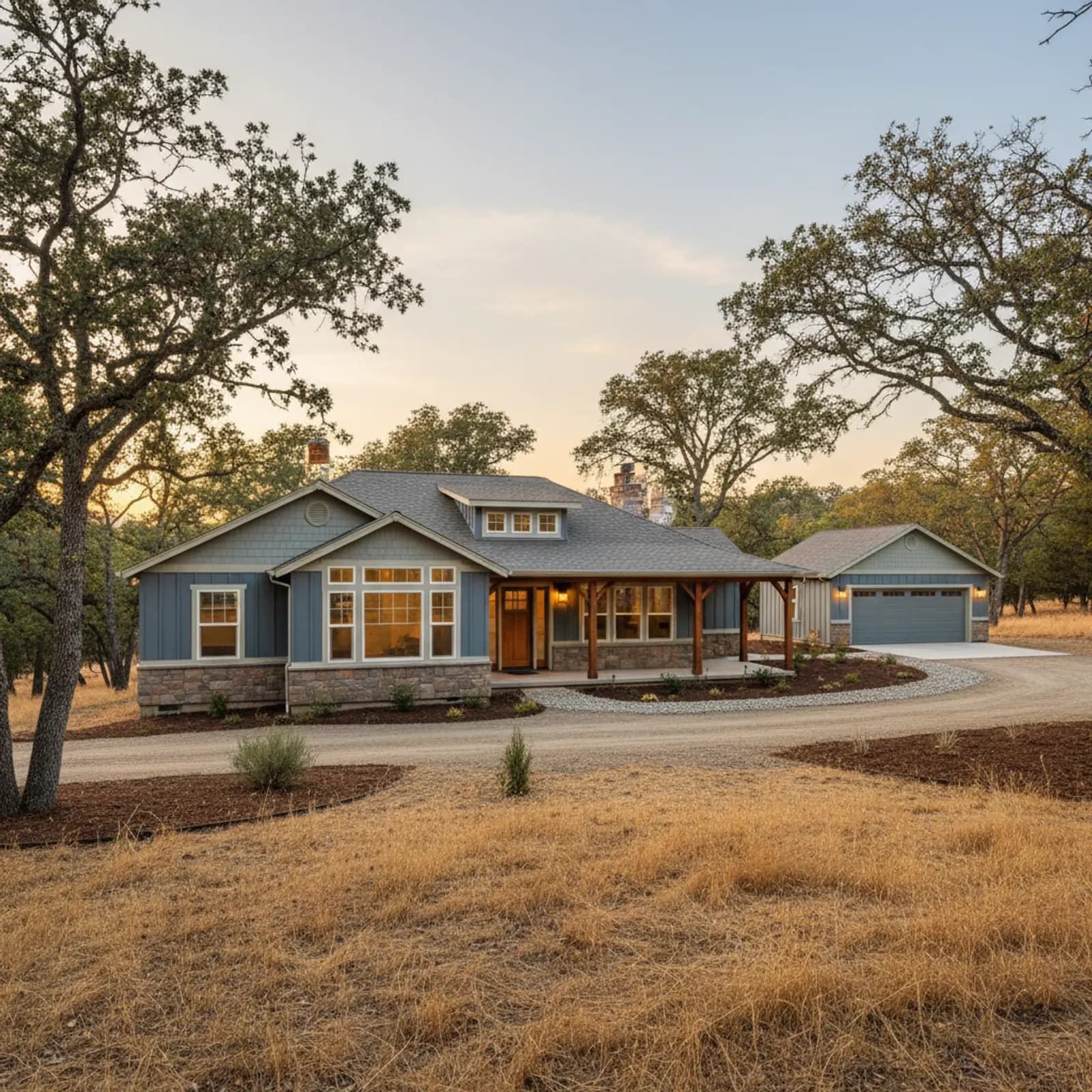
What a Penn Valley exterior contractor delivers is whole-compound scope — primary home, attached structures, and often the accessory shop or barn — as one defensive assembly with materials and detailing matched to actual parcel exposure. Some Penn Valley lots back to dense oak woodland; others sit in lower-risk grassland clearings. The same contractor making per-parcel decisions is what produces consistent, appropriate hardening across the property.
What an integrated Penn Valley exterior includes
On a Penn Valley acreage home or a Lake Wildwood property an integrated scope covers primary-residence cladding, WRB and flashing correction, ember-resistant vents and hardened eaves on parcels with woodland adjacency, ground-to-wall transition with clearance from landscape contact, and the detached shop or accessory structure where it makes sense to include it. The hardening detail is consistent across the compound rather than fragmented across separate trade engagements.
Where the split-trade exterior fails in Penn Valley
Penn Valley fails the same way most rural-acreage markets fail — the primary home gets re-clad, the original combustible siding stays on the shop, original vents stay everywhere, and the defense story has obvious gaps. An integrator addresses the whole compound at once so the hardening is actually consistent on the parcel.
Materials and detailing we specify for Penn Valley
On Penn Valley parcels we specify Class A non-combustible fiber cement, ember-resistant vents and hardened eaves on woodland-adjacent lots, non-combustible base trim and ground transitions, and finish selection appropriate to the rural character. On Lake Wildwood community homes we work within applicable architectural expectations; on independent acreage we scope per parcel.
Hardening the barn, shop, and outbuildings, not just the house
On Penn Valley acreage, the house is rarely the only structure on the parcel. These properties typically carry a detached shop, a barn, a hay or equipment cover, a well house, or a guest unit, and in a foothill fire scenario each of those is both a target and an ignition source that can carry flame back toward the home. An exterior approach that hardens the residence while leaving a wood-sided pole barn fifty feet upwind is only half a defense. We look at the whole compound and decide which outbuildings warrant non-combustible cladding, boxed or screened eaves, and ember-resistant venting, and which simply need the combustible material near them cleared away. Connector elements get attention too: an attached lean-to, a covered breezeway, or a wood fence tying a shop to the house can act as a flame bridge across the parcel. Because these structures sit on oak-and-pine ground west of Grass Valley, sequencing the work across multiple buildings in one engagement keeps the materials and the defensive logic consistent rather than piecemeal.
Lake Wildwood's gate, CC&Rs, and the rest of the parcel mix
Penn Valley splits into two very different working conditions for an exterior crew, and the spec follows the address. Inside the gated Lake Wildwood community, homes sit on tighter lots with an active homeowners association, so siding color, trim profiles, and roof or exterior changes usually run through an architectural review before anything is ordered, and crew and material deliveries clear a manned gate on the association's schedule rather than ours. We build that approval and access lead time into the plan up front so a project does not stall waiting on a committee. Outside the gate, the rural ranchettes flip the equation: long private drives, narrow bridges, and seasonal-grade access govern how cladding and staging arrive, and the wide defensible-space setbacks open the door to a more aggressive ember-resistant build than a confined lot allows. The same exterior service, in other words, is shaped less by the Penn Valley name than by which side of the Lake Wildwood gate the home sits on, and we scope each accordingly. Nearby Grass Valley and Nevada City share the foothill exposure but not these access constraints.
Why this matters in Penn Valley
- Specified for Sierra Foothills conditions
- Class A non-combustible fiber cement as the recommended system
- Correctly detailed weather-resistive barrier and flashing
- Installed by a crew with 20 years combined experience
Recommended systems for Penn Valley
- Class A non-combustible fiber cement
- fire-aware detailing
- robust flashing
Exterior Contractor for Penn Valley homes
The full exterior contractor approach — materials, weather-resistive detailing, and the manufacturer standards we install to — is covered on the main service page, then specified for Penn Valley's conditions on this one.
Our Penn Valley process
- Step 1
Consultation
We listen to your goals and assess your home on site — exposure, substrate, and architecture.
- Step 2
Design & Proposal
A clear written proposal with the right system specified for your climate and a transparent scope.
- Step 3
Expert Installation
Trained crews install to manufacturer best practices with careful weather-management detailing.
- Step 4
Walkthrough & Support
A final walkthrough, full cleanup, and a clear written record of the scope completed — work we stand behind.
FAQ
Exterior Contractor in Penn Valley — FAQ
Often — it's frequently the right call on acreage where the outbuilding has the same combustible cladding and exposure as the primary residence. We scope them together so the hardening story is consistent.
Yes — we prepare any applicable architectural review submissions as part of the project and coordinate access through the community's procedures.
Real foothill exposure on most parcels, with serious exposure on woodland-adjacent and canyon-edge lots. The hardening scope follows the per-parcel assessment.
Most primary-residence projects are four to seven weeks; compound projects including outbuildings can run longer depending on scope.
Keep Exploring
More for Penn Valley homeowners
More in Penn Valley
Other exterior services in Penn Valley
Nearby Service Areas
Exterior Contractor near Penn Valley
Helpful Exterior Guides